Article
What comes after the Design Sprint

- Reading time
- 5 minutes
- Updated
How to build on the momentum and bring the idea to life
A Design Sprint is a great way to drive ideas toward implementation quickly and without detours. But it’s really just the first step. A tested prototype is only worth its weight in gold if it leads to further action. That sounds logical, but then there’s reality, which often causes the good results of the Design Sprint to fizzle out or responsibilities to get lost.
How do you capitalize on the positive momentum after the Design Sprint? How do you keep the team motivated? And how do you ultimately turn an idea that users like into a product they love?
Carry on right away
Days of intense focus. From morning till night. The whole team in one room, or, even more exhausting, everyone working remotely in front of their screens. And then it’s done: the prototype is ready, the test results are in, everyone’s happy, and the job is done. Still, now is the time to get right back to work. Because:
- Motivation is at its peak during the Design Sprint and shortly afterward. The team is fully committed and has developed a connection to the idea.
- The knowledge is still fresh in everyone’s minds, so now is the best time to put it to use.
- Everyone is still in the middle of the process, and the participants see themselves as a team. Later on, people would have to be brought back on board and trained again.
- Due to the limited time available, a Design Sprint often allows only a rough direction to be tested. Irrelevant user groups, such as friends and family who just happened to be available, also lead to inadequate test results. Therefore, a product should be launched quickly and tested on the right audience.
What’s more: The sooner you move forward, the less likely it is that the idea will gather dust in a drawer.
Common challenges
Despite all the good reasons to keep going, momentum sometimes stalls after the Design Sprint. Why is that?
Design Sprints are often planned and carried out by external service providers as a standalone, self-contained process. Once the Design Sprint is over, the company is on its own. At the same time, development is often left out of the Design Sprint. This means that the people who are supposed to build the product aren’t involved in the Sprint. It’s only too late that people realize the effort required for implementation wasn’t properly estimated. (Incidentally, this problem didn’t arise with the original Design Sprint concept at Google Ventures, since internal resources were available there for all tasks.)
Another stumbling block can arise if ideas or prototypes aren’t scaled down and too much is crammed into the MVP. If waterfall-style work methods are also entrenched in the company, the project can easily turn into a massive, unmanageable beast that’s hard to control. This is because there’s a lack of flexibility to complete individual steps quickly and make spontaneous adjustments on the fly.
How do you overcome these hurdles?
The good news: In our experience, there are two effective ways to avoid a lull after a Design Sprint.
Integrate the Design Sprint into the bigger picture right from the start.
When a client asks us about a Design Sprint, we never jump right in. We work together to develop a strategy. What are the client’s requirements, in terms of time and personnel? How and when can we move forward after the Design Sprint? What fits within the scope, and what priorities should be set? What resources do we need, and which ones can the client provide themselves? All necessary disciplines should be involved from the start, from strategy to front-end and back-end development. If, for example, the client doesn’t have in-house developers, we bring our own team members into the project to ensure a consistent, seamless process.
Set aside a day for planning.
As a second key strategy, we’ve found it effective to extend the four-day “Design Sprint 2.0” from AJ&Smart by a fifth day. We dedicate this day to planning the next steps. The entire team, ideally all stakeholders, but definitely the implementers and decision-makers, comes together once more to collectively consider what conclusions to draw from the results.
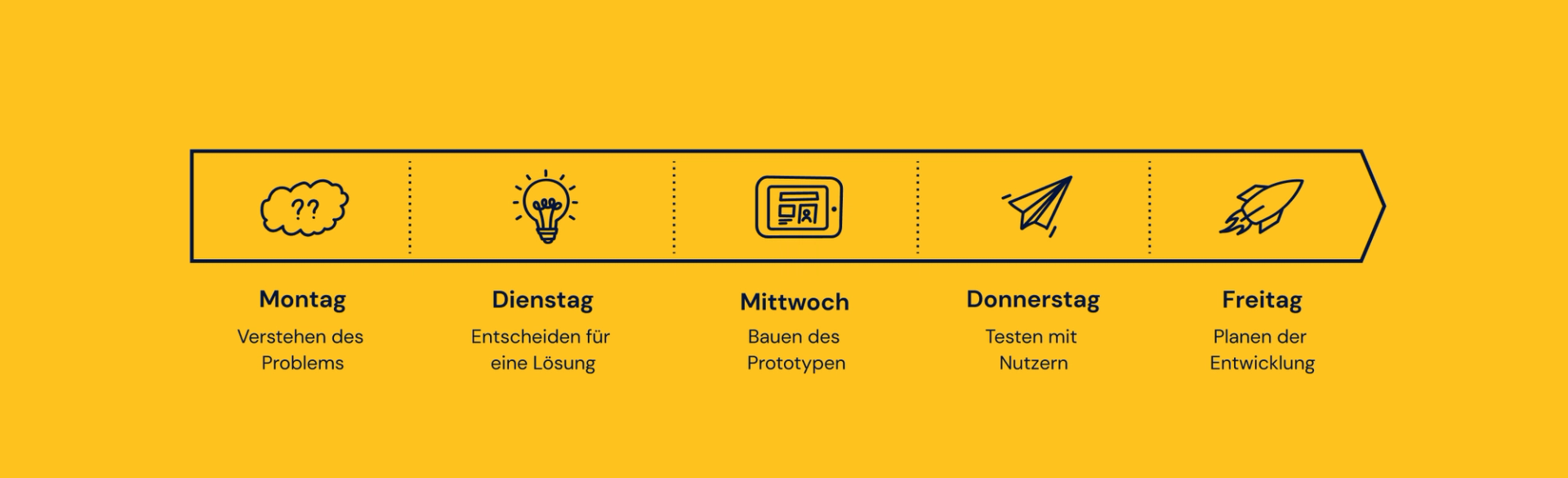
An MVP is developed, and plans are made for how the implementation will proceed. You can find out exactly how this day unfolds in the article “The Design Sprint Method: Testing Ideas in 5 Days.” Sure, it can be tough sometimes to push through one more day after an exhausting sprint. But it’s worth it: This day creates a smooth transition to implementation. And here’s another advantage:
Maintaining motivation
It’s incredibly motivating to have a clear vision and to know that the product will be created within this set timeframe. The detailed planning on Day 5 of the Design Sprint makes the product feel tangible, so you naturally want to keep going.

The Product Sprint Framework: A fast track to a market-ready product
To decide exactly what should happen after the Design Sprint, the results are the first thing to consider: If the user testing showed that the idea was well-received by the target audience, it’s time to move on to implementation. Otherwise, either further research is needed and the idea needs to be refined, for example, through additional Design Sprints, or the idea needs to be fundamentally rethought.
Let’s focus on the first and most common scenario: the idea needs to be brought to market. We like to use the Product Sprint® framework for this. With Product Sprint®, ideas are refined with laser focus and quickly transformed into market-ready products. Quickly, that is, in 8 to 12 weeks, including the Design Sprint. This pace is a secret weapon; it fosters commitment, motivation, and user-centered end products. In addition, the reduced time investment also saves money. A cornerstone of the method is that implementation begins the very Monday after the Design Sprint and is then carried out over 6 to 9 weeks. A week is set aside at the end for validation. This is also when decisions are made about what to do next with the finished, tested product version.
This approach allows you to provide the team and all stakeholders with a clear vision right from the start. It also makes it easier to estimate the effort required and overcome the usual hurdles that arise after the Design Sprint. You can read about how well this works in practice in our showcase on Provinzial Rheinland, where a massive network of tradespeople reached market readiness in just 12 weeks.
Conclusion
Resting is not an option. After the Design Sprint, you should move forward as quickly as possible to efficiently and purposefully develop a market-ready product. It helps to be aware of, and navigate around, a few hurdles: You should think ahead from the very beginning of the Design Sprint and involve the people who will later implement the idea. It’s also a good idea to schedule a fifth day to derive concrete next steps from the Design Sprint’s results and prepare the team for the implementation phase. The Product Sprint Framework provides a solid foundation for a seamless process from the Design Sprint to the finished product version.
Our expert
Jessica is a UX consultant and has been working in digital product development since 2009. In her workshops, she manages to wow even her most introverted colleagues.