



Skip to content

Provinzial

Ready for market in just 12 weeks?

Companies like Provinzial Rheinland, which have a vast network of tradespeople at their disposal and understand market needs, come up with great ideas. After a concierge pilot, the idea was validated and was now set to be launched quickly and digitally.

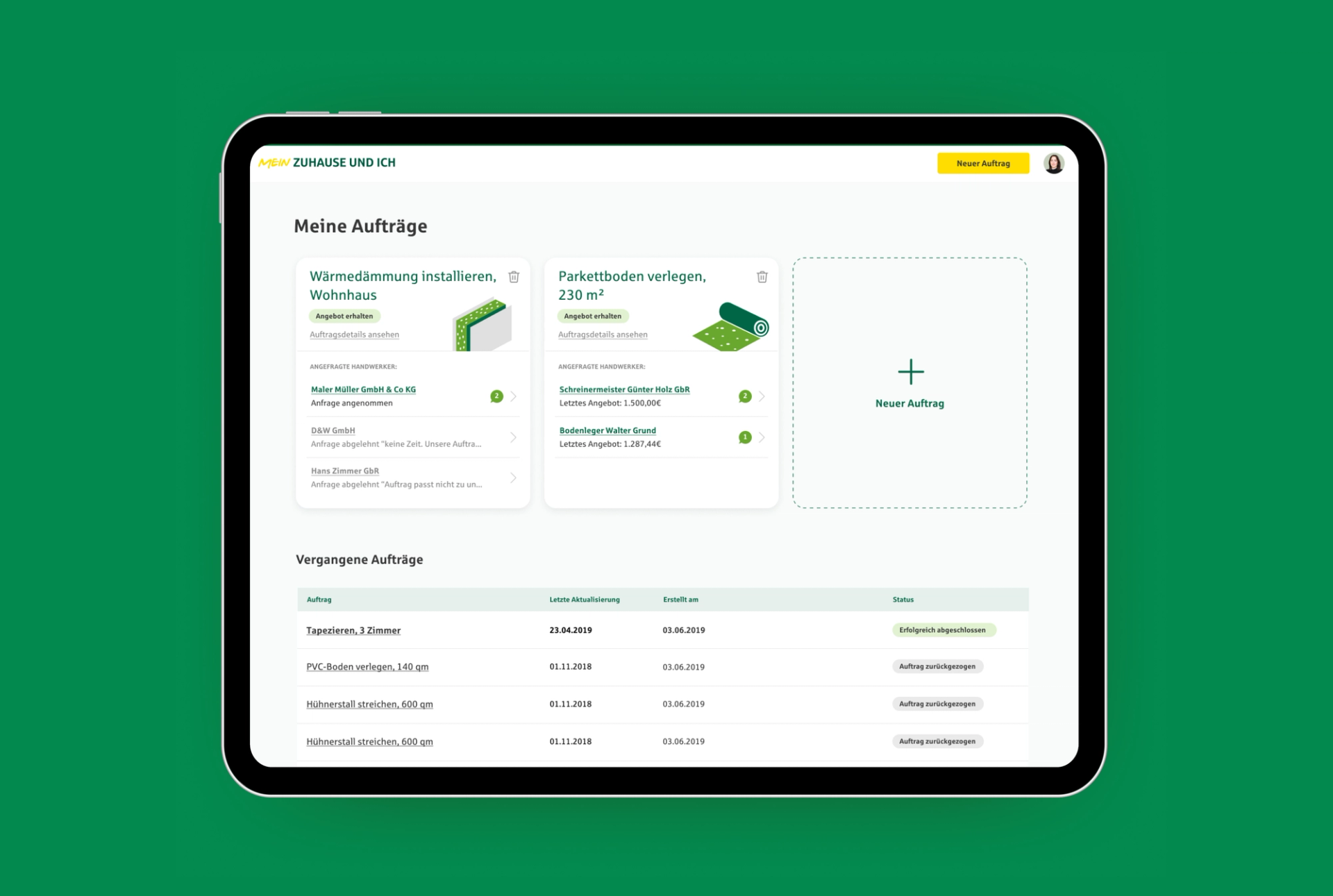
Tablet showing the “Meine Aufträge” page of Provinzial’s “Mein Zuhause und Ich” platform: cards for insulation and parquet flooring with quotes, a “Neuer Auftrag” tile and a table of past orders
Patric Fedlmeier
““MeinZuhause und ich” served as a flagship project demonstrating successful agile development in a cloud-native context. Through their goal-oriented approach, codecentric and UX&I were able to demonstrate that the Product Sprint program enables a significant acceleration of the development cycle while maintaining a high level of quality.”
Patric Fedlmeier Deputy chairman of the executive board, Provinzial Rheinland

If you have good ideas, you need modern methods to test them as quickly as possible.

The idea

Simply more service: Insurance customers should be able to access tradespeople from the Provinzial Rheinland network even when they aren’t filing a claim. After all, good tradespeople are hard to come by. Following a successful concierge pilot, the idea needed to be implemented digitally, in a scalable way, and, above all, quickly.

The process

Tailored to the insurance company Provinzial Rheinland, we applied the Product Sprint Framework developed with codecentric. The Product Sprint consists of three phases: Design Sprint, Implementation Phase, and Validation Phase.

The first milestone

The idea is a hit: The platform for connecting customers with tradespeople is live, delighting customers, and undergoing continuous development and expansion. In 2020, it was named “Brand Experience of the Year” at the German Brand Award.

The three phases of the Product Sprint in detail:

Product Sprint diagram in three phases: Design Sprint (1 week), implementation phase (6–9 weeks) and validation phase (1–3 weeks), followed by product development

Phase 1: Design Sprint (1 week)

To lay a solid foundation, a key prerequisite for the Product Sprint framework, we began with a Design Sprint. Together with stakeholders from Provinzial Rheinland, developers from codecentric, and our UX/UI experts, we set out to better understand the problem and to develop and scrutinize a shared solution.

Design Sprint diagram over five days: Monday understand the problem, Tuesday define a solution, Wednesday build the prototype, Thursday test with real users, Friday plan development

The sprint focused on the following questions:

  • What added value can we create for tradespeople and customers?
  • In what areas can we outperform similar platforms?
  • How can we develop products in an agile and rapid manner, without crippling corporate dependencies?

With the results: a tested prototype, a prioritized list of requirements, and agreed-upon goals for the first product iteration, we were able to get off to a great start in the subsequent development phases. Our digital matching platform was now really starting to take shape.

Clickable prototype of the Provinzial tradesperson platform: linked screens for the home page, request questions, tradesperson selection, confirmation, order overview and chat, labeled “Prototyp”

Phase 2: Implementation (9 weeks)

After defining the scope of functionality, we began the essential preparations for development in the first week of the implementation phase.

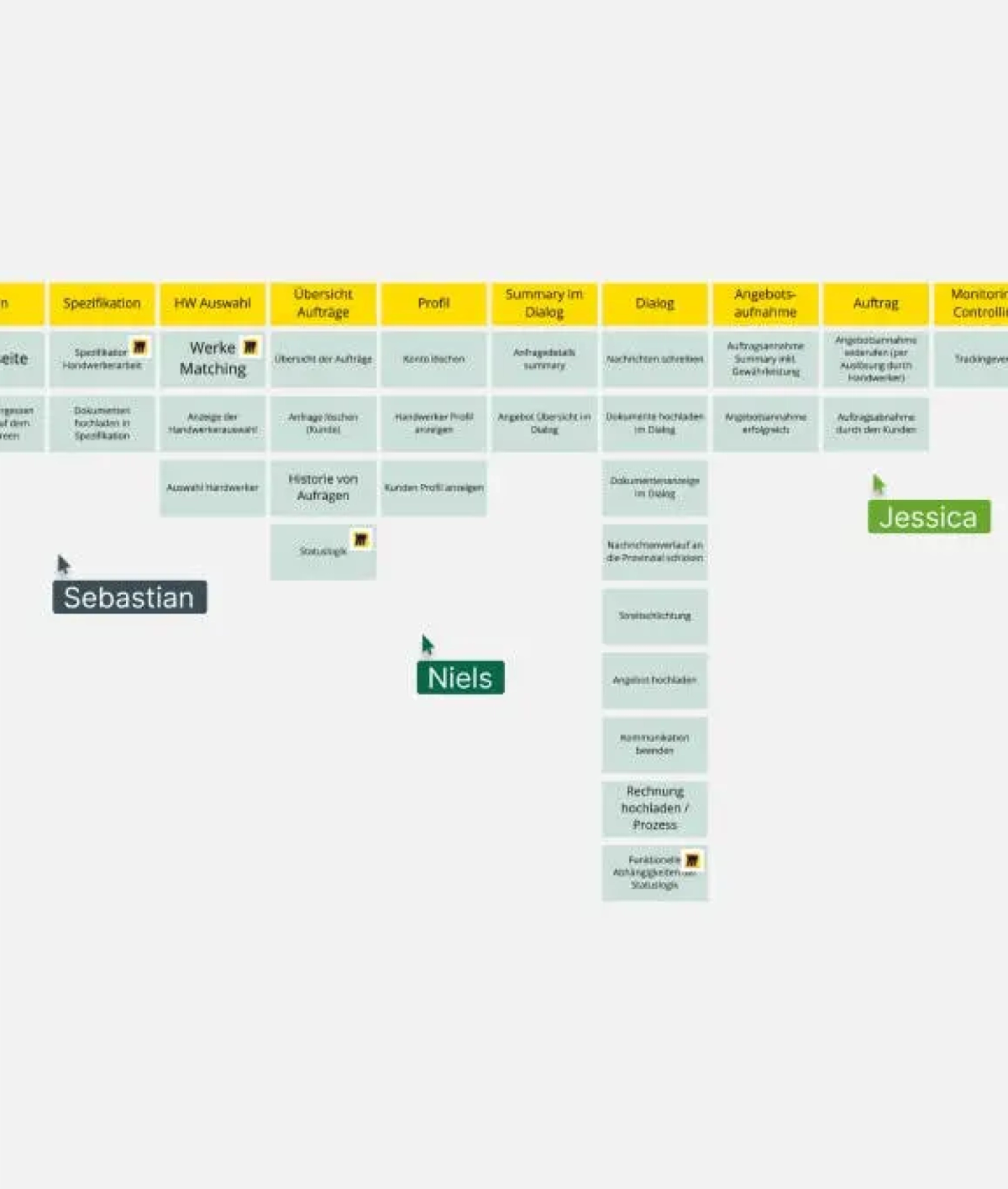
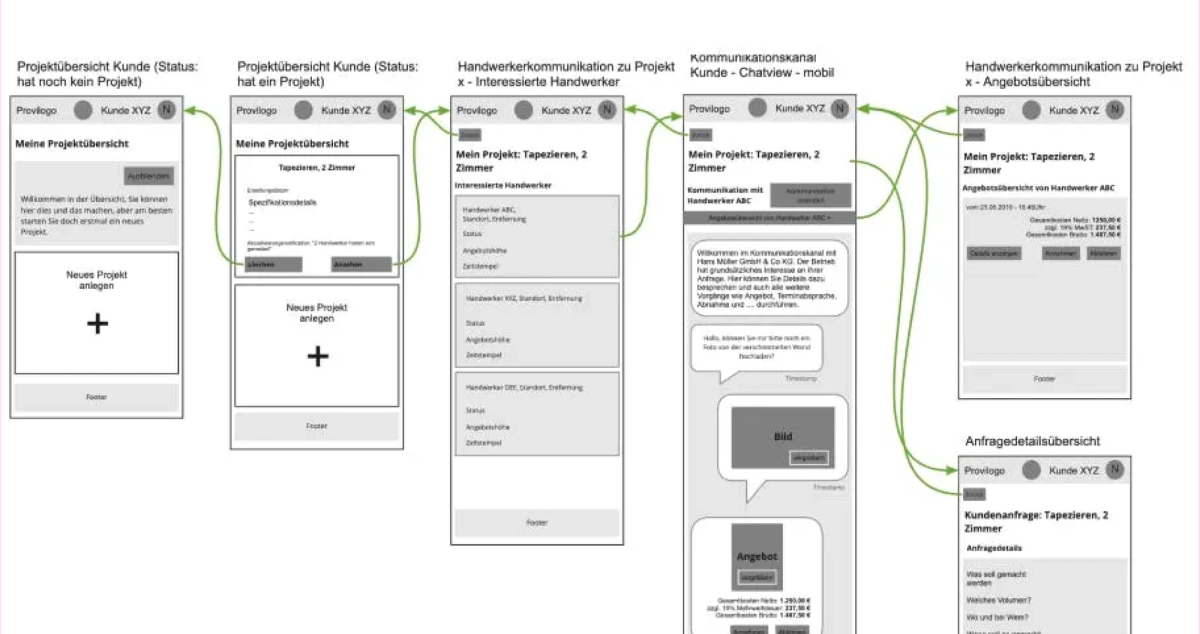
In addition to the technical setup in the AWS cloud, we established a pattern library, developed an information architecture, and designed the first user interfaces as wireframes. We also defined the backlog, prioritized and tailored to the short development timeframe.

The weeks that followed were devoted entirely to implementation, but not behind closed doors; rather, the process was closely coordinated with the client through the Product Owner we provided. To ensure that all activities remained aligned with user needs even during implementation, we strategically conducted supporting user interviews and surveys and reconciled the results with Provinzial Rheinland’s industry expertise.

Phase 3: Validation (3 weeks)

During the final phase of the Product Sprint, we validated the next steps with the help of potential end users. To do this, we asked ourselves the following questions: Should we move forward, or do we need to take a step back and pivot? Were the goals achieved, and were the questions that were open at the beginning answered?

To gather the most honest feedback possible, we tested the product in its intended context: We surveyed a large group of tradespeople and customers and conducted a two-week diary study with them, followed by qualitative interviews.

Not all of the unique selling points we had assumed actually turned out to be such. Nevertheless, the result was very satisfactory for everyone involved. No critical usability hurdles stood in the way of the go-live.

Two tablets with the Provinzial platform: “Neues Projekt erstellen” asking “Was soll innen gemacht werden?” with tiles for types of work, and a project with a quote in the chat
Provinzial’s “Mein Zuhause und Ich” tradesperson platform on a tablet and two smartphones: “MeineHandwerker” home page asking whether you need a tradesperson, ongoing projects and a chat with a quote
Jessica Berger
“Working with the client to define the project goals helped us establish a clear focus and set aside less relevant requirements.”
Jessica Berger Senior UX consultant at UX&I

What comes after is what comes before: A Product Sprint rarely comes alone

We were able to launch the tradespeople matching platform after receiving legal approval. Then the data-driven product development cycle began: measure, learn, optimize…

We are currently preparing to launch additional complementary products. What pleases us most is that Provinzial Rheinland, codecentric, and UX&I have become a well-coordinated team. Nothing stands in the way of a new product development cycle.

2019–2021

Related

Instana

From MVP to a $500-million exit

November 2020: A startup from Solingen becomes part of IBM in a deal valued at an estimated $500 million. We supported Instana along the way, from the initial strategy sessions to the product that’s taking the international tech world by storm.

Also on this topic: Design Sprint method: Testing ideas in 5 days Remote Design Sprints: Lessons learned, methods, and setbacks

Do you have an idea or a tricky UX problem?

We support you from strategy and agile product development all the way to training your team.

Nadine Pieper, senior UX consultant at UX&I, smiling with glasses and arms crossed in the office

Nadine Pieper Senior UX consultant · Berlin

Prefer to talk right away?

30 minutes by video call, free and with no obligation. All times are Berlin time.

 Loading available times …

Or send us a message

Two or three sentences are enough.

We reply within two business days.

We process your data to handle your request. Details in our privacy policy.

Nadine Pieper
Hias Wrba
Patrick Oselka
Claudia Schönwälder
Mato Sauer

Your call with

Nadine Pieper

Senior UX consultant

Berlin

Your call with

Hias Wrba

Product coach

München

Your call with

Patrick Oselka

Managing director at UX&I

Düsseldorf

Your call with

Claudia Schönwälder

Senior UX consultant

Hamburg

Your call with

Mato Sauer

Customer empowerment lead

Frankfurt