Article
Meaning or no meaning: What does our purpose mean to you?

- By
- Tobias Schlei
- Reading time
- 8 minutes
- Updated
Whether on an individual or organizational level, the search for a deeper meaning in one’s own existence and actions is ubiquitous. But how much meaning does “purpose” actually have in a corporate context? Whom does it serve, and why? What ensures that a purpose is deeply woven into the fabric of the organization and doesn’t remain mere lip service?
In this article, we’ll share how we arrived at our purpose, and why we’re not the only ones glad we have it.
Help, we need a purpose!
A good start makes for a good outcome
In the early days of UX&I, so much just made sense to us naturally. It was clear to us that we rejected the status quo of the agency world. That we wanted to work differently. That we view technology as a servant of humanity, not the other way around. That we wanted to steer clear of old patterns and not do things just because they had to be done. We were in agreement, especially about what we didn’t want. When it came time to decide whether to do something one way or another, we made the call. Sometimes by the coffee machine, sometimes in small meetings. The meaning behind what we did was an inner mindset that we all fundamentally shared.

Suddenly, something was different
In a short time, our first office in Düsseldorf had grown into several locations throughout Germany. The founding members had recruited great new employees everywhere. One realization was becoming increasingly apparent: Our organizational structure was no longer working perfectly.
“We’ve grown. We’ve noticed that the chaos is increasing; there are more and more people, and it no longer works to decide on the fly whether to go left or right.”
Decisions had become more difficult. We could no longer assume that what came naturally to us, without a second thought, would also serve as a guiding principle for other employees. The growing, decentralized environment required new structures and clear principles.
How meaning is created
We’re getting support
We were faced with a whole host of questions: How can we shape our way of working and our culture into a solid, scalable framework? Should we move toward self-organization, or do we need to become more hierarchical? Even though we had already explored different organizational structures internally, we needed professionals by our side. Our collaboration with the organizational developers at tealfox began (and continues to this day).
First meaning, then structure
The search for the ideal organizational structure took us right back to the basics, and thus to the question: What do we get up for in the morning? Through a systematic process, tealfox guided us to explicitly articulate our stance on the meaningfulness of our work. We were interviewed, held fishbowl discussions, and offered comments that were paraphrased by our coaches. We plunged into an intense debate that ultimately narrowed down to the most important core aspects. The most decisive one revolved around how we view technology. Do we follow Stewart Brand’s line of thought: “Once a technology rolls over you, if you’re not part of the steamroller, you’re part of the road”? Or are we optimistic, like Stanislaw Lem: “Any work that could also be done by a machine is unworthy of a human being.” Our purpose ultimately emerged as an answer to the question: Will technology work for people in the future, or will it be the other way around?
Loading this sends data to YouTube.
We have a purpose
After all these reflections and discussions, we eventually arrived at the statement that today forms the foundation of our organization and all our decisions:
“We empower people to shape technology for the benefit of humanity.”

The key components
Empower: We’re not an agency, we’re a consulting firm. That means we empower our clients and ourselves to be effective and to influence our respective environments.
Technology: Our purpose assures us that we won’t be selling sunglasses tomorrow. Technology is our passion; it’s how we make our living, and we believe that humanity can become better through the use of technology.
For the benefit of humans: We help people work for the benefit of others. Mind you, not for the benefit of all humanity. We take small steps and focus on the individual.
What should we do with this hard-earned piece of text? Anyone walking through our offices won’t find our purpose written in big letters on any wall. How do we still ensure that this statement is brought to life and doesn’t remain just a theoretical construct? How can we, and others, truly benefit from our purpose?
Living our purpose
The story behind our founding
A purpose dies if it isn’t genuine. It’s genuine when it’s rooted in the organization’s history and DNA. A purpose needs a story, and that story usually comes from the founders. Take Patagonia, for example. Yvon Chouinard founded the company so that people could discover pristine, “wild” places. It followed logically for him that these places needed to be protected. The larger the company grew, the more important this underlying commitment became. Today’s purpose: “Patagonia is in business to save our home planet.”
Our thesis is that there can be no authentic purpose without founders. At UX&I, our purpose became such a natural part of the daily work routine at all our locations because it sprang from our deepest convictions and gave visible expression to our inner mindset.
“Our purpose is a distillation of our founding story.”
Ikigai
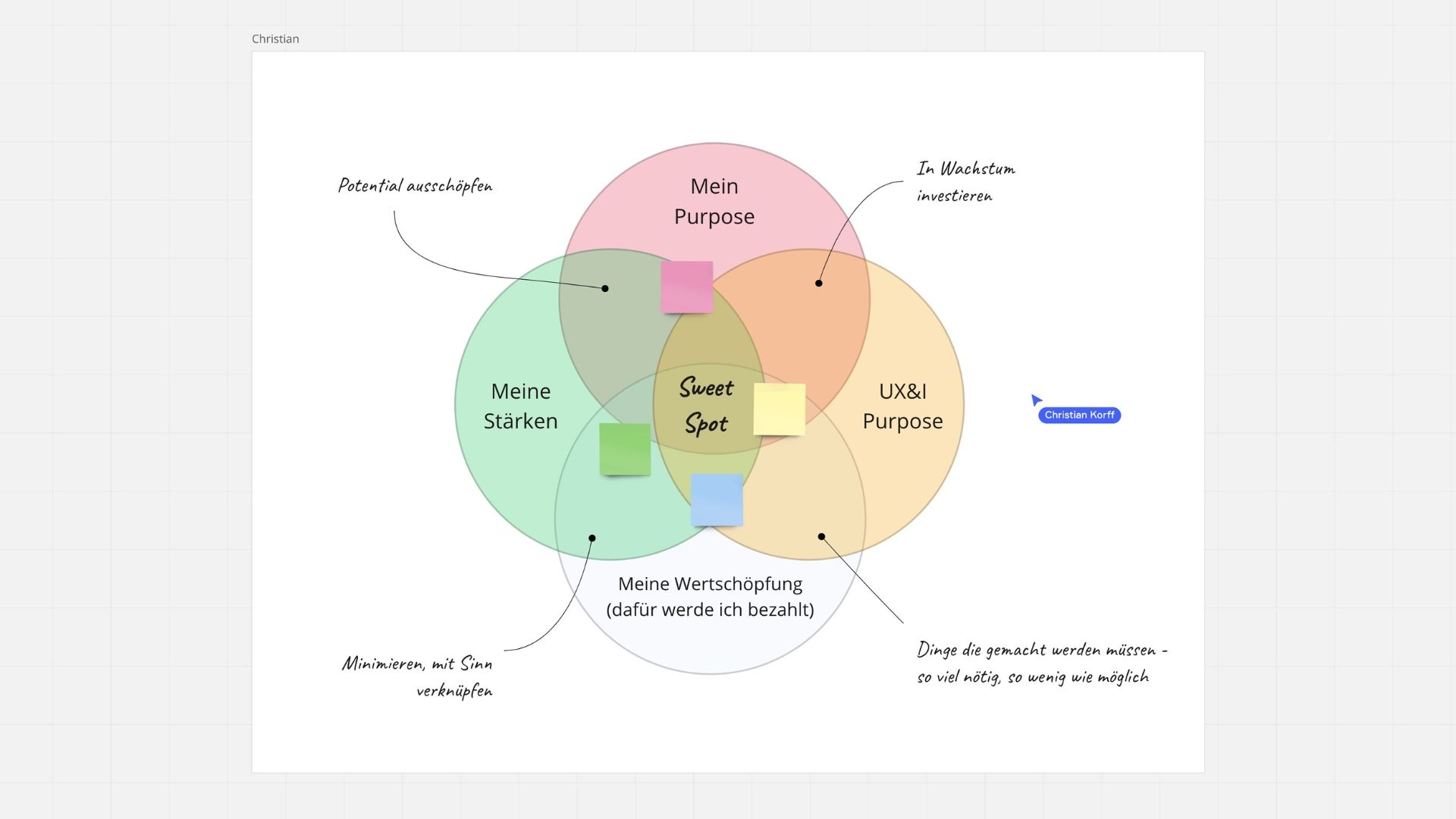
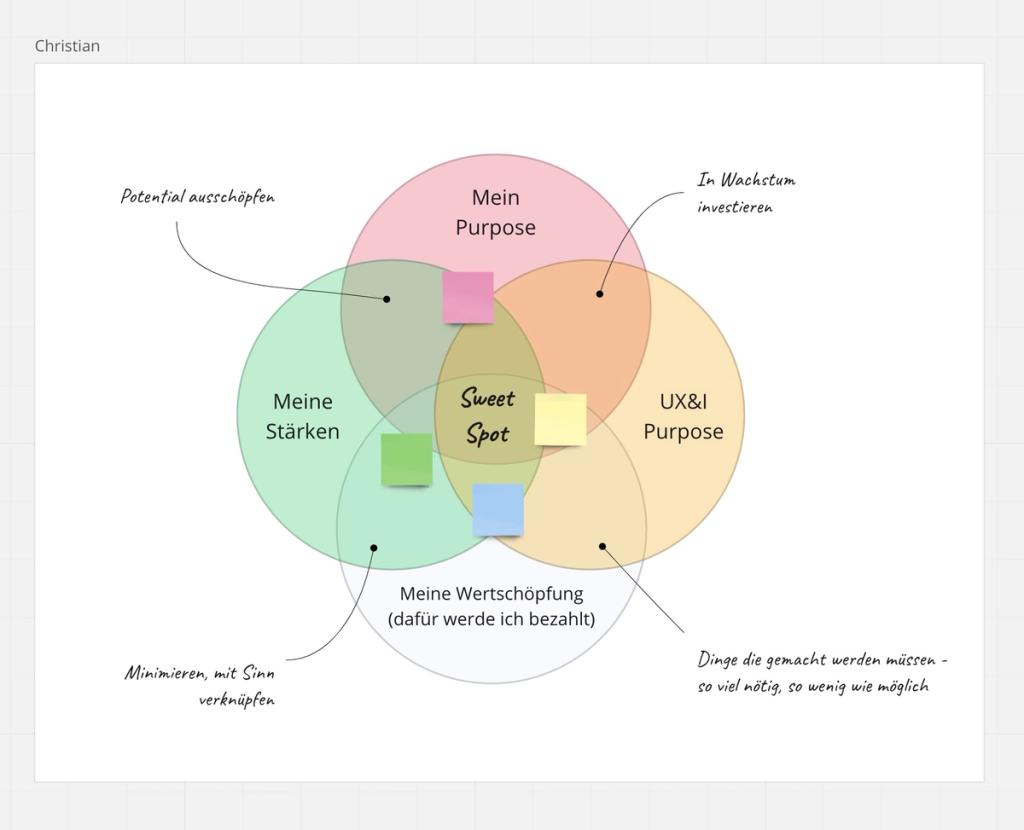
The Ikigai method is an integral part of our onboarding process for new employees. Its purpose is to align the purpose of our organization with the personal purpose of each employee. We take a close look at where there are overlaps, how we can address any discrepancies, and how each individual’s strengths can be leveraged to benefit both the people and the company. The Ikigai method helps employees align their own personalities with our purpose and bring it to life in their own unique ways.
A shared endeavor and a leadership task
Our purpose wasn’t developed behind closed doors. Many employees were directly involved in formulating it, and we presented and explained it in detail as part of our reorganization. It was understood as our corporate culture and was thus able to become part of the organization: the property of the entire company.
For our leaders, this also meant having to let go of some control. At first, there were definitely mixed feelings: Wouldn’t we be giving up something important by defining our purpose? We had to commit to a new responsibility.
“A purpose frees leadership from the tyranny of autocracy.”
Bringing our purpose to life is also a leadership responsibility. Leadership must stand behind it, defend it, and make it the foundation for decisions.
Here’s how the entire ecosystem benefits
Ultimately, the key to a purpose’s impact is this question: Does it serve a purpose? Below, you’ll learn how having a clear guiding principle benefits us, and not just us, but also our clients and partners.
Relevant projects
Our purpose provides clear criteria, especially when it comes to selecting projects. This makes our business model more rigid, but it helps us find projects that truly suit us, and to which we are a good fit. For example, we received a project inquiry that divided opinions within the team. Some UXIs refused to work for the company, while others could see it as aligning with our purpose. That’s where the magic lies: Everyone can decide for themselves, and our purpose leaves room for interpretation. But it doesn’t matter whether “the higher-ups” think a project is a good fit or not.
“When things get tough, the question of “why” arises.”
Our purpose is our foundation, even when it comes to difficult questions. It takes decision-making power away from individuals and makes our organization’s actions transparent and understandable. This applies internally, but also to our clients. Although our purpose usually doesn’t play an explicit role in the initial stages of a project, it indirectly gives us a clear profile and makes it quickly apparent for which projects we’re the right fit. It’s also an important motivator for our employees when they work on projects that are meaningful to them. This, in turn, benefits our clients: because the greater the motivation, the better our results.
Relevant services
Based on our purpose, we’ve established a corporate direction for the coming years. It helps us tailor our portfolio precisely and define effective strategies.
For us, it’s crucial, for example, that we aren’t just a service provider, we’re partners and enablers. Our services must clearly reflect our goal of empowerment, regardless of industry or project type. Whether it’s redesigning an app or developing a comprehensive UX strategy, we roll up our sleeves and empower our clients. That also means:
“We view organizations’ efforts to develop UX as a distinct competency not as a threat to our business model, but as an opportunity and a way to fulfill our purpose. We align our company’s mission to support people and the organizations they work for on their individual journeys toward a true human-centered approach.”
Individualized recruiting
To offer the right services, we need the right people. Our purpose plays a role even as we’re getting to know applicants, and people often ask us about it directly. From the very beginning, our purpose helps create an understanding of who we are as an organization, how we work, and our view of people and the world. This allows us not only to attract the right candidates professionally but also to ensure that we’re a good fit on a personal level and that we fundamentally share the same goals.
“Our purpose creates a completely different kind of connection to the company. It helps us achieve our mission: that everyone at UX&I wants to stay until retirement.”
It’s interesting to note that we’ve rarely encountered a situation where the company’s purpose diverged so greatly from an individual’s purpose that it stood in the way of collaboration. Conversely, the company’s purpose has often made it clear that someone should definitely join the team.
Decentralized organization
Let’s go back to the beginning: We were looking for a new structure for our growing, decentralized organization. To do that, we first had to define our purpose. Once that was established, we were able to determine the appropriate organizational structure.
For us, “For the benefit of humans” means human-centered work. “Empowerment” means autonomy and self-efficacy. We therefore committed to a sociocratic model, which we continue to refine and adapt to our day-to-day practice to this day.
The sociocratic organizational structure allows us to streamline decentralized decision-making processes. It works very well. We, too, have internal conflicts or points of contention, just like any other group of people. But we have a framework and processes in place to address them so that something positive can come of them. The company’s direction is well defined. When in doubt, we can always fall back on our purpose. If, for example, the question arises as to whether we should continue to grow, the answer is:
“As long as growth enables us to better fulfill our purpose, growth is a good thing.”
By the way, human-centered work based on the sociocratic model has many other benefits, including for our clients. Our colleague Christian Korff has summarized them in this article: UX Mindset Meets New Work: Why We Work in a Human-Centered Way.
Conclusion
For us as an organization and for every UXI, our purpose serves as an important anchor. It provides clarity and strengthens our corporate culture across multiple locations. It also offers guidance in our recruiting efforts. Last but not least, it helps our clients: they benefit from a perfectly matched, transparent, and highly motivated partner.
Our expert
Tobias co-founded UX&I. He is dedicated to empowering people. His areas of focus also include organizational culture and structure.