Article
Design Sprint method: Testing ideas in 5 days

- Reading time
- 8 minutes
- Updated
The book “Sprint: How to Solve Big Problems and Test New Ideas in Just Five Days” by Jake Knapp, John Zeratsky, and Braden Kowitz is a huge success. Using the Design Sprint method, it’s possible to test a product idea with the target audience using a prototype within five days.
But what exactly are Design Sprints, and why do we at UX&I still talk about five days even though there’s a more optimized version? What are the pros and cons of a Design Sprint? In this article, you’ll learn why we’ve developed our own version based on our Design Sprint experience.
What are Design Sprints?
A Design Sprint is a method used in digital product development that was created in 2010 by Jake Knapp at Google Ventures. Design Sprints provide a framework for addressing problems in digital product development. In a very short time, a specific problem is discussed, and a solution is sketched out, prototyped, and then tested. To achieve this, all relevant roles, such as product managers, stakeholders, and subject matter experts, come together for five days. The results of a Design Sprint are diverse:
- Refine the prototype: The product idea was well-received by test users, but some inconsistencies were noted during testing. The idea should then be pursued further, and the feedback incorporated.
- Pivot the idea: The product idea only partially meets the needs of the potential user. In this case, it’s advisable to modify the idea so that the user’s needs are brought back into focus.
- Reject the idea: The product idea is not relevant to users. If this is the outcome, it’s advisable not to pursue the idea further. However, this outcome should not be viewed as a failure, but rather as new insights into the product, the target audience, and the market.

From Design Sprint to Design Sprint 2.0
The Design Sprint described in the book by Jake Knapp, John Zeratsky, and Braden Kowitz is the original version of the Design Sprint. It spans five days and requires the presence of all product leads and stakeholders on every day, as this is the only way to make important decisions.
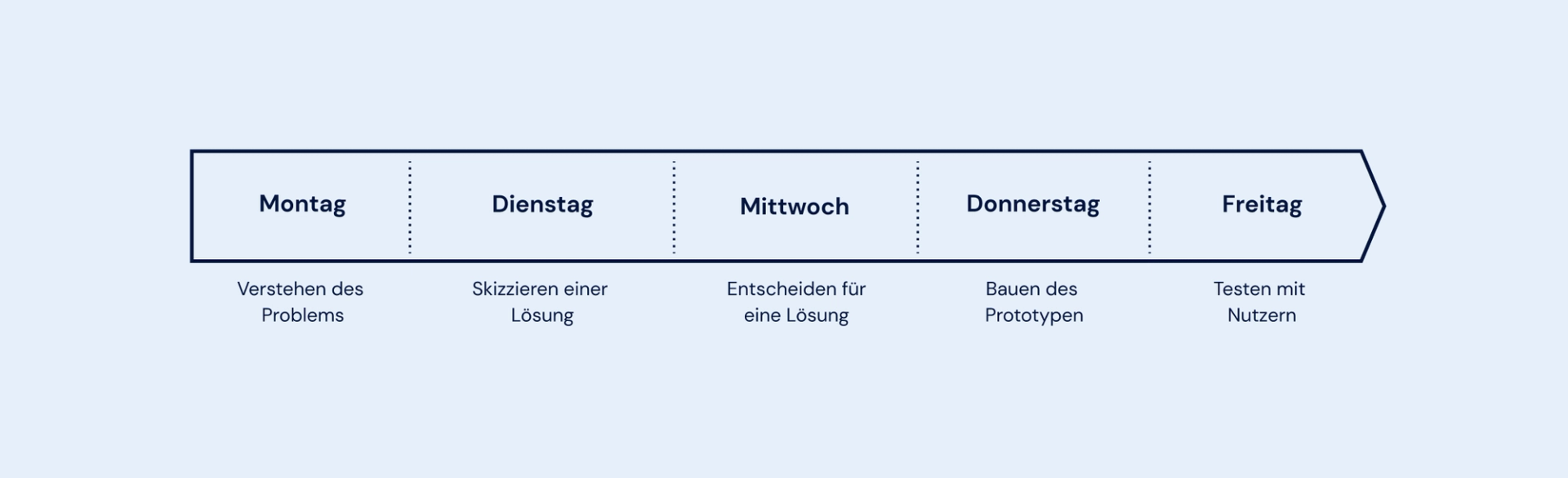
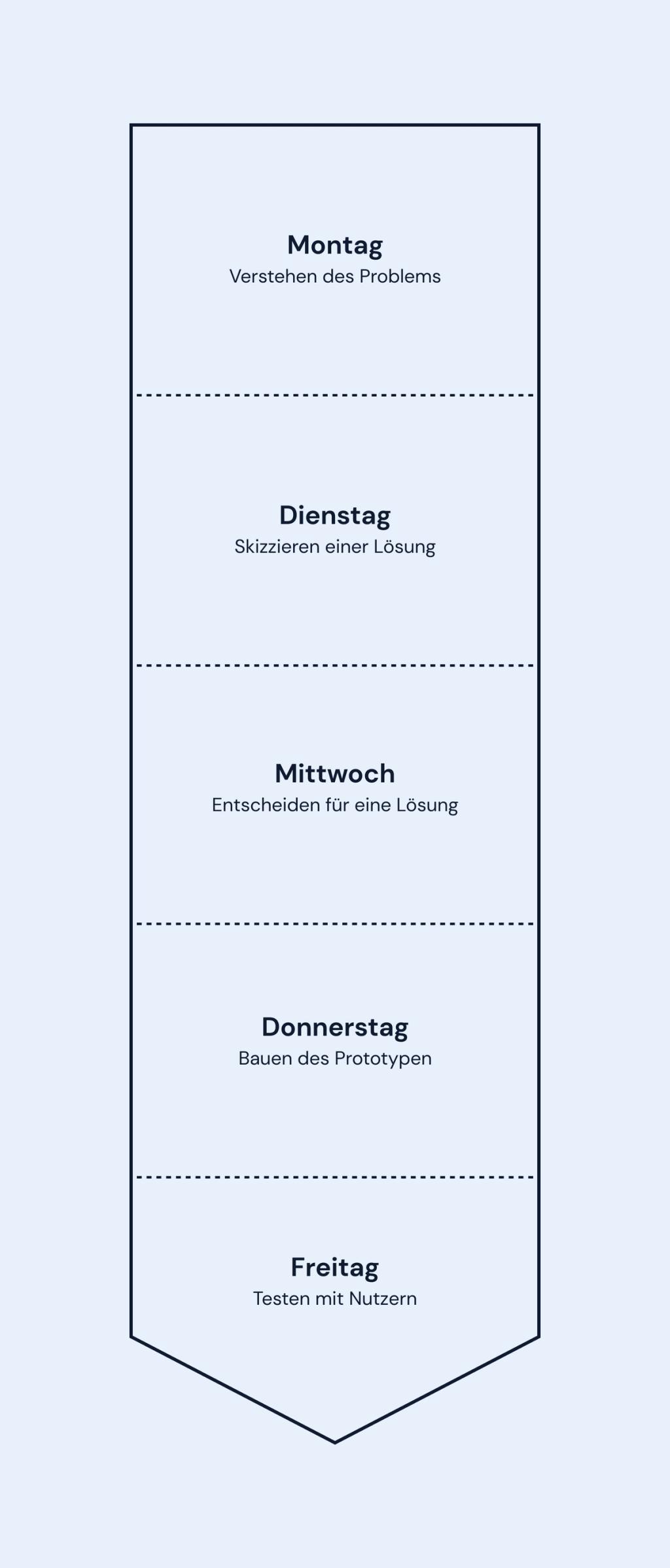
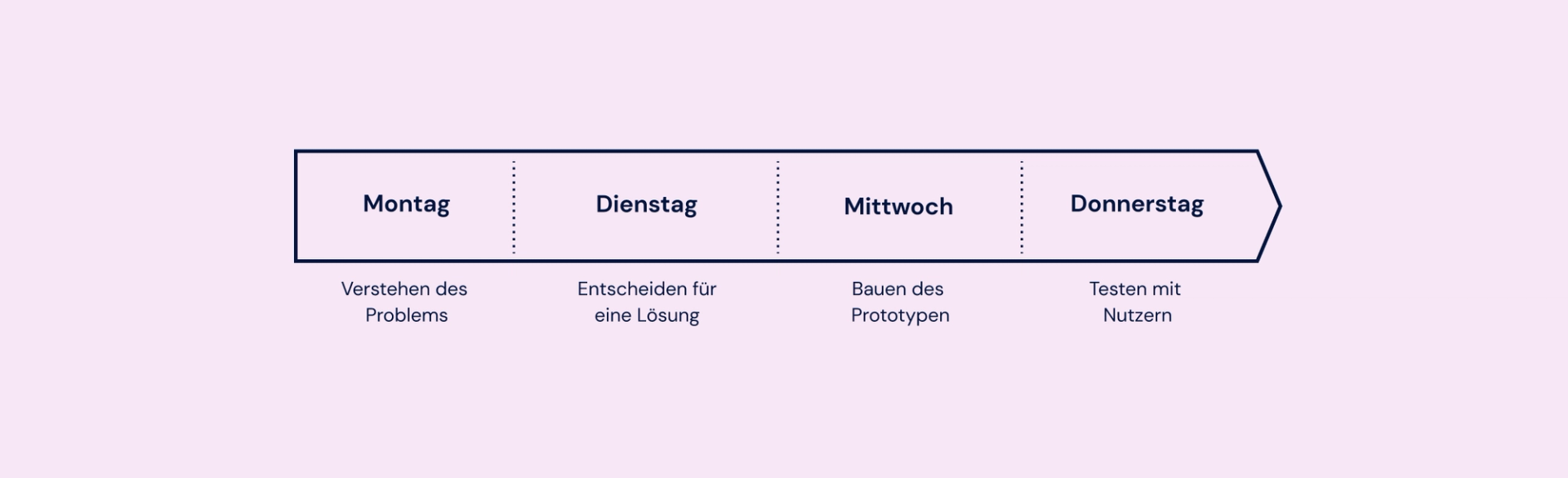
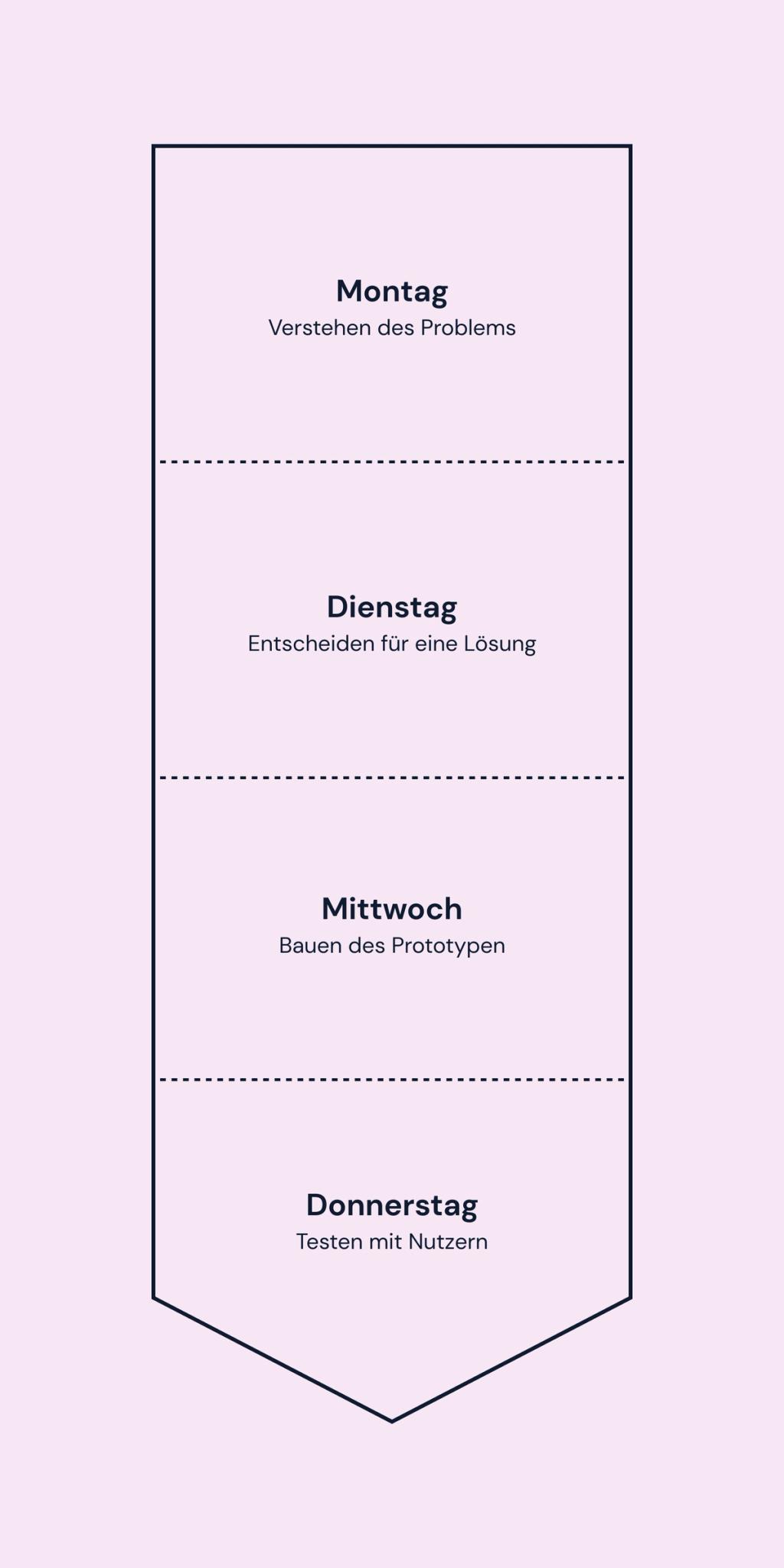
For companies, this poses a major challenge. That’s why AJ&Smart adapted the method: By moving all key decisions to the first two days, AJ&Smart was able to offer a model with just four sprint days: the Design Sprint 2.0. With this model, decision-makers only need to be present for the first two days. This model is suitable not only for startups but also for large corporations.
And what if the question isn’t “Which feature?” but “Where does AI really help us?” Then the AI Design Sprint® is the perfect fit: the same sprint logic, applied to AI decisions.
Design Sprints, UX&I style
We use the AJ&Smart model because it allows us to produce results in just four days. However, we add an extra day. We use this fifth day to plan the next steps. Depending on the results of the sprint, the next steps can vary greatly. Ideally, we can start development right away the following week. That was the case at Provinzial, for example.
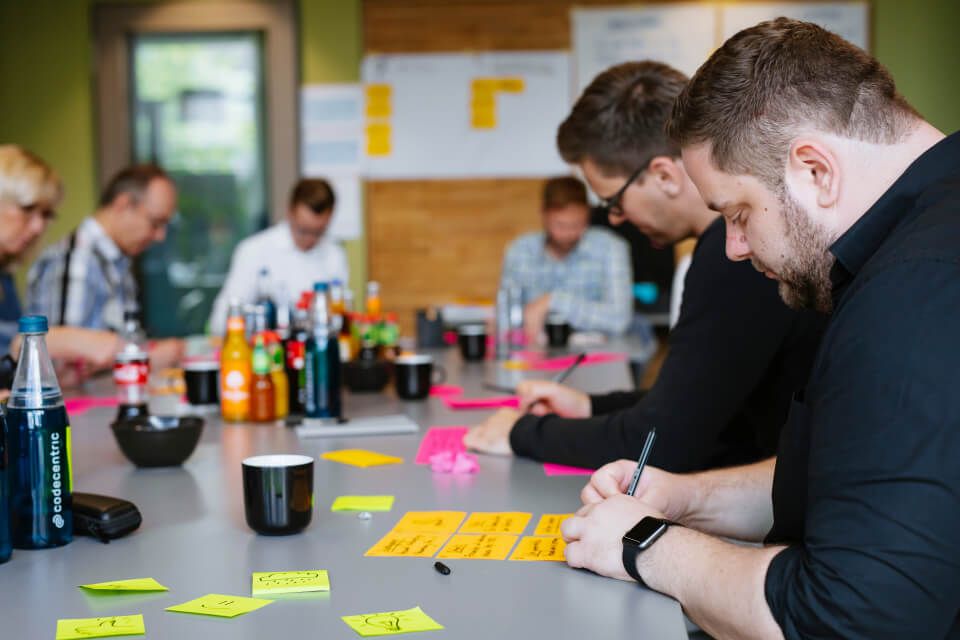
For our Design Sprints, we recommend that stakeholders be present on all five days. This is the only way we can ensure that every stakeholder’s opinion is heard at every step, thereby fostering a greater sense of commitment to the product.
How does a Design Sprint work?
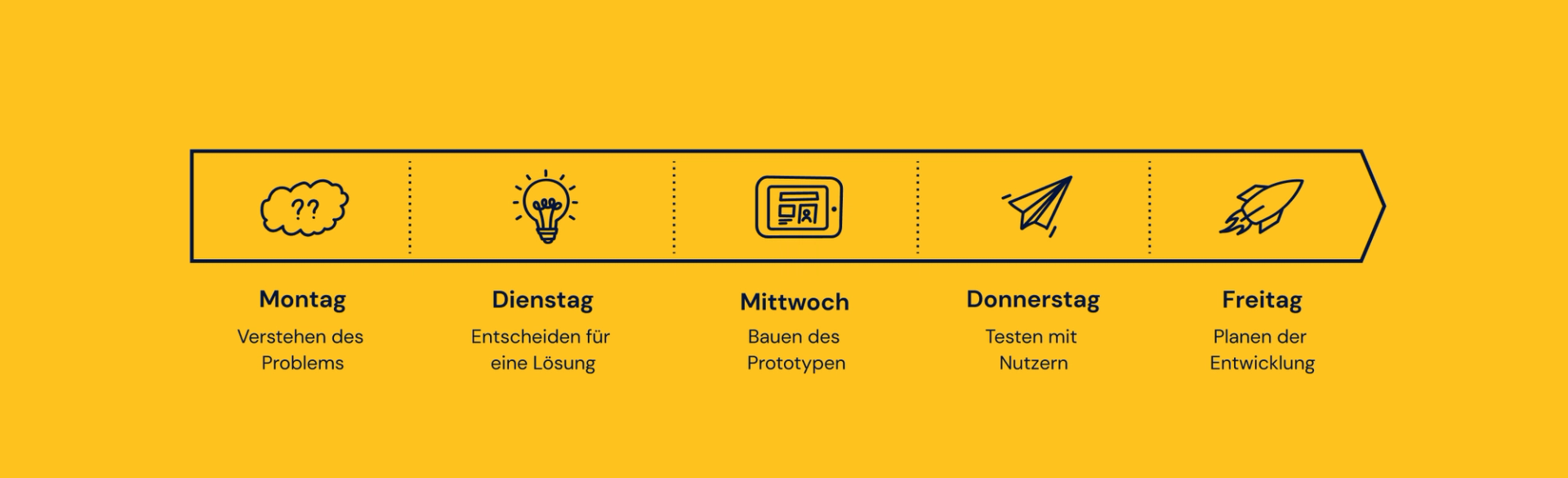
To help sprint participants get into the flow as effectively as possible and stay focused, we recommend holding the five-day sprint within a single workweek, typically from Monday through Friday.
Day 1: Understanding the problem
On the first day, the entire focus is on problem analysis. After all, a shared solution can only be found once all workshop participants understand the problem.
- Understanding the problem
- Reaching a shared understanding
- Define the goal for the Design Sprint in the form of sprint questions and a sprint goal
- Set the focus for the sprint
- Sketch out initial solutions in the form of wireframes
Day 2: Choosing a solution
The second day is dedicated to the entire team agreeing on a solution. The solution is refined so that a prototype can then be created. This is based on the wireframes created the day before.
- Agreeing on a solution as a team
- Work together to develop further details of the solution
- Make all the necessary preparations for the prototype
Day 3: Building the prototype
On the third day, based on the results from the first two days, an initial version of the product is created in the form of a prototype.
- Design and develop a prototype
- Develop the structure of the user test that will take place the following day
- Make further preparations for the test day
- Recruiting suitable test participants
Day 4: Testing the prototype
On the fourth day, the focus is on having potential users evaluate the proposed solution.
- Testing the prototype
- Organizing the test results in a structured way
As for the number of tests, we recommend conducting no fewer than five and no more than eight. One interviewer remains in the room with the test user and streams the test to an adjacent room. All other Design Sprint participants sit in this room to record observations and responses from the user test. Following each test, the results are then clustered and categorized. Since this day is very long and exhausting, we prefer to do the analysis with fresh eyes the next day, another difference from Design Sprint 2.0, in which everything is completed in a single day.
Day 5: Planning the next steps
On the fifth and final day, in addition to summarizing the results, the focus is on looking ahead and planning the next steps.
- Evaluate the results from each day
- Compare the results with the sprint goal and sprint questions
- Derive implications
- Plan next steps
- Gain the commitment of the entire team
Our clients’ projects are too diverse and complex. That’s why we work with the project team to define the goals to be achieved with the first version of the product. We then use a user story map to document all relevant features for this first version. It’s important to clearly define what’s included in the scope. Once we have enough content, we can start implementing the product as early as the following week. The benefit for our clients: By the end of the fifth day, they know exactly what specific steps to take next.
What are the benefits of a Design Sprint?
Conducting a Design Sprint offers various benefits for both the product and the team:
- Get results fast: In no time at all, stakeholders gain valuable insights and a solid basis for decisions about their product idea. The results of a Design Sprint can help determine whether an idea should be pursued further or whether a pivot is necessary.
- Save resources: We’ve worked with companies that have taken months or even years to arrive at similar insights. However, due to the long time frame and the associated high investment, it’s sometimes impossible to reevaluate a decision or even take a different approach. With a Design Sprint, the product is tested without implementing anything or spending a lot of money.
- Boost motivation: It motivates individual stakeholders to see their product idea brought to life and to get a first look at a prototype within the short timeframe of a Design Sprint. For most (large) companies, this is actually a new experience.
- Shared vision: During the Design Sprint, participants develop a shared product vision. Having a vision and being able to actively shape it is fundamental to a successful team, as it creates focus and confidence.
- Incorporate valuable user feedback: Involving potential users in the Design Sprint is extremely valuable. After all, if the product doesn’t offer them any added value, there’s no reason for them to buy it. And the only way to get their opinion is through testing.
- Consider all aspects: It’s a major advantage to have all areas of expertise and stakeholders involved from the very start of product development. This ensures that the product idea is examined from all angles right from the beginning.
- Make implicit knowledge explicit: It’s often the case that Design Sprint participants are talking explicitly about their various concepts and ideas for the first time. In a Design Sprint, these different perspectives are addressed and refined until everyone arrives at a shared solution and a common understanding of the problem.
What are the drawbacks of a Design Sprint?
- Weigh your options: In principle, you can’t go wrong with a Design Sprint if the topic is suitable. However, if the focus is solely on a specific feature, a Design Sprint is overkill. In such cases, we recommend more appropriate methods, such as Crazy 8’s followed by a user test.
- Be there from the first day to the last: Unlike AJ & Smart in Design Sprint 2.0, we recommend that our clients participate for the full five days. This ensures that all relevant stakeholders can be involved in developing the solutions. However, this also means that sprint participants should be present for all five days.
- Laboratory conditions during user testing: Since testing is conducted over just one day, it is often not possible to test under real-world conditions. However, an artificial testing environment can affect the test results and, consequently, the insights gained. Furthermore, because it isn’t clear until the second day who will be needed for the user test on the fourth day, it is often difficult to recruit genuine potential users of the product.
Conclusion
As part of our version of the Design Sprint, a rough idea is turned into a prototype in just five days, a prototype that has already been tested with potential users and planned for further development. This gives product managers and other stakeholders a degree of certainty as to whether the idea should be pursued further. And thanks to the added fifth day, they know what comes next after the Design Sprint:
- Further development: If the decision to proceed with further development has been made, the product team knows, thanks to the product vision they’ve developed and the joint planning, what can be done starting the following week. What happens after a Design Sprint?
- Pivoting / adaptation: If the results indicate that the team should pivot or adapt the idea, the product team will know exactly what next steps to take to move closer to the new product.
You should always assess whether a Design Sprint is the right approach for the problem at hand or whether other methods might provide the answers you’re looking for more cost-effectively or with greater depth. For example, feature ideas can be developed exceptionally well using Crazy 8’s followed by a user test.
Our expert
Jessica is a UX consultant and has been working in digital product development since 2009. In her workshops, she manages to wow even her most introverted colleagues.