Article
The design system maturity model: 7 steps to greater structure and impact.



- By
- Jasmin Amend, Christian Korff & Bernd Feldmayer
- Reading time
- 8 minutes
- Updated
Design systems are rightly considered the backbone of digital product development. They enable scalable interfaces, foster collaboration between design and development, and accelerate releases. Yet many companies underestimate the complexity and dynamics of a design system.
With our maturity model, we help you realistically assess the current state of your system.
Why a maturity model for design systems?
Maturity models provide guidance, especially in complex environments. They reveal where a company stands, what untapped potential exists, and what the next logical steps should be. Well-known frameworks, such as the Nielsen Norman Group’s UX Maturity Model, have demonstrated for years how helpful a structured, objective view of one’s own level of development can be.
In our work with enterprise organizations, we repeatedly encountered a gap: While we could measure overall UX maturity, we couldn’t measure the dynamics of design systems: that is, the technical and organizational infrastructure that makes modern product design scalable in the first place. Especially for design systems that are deeply embedded in the product, processes, and team culture, such a model can offer far-reaching possibilities.
Our model emerged from this practical need. In one project, we helped develop a design system almost from scratch, and we wanted to make our progress measurable. In doing so, we conducted an initial assessment and realized how much it helped clarify priorities and achieve shared goals. This experience was the starting point. We wanted to gain a deeper understanding of where companies stand with their systems, which patterns recur, and where support has the greatest impact. This allowed us to help our clients in a structured way to further develop their systems in a targeted manner. At the same time, we noticed that many organizations misjudge their own status because they lack benchmarks. While there are numerous public design systems whose structure and logic can be copied or used as a guide, the underlying processes and structures are rarely transparent.
Our maturity model establishes a foundation: an objective assessment based on real-world stages of development that helps companies better understand where they stand.

“Our goal was never simply to create yet another theoretical model. We wanted to understand where companies truly stand, and to create a tool that facilitates conversations, brings clarity, and makes progress visible.”
Where does your design system currently stand?
How the classification helps your company move forward
While it’s exciting to identify and assess your own maturity level compared to other companies, the model is more than just a benchmarking tool. It’s not about mere comparison, but about providing guidance. It’s a mirror that shows where your design system stands today and what steps are necessary to develop it sustainably. Each level describes typical patterns in organization, processes, and culture. This makes it possible to clearly identify and prioritize strengths and weaknesses. The model also helps you make informed decisions: Where is automation worthwhile? Which roles are missing from the design system team? What governance mechanisms are needed to enable scaling?
The model works best when applied in an interdisciplinary manner: product owners, designers, developers, and business stakeholders work together to assess the current state of affairs. It’s important to have a shared understanding of the current situation, the specific challenges, and the next sensible investments. This creates an excellent foundation for moving toward the next level with combined efforts and a shared awareness of the issues.
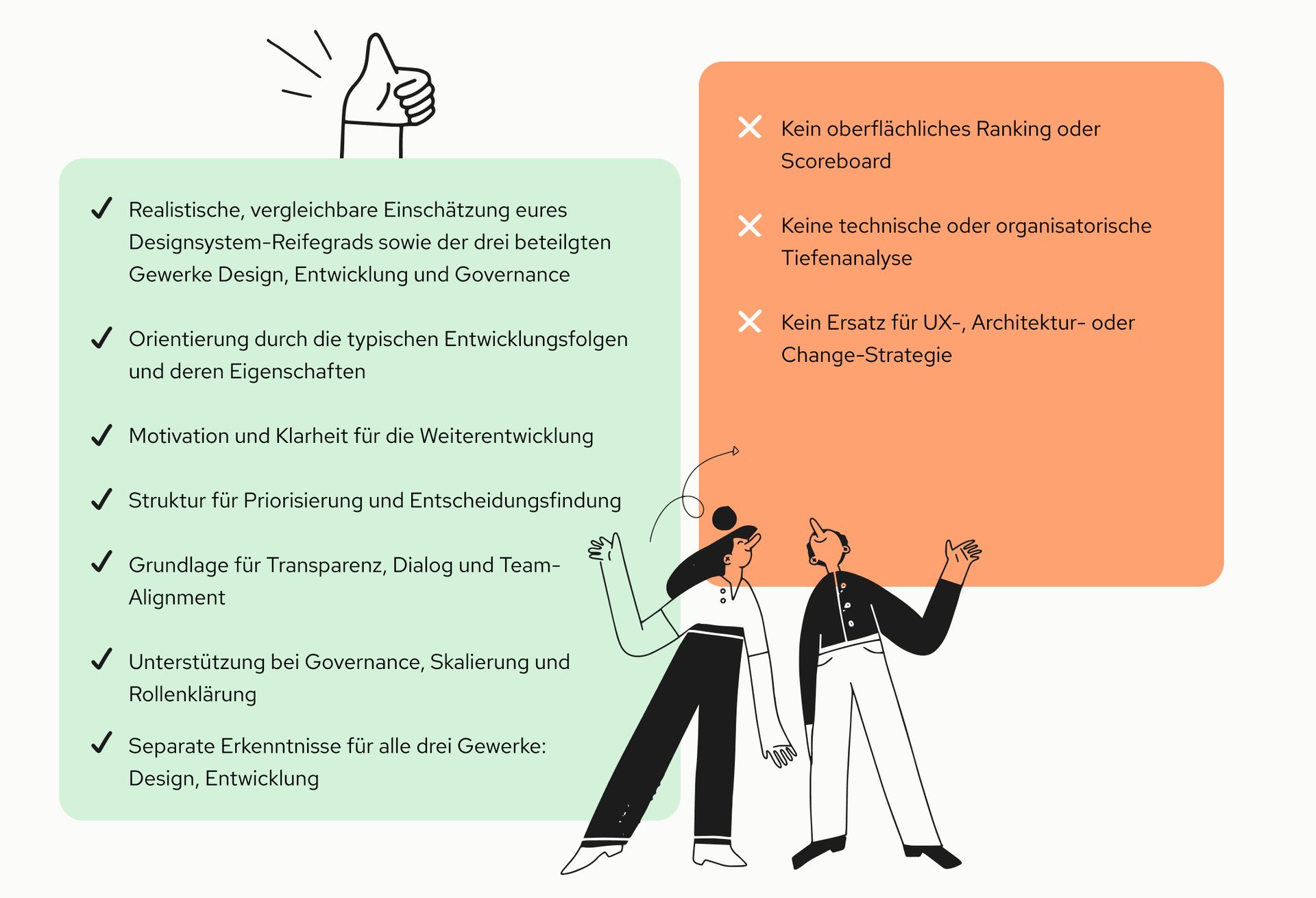
What the model doesn’t do: It doesn’t replace an in-depth analysis of design system architecture, processes, or organizational structures. It is the starting point, not the goal. Its greatest value lies in creating transparency and dialogue, and thus a foundation upon which design systems can continue to evolve strategically.
What the design system maturity model can and cannot do:
The 7 levels of design system maturity
Our model describes seven stages of development, from initial fragments to a strategically anchored design system. Each stage highlights typical patterns, challenges, and opportunities. Three key factors are relevant for classification:
- Design: Components, tokens, Figma library, guidelines
- Development: Technical consistency, automation, tooling
- Adoption & integration: usage, communication, onboarding
A mature design system only emerges when all three areas are in balance. It’s perfectly normal for the disciplines to develop at different rates, for example, when design is already at Level 4 (“Growing”), while development remains at Level 1 (“Absent”). Too great a disparity between the areas can also be an indicator of why the system isn’t yet functioning ideally in practice. For example, it may initially be ineffective to further improve the system in the design area if the other two areas are still lagging behind. Thus, good design can only emerge when there are also opportunities for designers to collaborate. At the same time, a system whose content is too elaborate, and which consequently requires too many or overly complex processes, can also be a roadblock. Furthermore, structures, naming conventions, and the like that arise from the design phase may become obsolete if they are later redefined differently in the development phase. These areas are interdependent and must grow in harmony with one another.
The model provides you with two key outcomes: first, the overall maturity level of the design system; and second, individual assessments of the three areas. The two complement each other and offer a realistic picture of how far along your system really is and where you can make improvements.

“Technical maturity doesn’t mean more code, but better connections. When design, development, and governance work together seamlessly, the system is no longer an obstacle but becomes an accelerator for everyone.”
An overview of the 7 levels
Level 1: Absent: No system in sight
In this initial phase, there’s little sign of a true design system yet. Components are often created individually, duplicated, or improvised. Design decisions are made anew time and again, and developers fall back on their own solutions. There are no consistent guidelines, no central repository, and no reusability. Everyone works according to their own logic, which leads to enormous inefficiencies.
Level 2: Limited: First tentative attempts
Individual teams are beginning to collect patterns and components. Here and there, the first design guidelines are emerging, but they are neither complete nor binding. There is a lack of naming conventions, clear structures, or a shared understanding. Nevertheless, an initial desire to systematize things is becoming apparent. Often, it’s the “button file” that gets copied over and over again. A small step in the right direction, but still a long way from true scalability.
Level 3: Documented: Order in the system
At this stage, the system has a solid foundation: components, tokens, and styles are documented, reusable across projects, and accessible to teams. There is a central library, usually in Figma, with a certain structure. The technical side is also slowly catching up: components in the code are versioned, documented, and reused. The system is perceived as a resource, not as a project, but as a foundation for work. Collaboration is already noticeably benefiting from this.
Level 4: Growing: The system is taking shape
The design system has emerged from the shadows and is actively growing. It is being used productively, not only in design but increasingly in development as well. New components are no longer created randomly but are driven by real-world requirements. Teams are actively participating in the system through feedback, suggestions, and collaboration. At the same time, structured processes for maintenance and expansion are beginning to take hold. The system has developed a dynamic of its own: it is alive.
Level 5: Processual: The engine room is running
At this stage, the design system is deeply embedded in the product development process. Maintenance and expansion follow clear processes supported by governance rules. Components have lifecycles. Design and code are integrated via automated toolchains such as Tokensync, CI/CD processes, or test setups. Teams know when and how they can adapt the system without causing uncontrolled growth. Collaboration between design and development runs smoothly.
Level 6: Optimized: Perfectly aligned
The design system is fully integrated into the organization. It is flexible enough to accommodate different platforms and products, yet stable enough to ensure consistent experiences. Processes are automated, and changes follow defined approval workflows. Teams actively rely on the system and trust its quality. At the same time, there are clearly documented workflows, usage metrics, and continuous reviews. The system is a “first-class citizen” in the digital ecosystem.
Level 7: Innovative: The system thinks ahead
A design system at this level is more than just infrastructure. It is an active driver of innovation, both technically and creatively. New paradigms such as AI, new token standards, or automation are tested and integrated at an early stage. The design system team acts strategically, initiates change, and provides impetus toward the product vision. There are regular experiments, cross-system collaboration formats, and a culture that welcomes change. The system has an impact beyond its own boundaries: it inspires.

“A design system is truly mature when it helps teams make decisions, not just place pixels. Good design emerges when design systems provide both guidance and freedom.”
Where do you stand, and what do these levels mean for your organization?
Just as we help our clients with our Design System Maturity Model, we want to give all companies the opportunity to quickly and objectively assess their maturity. That’s why we developed the Design System Maturity Calculator. It’s now available for free on our website. The results not only show you the current level of your design system but also provide answers to these important questions:
- What are the typical characteristics and challenges of your level?
- What vision is driving you forward right now?
- What is the greatest opportunity at this level?
- So how exactly can you move forward to reach the next level?
Conclusion
Design systems are more than just collections of components. They are living systems that evolve alongside organization, technology, and culture. This is precisely where the maturity model provides a common language. It reveals what has remained hidden until now: the actual stage of development, the dynamics behind it, and the potential that already exists.
Those who know their maturity level can take more targeted action, in design, development, and organizational structure. The model helps not only to sense progress but also to demonstrate it. And it provides guidance in an era of growing complexity and increasingly critical standards.
This way, the design system is no longer viewed as a side project, but rather as a strategic lever for quality, efficiency, and impact.
P.S.: Would you like to discuss your design system or just get an initial outside perspective? Let’s talk: we’re passionate about this topic and would be happy to help.
Our experts
Jasmin is passionate about design and art. In her work, she combines her love of aesthetics with a healthy dose of pragmatism and structure.
“UX is only sustainable if everyone gets on board.” Christian Korff turns user experience into a team effort and particularly enjoys getting involved with complex systems.

Bernd Feldmayer
Senior UI engineer
With a focus on design systems and user-centered design, Bernd develops scalable front ends and equips teams to handle day-to-day tasks through training.