Article
Improving team performance: dysfunctions, indicators, and supportive rituals

- By
- Alina Binzer
- Reading time
- 7 minutes
- Updated
Many people dream of the perfect team: a team that completes complex projects on time and within budget. Naturally, they outperform the competition, and the team enjoys their work. In reality, however, most people quickly let go of this idea. On top of that, many are now facing a new situation: working from home full-time.
A study by Stepstone shows that things are often far from rosy. The second most common reason for quitting, nearly tied with low pay (39.7%), is a poor work environment (37.4%).
In this article, we’ll focus on the five dysfunctions, or functions, of a team as defined by Patrick Lencioni. We’ll discuss indicators that can be used to analyze teams. We’ll then share methods and rituals that have worked well for us and that can help improve team performance in a targeted way.
What makes a bad team: Patrick Lencioni’s 5 dysfunctions
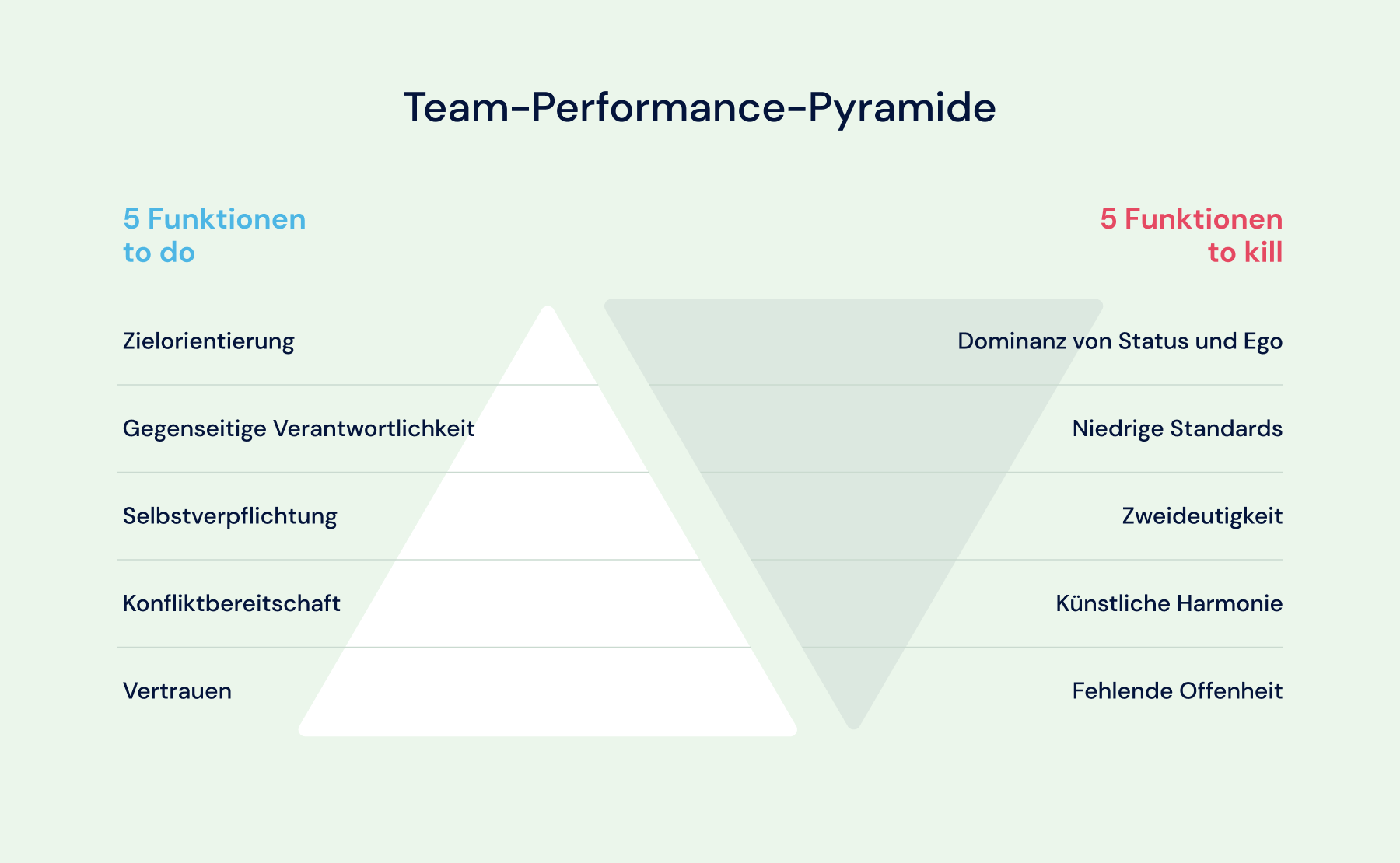
In his book The Five Dysfunctions of a Team, Patrick Lencioni identifies five dysfunctions that often cause even the best teams to fail. He also describes the five corresponding functions that help teams move forward:
How can team performance be improved?
Trust as the foundation for effective teams
Trust is the foundation of all teamwork. Without trust, or, in other words, without the certainty that one’s own team members are “good” and that no caution is needed, teams quickly become paralyzed. Time and energy are wasted trying to find a scapegoat or hide weaknesses. And ideas are often not shared out of fear, which is a huge loss of creativity and talent.
“Trust can only be built when teams are open with one another and feel comfortable discussing their weaknesses. To build trust, therefore, it is essential to have a good understanding of each team member’s personality, including their typical strengths and weaknesses.”
Indicators of trusting teams:
- Mistakes and weaknesses are openly acknowledged
- Collaboration is perceived positively
- Appreciation within the team
- Openness to questions or feedback
- Energy is invested in the work
Rituals that build trust
- Taking turns asking check-in questions during meetings to break the ice and get to know team members better (How are you today? Which song best describes how you’re feeling right now? What’s your favorite hashtag? …)
- Identifying shared strengths: It’s not just a feel-good exercise; this activity is also designed to foster appreciation and empathy. Many thanks to Sipgate for this effective retrospective method.
- Spending time together: As trivial as it may sound, it’s difficult to build a trusting relationship without spending time together. At UX&I, for example, we have a team breakfast every Friday. Even while we’re all working from home, we’ve kept this ritual going and have also created new formats where we get together remotely for an evening beer and talk about things other than work.
A willingness to confront conflict rather than artificial harmony
People tend to avoid conflicts, whether to buy time (though the opposite is usually true) or to avoid stepping outside their comfort zone. Yet conflicts are genuine catalysts for innovation and true drivers of product improvement. In extreme cases, without conflict, only the perspective of a single business unit is taken into account. To identify the best possible solution in the shortest amount of time, differences of opinion are essential. Conflicts are real opportunities, as long as they are not handled in a personal or emotional manner. And they should be viewed as such by the team.
“Harmony within a team is beneficial and can inspire us. But an obsession with harmony is deadly and stifles all growth.”
Indicators of teams that are open to conflict
- Meetings are dynamic and energetic
- Discussions focus on possible solutions
- All team members’ ideas are heard
- Innovative ideas emerge
- Critical issues are addressed openly
- Relevant problems are resolved quickly
Facilitated rituals for constructive conflict
- Joint brainstorming sessions where even crazy, out-of-the-box ideas are actively encouraged and where it’s emphasized that there are no bad ideas.
- Seeking direct dialogue when tensions arise: Everyone should lead by example here. Paradoxically, most people address problems much more often in their personal lives, such as in their relationships. At work, however, many people prefer not to deal with conflicts. At UX&I, this is exactly the principle we follow. As soon as we sense tension, we seek dialogue. To make sure this principle is firmly anchored, it has even become one of our official company principles.
- Valuing the critical leader: In most teams, there are at least three informal roles: the functional leader, the emotional leader, and the critical leader. When these roles are well balanced, the team stays focused, remains motivated, and reflects on its decisions. The critical leader ensures that ideas are scrutinized, thereby uncovering blind spots. As long as the critical leader remains constructive, this role is invaluable and should be leveraged.
Commitment instead of ambiguity
If the requirements or the direction the team is headed aren’t clearly communicated, there’s plenty of room for interpretation. Only by clearly and unambiguously defining the company’s or project’s goals can a team commit to them.
“Often, it is the uncertain outcome and the lack of consensus that prevent teams from committing. Here, it helps to create a culture in which quick decisions are encouraged, mistakes are allowed, and it is clear that certainty and security are often unattainable goals. A team can commit even when there isn’t 100% consensus. However, this requires that team members’ individual ideas and objections have been heard, understood, and taken into account in the overall decision.”
Indicators of strong team commitment
- Team members strive to achieve a common goal
- Everyone on the team knows what the others are currently working on
- There is a commitment to decisions made within the team
- Meetings are productive: decisions are documented, tasks are defined, and responsibilities are assigned to specific individuals
Rituals for greater personal responsibility
- Team updates: Aside from their frequency, daily, weekly, and monthly meetings share a common purpose: they ensure transparency. The discussion should be moderated whenever possible to ensure the meeting stays on track.
- Constructive meetings: To ensure that meetings are as constructive as possible, we only hold a meeting if there is an agenda and a facilitator who ensures that the meeting yields the best possible results and achieves its goal. At the end of the meeting, we document the tasks to be completed.
Mutual accountability instead of low standards
Performance standards within a team often vary widely. In some teams, this creates significant potential for conflict. Furthermore, if team members do not feel responsible for the work of their teammates, the result is often a lower standard of quality. Here, too, a team that provides mutual feedback and feels responsible for the overall achievement of team goals achieves better results.

“Establishing shared goals is essential and also fosters a shared sense of responsibility. That’s why the team should meet before getting started to define goals that everyone can identify with. Only then can a team pull together.”
Indicators of teams that hold each other accountable
- Team members point out unproductive behaviors
- Team members question established practices
- Team members show interest in each other’s tasks
- Potential conflicts are quickly identified
Rituals that foster a sense of responsibility
- Scheduled feedback sessions: To ensure feedback is as constructive as possible, scheduled feedback sessions can be helpful. One method is the “traffic light” method, which is easy to implement: Red stands for “I don’t like that…,” yellow stands for “I suggest the following improvement…,” and green stands for “I liked that….”
- Retrospectives: Retrospectives are team meetings in which the team reviews a previous time frame to gain and document insights. What went well? What didn’t go so well? What would you like to keep? What would you like to start doing? Retros help the team on the path to continuous improvement. In this article, we explain how to organize retrospectives remotely: Designing remote retrospectives for effective outcomes.
Focus on goals rather than status and ego
According to Patrick Lencioni, the most critical dysfunction in a team is the dominance of status and ego. It’s no longer about achieving the team’s goals. Far more important are other goals that are played out through hidden agenda items in meetings. It’s about making a name for oneself, gaining recognition, and perhaps landing the newly vacant department head position?
“It’s important to overlay the knowledge, perceptions, and mental models that everyone has in their minds and determine what is likely the best option for solving a problem. It is particularly important to engage with others, to be open, to give others space to flourish, and to define a shared solution in the process. Egos, and the desire to stand out that comes with them, are at odds with this and hinder teamwork.”
Indicators of results-oriented teams
- Team members give their all to achieve the defined team goals
- Goals are documented in writing within the team
- Every team member knows the goals
- High-performing employees remain loyal to the team and the company
- Team successes are celebrated, while failures dampen morale
- All distractions are avoided
Results-focused rituals
- Objectives & Key Results (OKRs): OKRs are an agile framework used to define the company’s vision and goals. This creates transparency regarding what everyone is working on and how their individual contributions fit into the bigger picture. The goals are broken down top-down, from management all the way down to the individual employee
- Dot voting for meeting decisions: When making decisions in meetings, we at UX&I like to use dot voting, which, by the way, also works wonderfully remotely with Miro. Everyone gets 2–3 dots to distribute freely across different topics or solutions. The team then works on the topic or solution with the most dots.
Conclusion
What sounds simple in theory can lead to frustration in practice. It is, in fact, teamwork that can give a company its greatest competitive advantage. To really get into the flow, a team goes through a process. This process can be positively influenced by rituals.
Basically, there isn’t just one solution or a “right” roadmap to follow. The good news is that there are many possibilities, and thus countless methods, for working better together as a team. Just give it a try, gain insights, firmly establish the most effective methods for your team, and feel free to reevaluate them after a while.
Our expert
Alina comes from the agency and startup scene and is passionate about inbound marketing that truly puts people first. She has been working at UX&I since 2020.