Article
The loss of UX effectiveness and how to stop it

- Reading time
- 5 minutes
- Updated
Something we see time and again in our projects: Companies have invested in UX by building up in-house UX capabilities. And yet, their product KPIs aren’t reflecting what’s possible.
The problem is almost never the talent of UX experts. It’s the framework that systematically prevents them from making an impact.
This article explains what’s really causing the problem and which structural changes can make a difference.
When UX operates without a goal
In many organizations, UX is still misunderstood as an afterthought meant merely to “make things look nice.” As a result, valuable resources are tied up in ineffective processes.
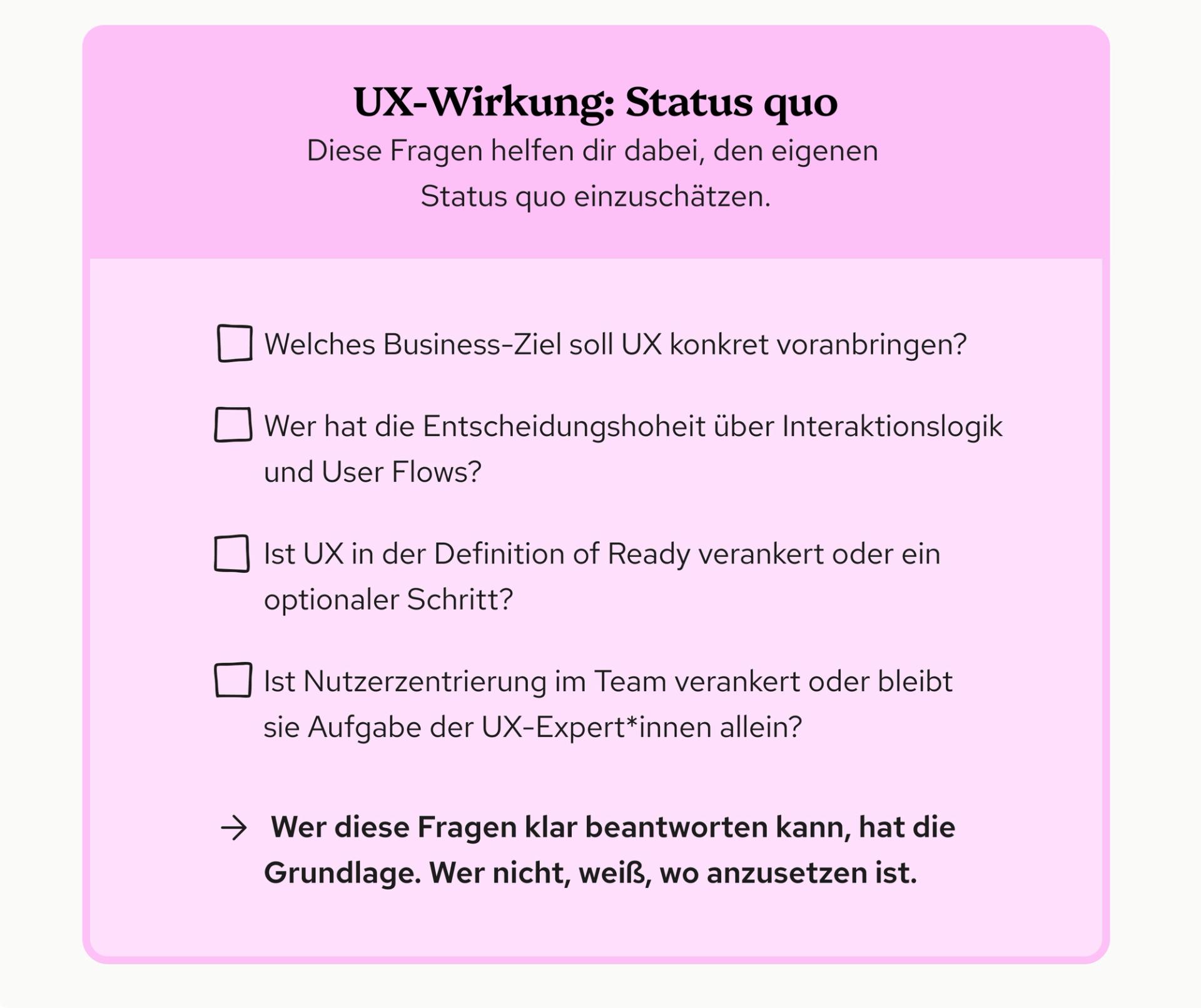
The underlying problem is often a lack of direction. Without a clear strategy outlining which business problems UX should prioritize solving, the team remains reactive. It solves localized issues and improves usability in the details, but cannot make targeted contributions to the key business KPIs.
To ensure that UX expertise doesn’t go to waste, it must be linked to specific business goals:
- Increasing the conversion rate: reducing friction in the checkout process
- Improving operational efficiency: reducing clicks and complex workflows so employees can complete tasks faster and without errors
- Reduce training efforts: An intuitive self-service approach that eliminates the need for lengthy onboarding phases for new users
- Reducing support burden: clear information architecture and error prevention to prevent user errors before they happen
- Preventing churn: A product that’s only used to its full potential is hard to justify, both internally and externally. UX increases the depth of usage and, with it, the perceived relevance of the product.
A helpful assessment: Which of these goals is currently the most urgent for the company, and is the UX team explicitly focused on it? If not, UX experts are usually not strategically integrated but instead operate reactively.
Responsibility without decision-making authority
UX experts often play only an advisory role. They’re allowed to make suggestions, but the final decision is frequently made by third parties, unfortunately sometimes based on gut feelings. This undermines the investment in UX.
Early signs that the problem may already exist:
- Are UX concepts regularly changed during reviews without user data to justify the changes?
- Does hierarchy or volume, rather than evidence, determine the final design?
- Is UX only brought in when it comes to the final design?
- Is it unclear who has the final say in UX conflicts?
If two or more of these points apply, value is actively being lost from your UX investment.
The solution isn’t a major reorganization, but rather a clear definition of and adherence to responsibilities:
- UX Matters: Interaction Logic, User Flow, Information Architecture
- The PM decides: prioritization, scope, release date
- Stakeholders are consulted: business requirements and market context
When it’s clear who makes which decisions, discussions about personal preference are replaced by discussions based on evidence.
Substance trumps surface
In practice, UX is often mistakenly equated with visual design. But there are fundamental differences:
The order matters. If you start with the UI, you risk building a product that looks good but fails to address users’ day-to-day work needs. A good UI can mask conceptual flaws, but it can never fix them.
The greatest economic value is created during product discovery. Here, UX replaces untested assumptions with reliable user data and protects the budget from costly missteps.
Three questions that have proven useful during the refinement phase before a ticket goes to development:
- Has the underlying user problem been validated, or is it based on assumptions?
- Was the users’ entire workflow understood before the solution was defined?
- Is UX involved as early as the conceptual phase, or is it only brought in once the technical direction has already been determined?
If the answer to the third question is regularly “afterward,” that’s not a process problem: it’s a structural problem.

“I’m saying this deliberately to provoke: Maybe the UX department itself is the problem. When you organize user-centered design in a silo, you’re signaling to the rest of the company that it’s not their job. In the product organizations that I find truly impressive, there are no “UXers.” There are product teams where everyone sees things from the user’s perspective. This isn’t an argument against UX expertise. But it is an argument for taking a close look at what a UX department actually solves: and what it might inadvertently create.”
Strategic integration instead of siloed work
In-house UX isn’t the goal, it’s merely a prerequisite. UX experts alone can’t make a difference if the company isolates them. As soon as UX is viewed as an isolated silo, friction arises and the loss of impact continues.
What needs to be changed structurally:
UX as a strategic filter for the roadmap
In a high-performing organization, UX acts as a quality gate for product definition. The simplest way to achieve this is to add a UX gate to the Definition of Ready. A ticket is only ready for development when:
- that the user problem is based on expertise or available user data, rather than purely on stakeholder assumptions.
- The usage context is described: Who uses the feature, in what situation, and for what purpose?
- there is a concept tailored to UX.
- Open UX issues have either been resolved or deliberately documented as risks.
This filter may sound like extra work, but it saves you from having to make much more expensive corrections after release.
Binding decision-making processes
UX goals must be an integral part of the business strategy. Specifically, this means that UX must take place where strategies are designed, not where they are merely executed. If UX experts are technically responsible but their findings can be revised at any time, the discipline is devalued. UX validation must serve as a genuine “go/no-go” criterion, not as an optional recommendation.
User-centered design as a team sport
True speed is achieved when PMs, developers, and stakeholders share a common understanding of the users. In practice, this means: There is a collaboratively developed persona that everyone refers to, not just the UX team. UX insights are actively shared, for example, during the Sprint Review or Planning meeting. And decisions made during the Refinement phase are explicitly evaluated: Does this help our users in their specific situation?
If only UX knows who the users are, user-centered design remains just one person’s opinion. When the entire team shares the same understanding, it becomes a common basis for decision-making. UX thus transforms from a supposed roadblock into a catalyst that gives the team the confidence to build the right thing.
Conclusion
Having in-house UX expertise is good. Making it effective is the real challenge. The difference rarely lies in the budget; it lies in the structure.
Our experts
Jessica is a UX consultant and has been working in digital product development since 2009. In her workshops, she manages to wow even her most introverted colleagues.