
Accessibility by Design: Training with Bernd Feldmayer
Accessibility is no longer just a nice-to-have. Learn how to develop products from the ground up that work for everyone, and get even better in the process.
- Format
- On site or remote
Product Academy
In two days, learn how to smartly combine analytics, A/B testing, and user research. Afterward, you’ll be able to make the case with numbers that convince stakeholders, and you’ll know exactly which metrics matter for your UX goals.

We’re opening up our toolbox for you. You’ll learn how to effectively combine qualitative insights and quantitative data to not only design UX but also to provide a robust rationale for it. Practical, well-founded, and immediately applicable.
A 2-day training course for anyone who wants to make better product decisions using data.
Good UX doesn’t come from opinions, but from the interplay of observation, understanding, and measurable results. That’s exactly where this training comes in: You’ll learn how to interpret analytics correctly, formulate meaningful hypotheses, set up A/B tests properly, and choose the metrics that are truly relevant to your product.
In the hands-on Data-Driven UX training, you’ll develop a solid understanding of which data truly helps you, where common misinterpretations lurk, and how to present results in a way that enables stakeholders to make sound decisions. After two days, you’ll be able to make clearer arguments, prioritize more effectively, and know which numbers really matter.
This training isn’t about looking at as many dashboards as possible. It’s about drawing the right conclusions from data. Together, we’ll explore which questions you can answer with analytics, when qualitative research remains essential, and how the two work together to provide a much clearer picture.
You’ll work with realistic examples from everyday product development and learn how to prepare decisions that are transparent and robust, without getting lost in the numbers.
We’ll teach you the fundamentals so you can apply them right away. Using examples, exercises, and real-world use cases, you’ll develop hypotheses, evaluate metrics, interpret results, and discuss common pitfalls encountered in practice.
Whether in a team or in small groups, you’ll try out methods firsthand and get a feel for when data provides guidance, and when it can lead you astray.
Our goal isn’t simply for you to “do more with data.” Our goal is for you to make better product decisions. After the training, you’ll be able to interpret data more effectively, link research findings more precisely to numbers, and present your recommendations more clearly.
How reporting becomes a true basis for decision-making.
This training is aimed at UX designers, product managers, and anyone who wants to develop digital products in a more data-driven way. It is particularly valuable for people who act as a bridge between research, design, product, and business and want to ground their arguments in a solid foundation.
The more diverse the participants’ perspectives, the more exciting the discussion becomes, because good decisions almost never arise from a single discipline alone.
Greater confidence
in decision-making You’ll learn how to interpret data effectively and derive reliable recommendations from it.
Better justification:
You’ll be able to justify your UX decisions more clearly, to the product team, stakeholders, and the development team.
Greater impact in everyday life
You’ll understand which metrics are relevant, how to set up tests properly, and where qualitative insights remain indispensable.
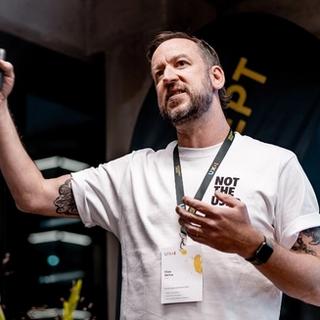
Hias is a product coach who, driven by his passion for agile methodologies, bridges the gap between people, business, and technology. He also shares his expertise at artop in Berlin through the UX Thinking concept, which he helped develop.

Dr. Ramona Casasola-Greiner
Data & AI ethics · (FELD M)
Dr. Ramona Casasola-Greiner studied art history, philosophy, and literature. Since 2017, she has been working at FELD M in Munich in the field of data and AI. As the author of several academic and non-fiction books, a speaker, and a coach, she focuses on the applications of Design Thinking and agile methods outside of software development, as well as the societal impacts of digitalization. She works with democratic parties, government agencies, NGOs, and executives; teaches Business & Society at the Munich Business School; and serves as co-director of the Artificial Intelligence Working Group at the think tank D64: Center for Digital Progress e.V.

Dr. Matthias Böck
Data scientist · (FELD M)
Dr. Matthias Böck earned his Ph.D. in bioinformatics and machine learning and has been working as a data scientist in the Data Product division at the Munich-based consulting firm FELD M since 2013. There, he serves as Technical Lead for projects in the areas of advanced analytics and machine learning. This includes, among other things, personalization, natural language processing, and predictive analytics, as well as the underlying data architectures and strategies. He leads design thinking workshops and collaborates with universities on research projects. In addition to these fields, he focuses on the topic of “Data for Good” and its practical application.
No. You don’t need in-depth knowledge of statistics. A basic understanding of digital products and a willingness to approach problems analytically are helpful.
Both. The training is intentionally designed to be interdisciplinary because data-informed decisions arise at the intersections of UX, product, and business.
No. The focus is specifically on combining quantitative and qualitative insights. You’ll learn when metrics are helpful, and when research makes all the difference.
Yes. You’ll work through the entire process: from hypothesis to test logic to interpreting the results.
Yes. The training is structured so that you can apply much of the content directly to your product context.
We support you from strategy and agile product development all the way to training your team.

Nadine Pieper Senior UX consultant · Berlin
30 minutes by video call, free and with no obligation. All times are Berlin time.




Your call with
Nadine Pieper
Senior UX consultant
Berlin
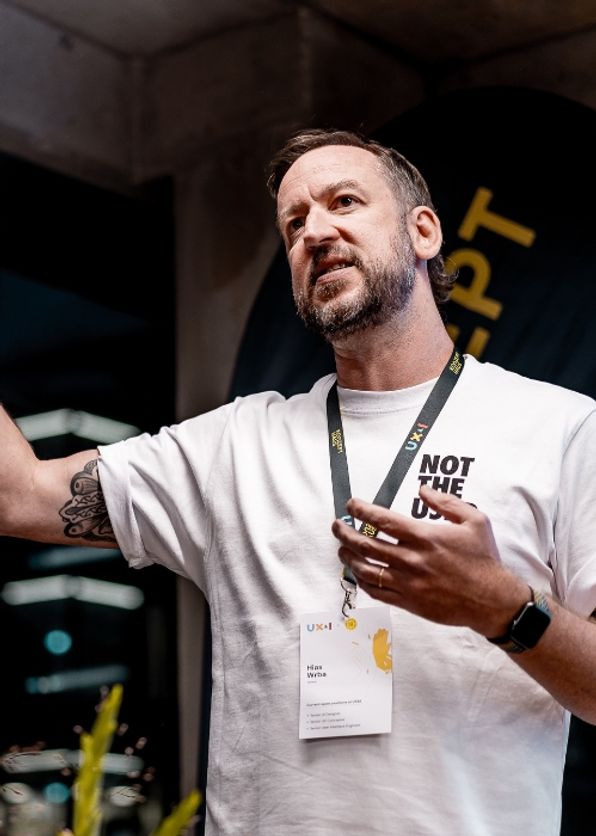
Your call with
Hias Wrba
Product coach
München
Your call with
Patrick Oselka
Managing director at UX&I
Düsseldorf
Your call with
Claudia Schönwälder
Senior UX consultant
Hamburg
Your call with
Mato Sauer
Customer empowerment lead
Frankfurt
Accessibility is no longer just a nice-to-have. Learn how to develop products from the ground up that work for everyone, and get even better in the process.

We’ll help you deeply and permanently embed UX and a human-centered approach within your company, far beyond the development teams.

Learn the key fundamentals of user-centered design, navigate the jumble of terminology, and discover how to assess and advance your company’s UX maturity.