Article
UX mindset meets New Work: Why we work in a human-centered way

- Reading time
- 7 minutes
- Updated
What does a fulfilling work life look like? What makes us happy at work, and what makes us productive? How important is our paycheck, and where does work-life balance fit in? These questions continue to be, and are increasingly becoming, a major topic of discussion, giving rise to entire industries.
At UX&I, as part of a process that has been ongoing for years, we’ve been exploring how we can organize ourselves as a company to achieve the greatest personal and business success. And lo and behold, even in this context, a human-centered approach is our guiding principle.
How does a human-centered organization work? And most importantly, what benefits does it offer our clients and us?
What does human-centered work mean?
Our corporate structure is based on sociocracy. First and foremost, this means that we are self-organized. Responsibility for the company and its employees lies with all of us, or, to put it even more clearly, with each and every one of us. No one sits at the top calling the shots. We have neither supervisors in the traditional sense nor project managers. We all enjoy the trust to make decisions without lengthy coordination processes.
Circles instead of an organizational chart
UX&I is structured according to the Peach Model, which consists of a circle divided into several layers.
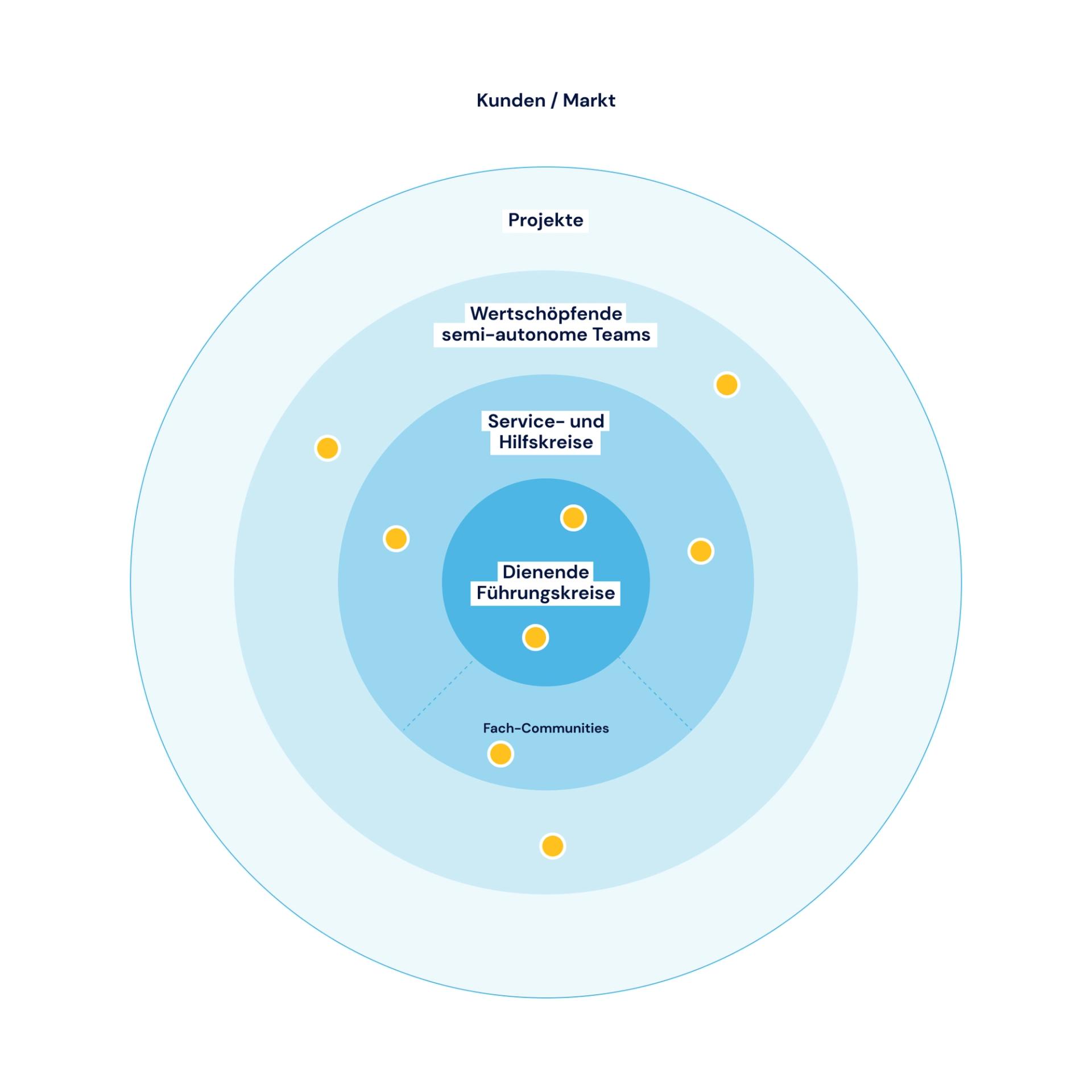
On the outer edge are the projects and value creation, in other words, what the company relies on for its survival. Further inward are the support functions that enable value creation, such as marketing and sales. The core consists of “servant leadership,” which includes, among others, the Managing Director. This is where decisions affecting the entire organization are made.
Roles instead of positions
The “layers” are not self-contained departments. Our UX consultants, for example, work on projects in their area of expertise but also belong to circles in the other layers and, depending on their strengths and interests, help with tasks such as recruiting or corporate development. Instead of being tied to fixed positions, we take on tasks flexibly and contribute wherever our skills are needed. Even at the project level, we can take on roles at any time that don’t align with our core competencies. A UX designer can also step in as a product owner if the project requires it.
Principles instead of rules
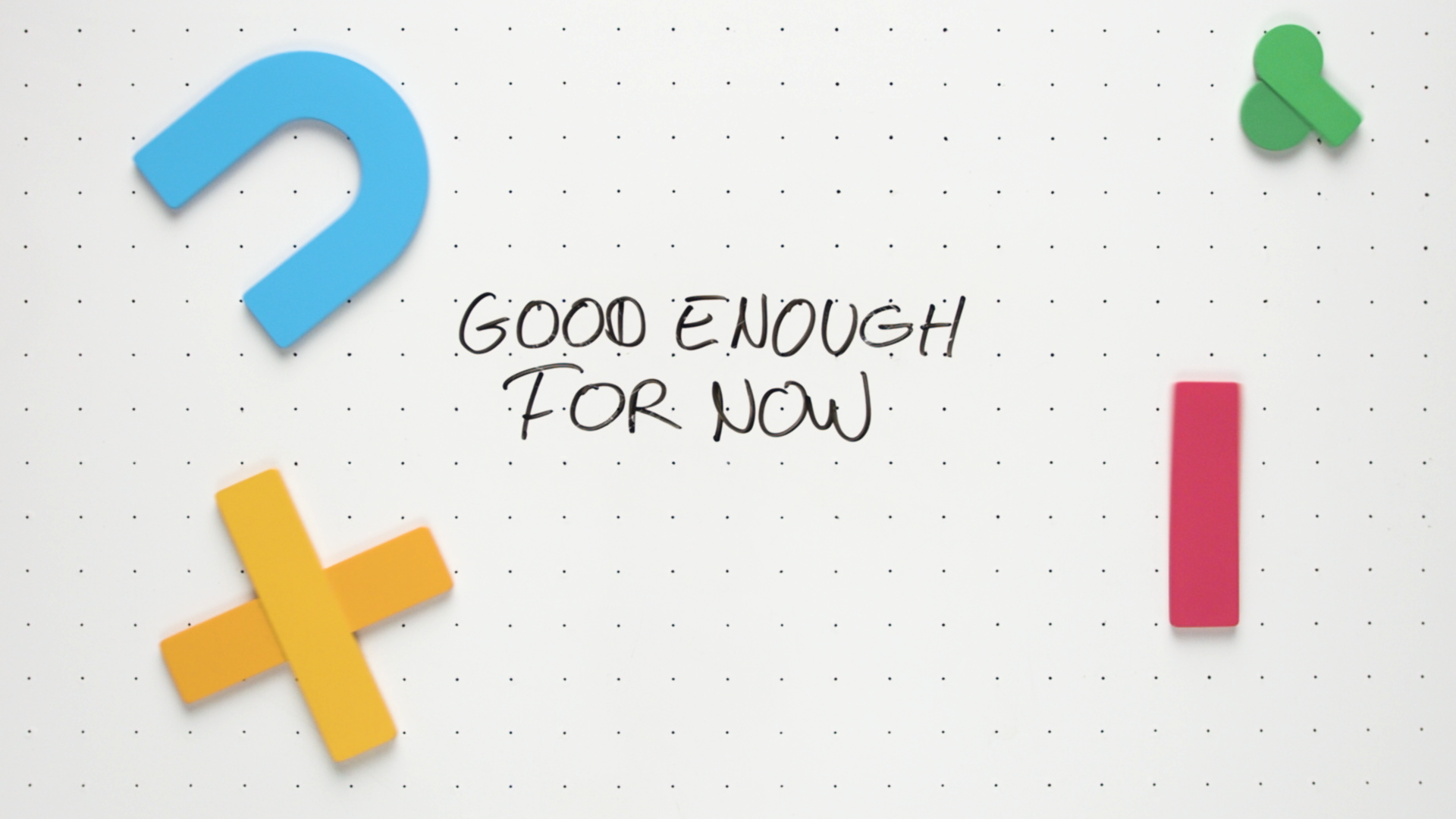
We have almost no fixed rules. Instead, overarching principles serve as our guidelines. Eight principles are particularly important and form a central part of our culture. These include, for example, personal responsibility. It states: “Take action when necessary: Follow through on what you’ve agreed to and keep the entire organization in mind.” This principle helps us make many day-to-day decisions independently: for example, we skip the approval process for vacation requests or travel expenses. Another guiding principle is “Good enough for now, safe enough to try.” We don’t always have to be perfect right away and can try things out without fear.
Responsibility instead of merely fulfilling duties
Self-organization also means: We work together for the success of UX&I. We all share responsibility for this and contribute our respective strengths. In doing so, we follow our own paths and don’t do anything just because that’s how it’s always been done or because there’s a perceived expectation in the air. It’s important to us not to be driven by short-term to-do lists, but to keep the big picture in mind. When we encounter obstacles or feel that things could go better, we have an established process through which we autonomously seek solutions with the colleagues responsible for the respective issue.
What are the benefits for us as a team?
Creative freedom and self-efficacy
The sociocratic model gives us a great deal of freedom and opportunities to help shape things, both at the organizational and project levels. By working in circles, everyone can contribute to the company’s development, and even on projects, we don’t have to follow rigid rules or simply tell clients what they want to hear.
“We are not just employees, but shapers of the organization.”
We can address problems openly and follow our common sense, always knowing that my colleagues have my back. Our culture of embracing failure gives us tremendous support. “Fail better” is our motto. Because we see mistakes as an integral part of success, we can act with confidence and without pressure, believe in ourselves more, and play to our strengths.
Furthermore, the opportunity to resolve issues on our own and through official channels empowers us. For example, there was recently a lack of transparency in one area that a team member wanted to address. The issue was easily added to the agenda and can now be proactively resolved, possibly in collaboration with other employees.
The feeling of being controlled by others is nipped in the bud by our work methods and structures. We aren’t dependent on “those up there,” nor do sudden obstacles fall from the sky to halt our solutions and leave us feeling powerless. Frustration can’t build up so quickly.
Our relationship to our work
This kind of self-efficacy brings us, as people, very close to our work. We are not mere executors, but a valuable part of the whole. If something doesn’t sit right with us, we can change it.
“At my previous companies, I often felt like I was just a resource assigned to whatever project came along; micromanagement, working for nothing, having little say, that all made me feel disconnected from my work.”
Furthermore, the human-centered mindset ensures that our personal needs are taken very seriously. For example, during the pandemic, we collectively decided and made sure that every employee could set up a home office where they could work comfortably and avoid back injuries. In addition, even in a hybrid work model, we continually create opportunities to meet as colleagues and have fun together. The company is not an abstract concept. It is a community of wonderful people with whom we share a close, respectful relationship through our culture.
Personal growth
A human-centered approach also applies to staffing. Employees aren’t simply assigned random tasks and then left to “do their job.” “What do I live for? What do I want to work for?”: these are the questions every new employee asks themselves as part of our Ikigai process. Together, we explore how their personal purpose aligns with the company’s purpose and where their personal strengths intersect with the company’s value creation. Perhaps someone has a secret passion for teaching and can develop further in the field of coaching, rather than just stubbornly pushing their technical skills.
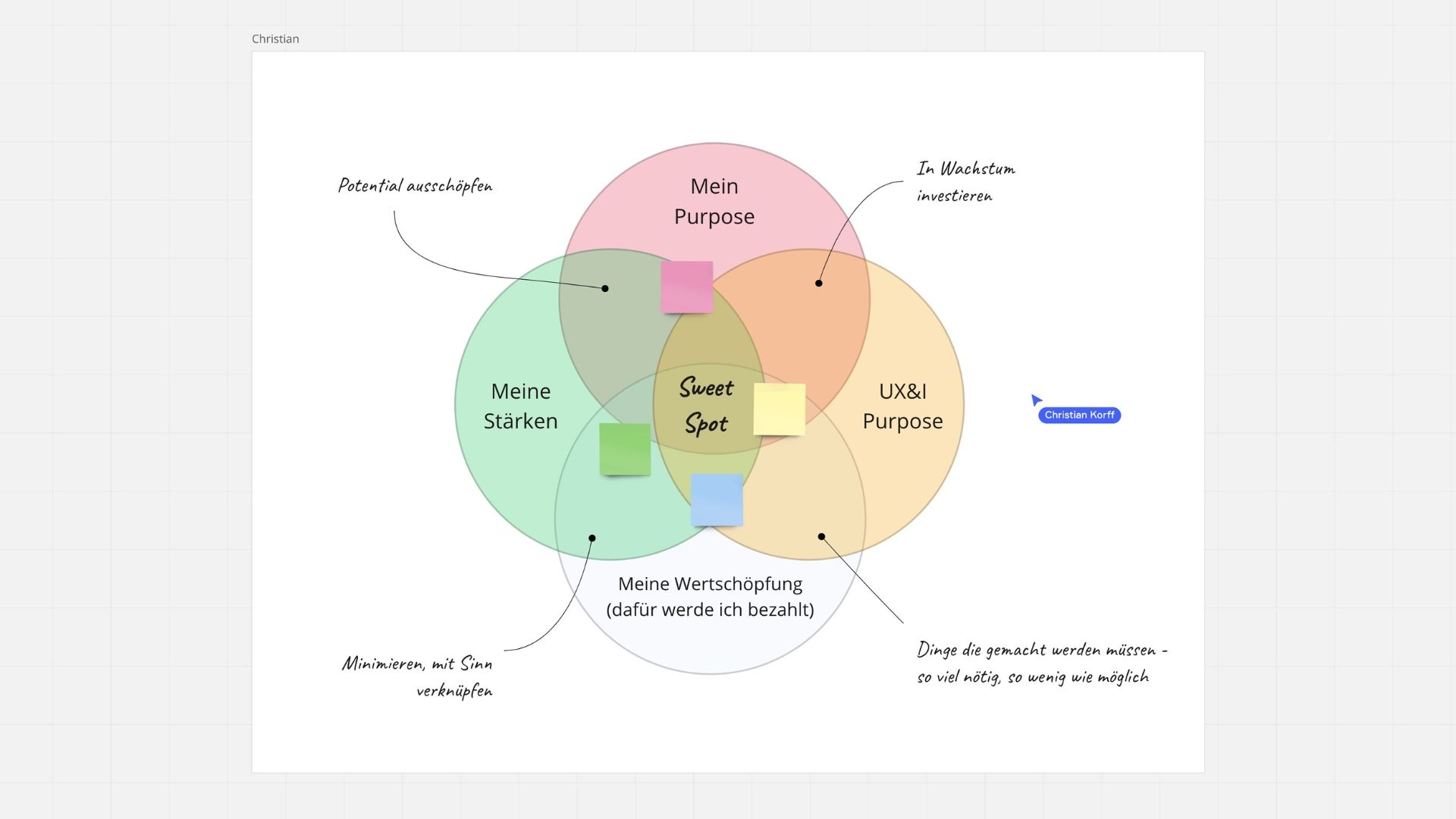
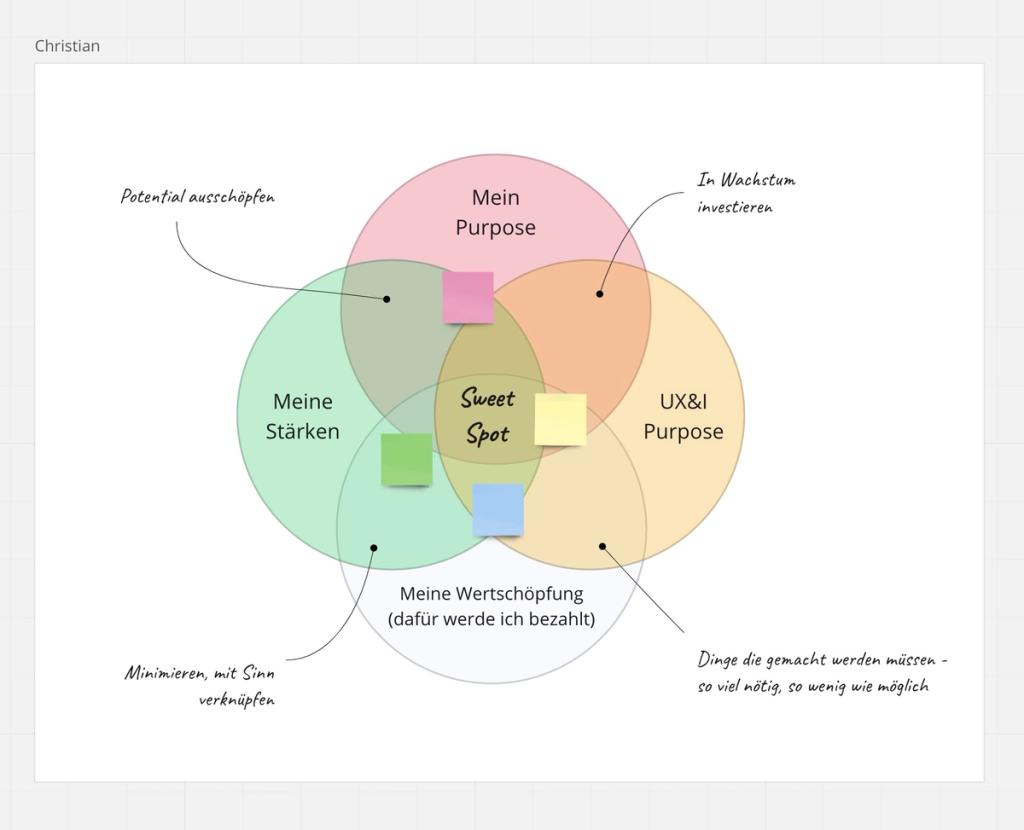
The 80-20 model gives us the time to explore topics unrelated to projects and set our own priorities: We spend 20% of our work time away from client projects, attending conferences, reading a good book, or working on our organization.
How does this benefit our clients?
Better results through motivation
We know and feel it: People who feel comfortable at work do a better job. Our satisfaction in the workplace boosts our intrinsic motivation and directly feeds into our projects. We’re much more willing to go the extra mile because we don’t see ourselves as company resources, but as self-determined individuals, who can do what they love and do well. And: Motivation is contagious.
Flexibility
We don’t see ourselves as individuals with fixed roles on the project, but rather as part of the whole. We keep the entire value creation process in mind and can leverage synergies, exchange ideas on specific topics, and get the best results for our clients. When the project requires it, we switch roles on our own initiative and are accustomed to taking the lead on tasks even outside our areas of expertise.
“We immerse ourselves in the client’s environment and then ask: What do you really need?”
Our open culture of embracing mistakes also allows us to be eager to experiment. Breaking out of old ways of thinking, trying new things, gaining insights, and developing innovative solutions.
Consulting instead of an agency
Our corporate structure requires us to take personal responsibility, and we naturally apply this approach to client projects as well. Just as we think outside the box internally, we feel responsible for finding holistic solutions to problems. This also means that we don’t simply carry out briefings. When necessary, we address the root of the problem and act freely and honestly. Since we are all senior professionals, we can draw on our experience to do so.
UX at the heart
By not just preaching a human-centered approach in our projects, but by living it ourselves every day, we can work authentically. We have internalized the UX Mindset and recognize its value in a wide variety of contexts. This enables us to apply and share UX knowledge effectively.
“I can only be a good consultant if I think in a human-centered way myself.”
What we need to keep in mind
Different needs
We’re a diverse group of people with very different personalities. While self-organization is a key focus even during the application process, not everyone is cut out for complete self-management. We have to take that into account. For example, the extent to which someone gets involved in topics outside their area of expertise, such as organizational development, never affects their salary.
Diffusion of responsibility
“Everyone is responsible” can sometimes be close to “no one is responsible.” The risk that tasks will be left undone without anyone noticing is slightly higher in self-organization. Just as in project work, we must also establish clear internal structures and find processes to reliably address priorities.
Lack of time
Self-organization doesn’t just happen on its own. It requires personal commitment, time, and a clear head in addition to project work. That’s why we’re only booked 80% of the time on client projects. Still, we need to keep a close eye on our scheduling (because: there’s no such thing as overtime).
Conclusion
The work environment has a huge impact on team satisfaction and the quality of results. The human-centered model works well in our organization on many levels, but we’re still a long way from reaching our goal. Time and again, we have to strike a balance, weigh our options, let go of certain things, and make changes. Here, too, the guiding principle helps us: “Good enough for now, safe enough to try.”
Our expert
“UX is only sustainable if everyone gets on board.” Christian Korff turns user experience into a team effort and particularly enjoys getting involved with complex systems.