Article
Past-Present-Future method: the launchpad for smooth projects


- By
- Alex Lenz & Thomas Petzold
- Reading time
- 5 minutes
- Updated
The initial phase of a project often offers a brief window of opportunity to set the project’s course, team collaboration, and ultimately the goal and the path to it on the right track from the very beginning. It is particularly important to ensure right from the start that all stakeholders share the same understanding of the project and its associated goals. Even minor uncertainties or misunderstandings during this phase can have a major impact on the entire project and cost a great deal of time and money.
We developed the Past-Present-Future Method to align teams and stakeholders from the very beginning and lay the groundwork for moving in the right direction together.
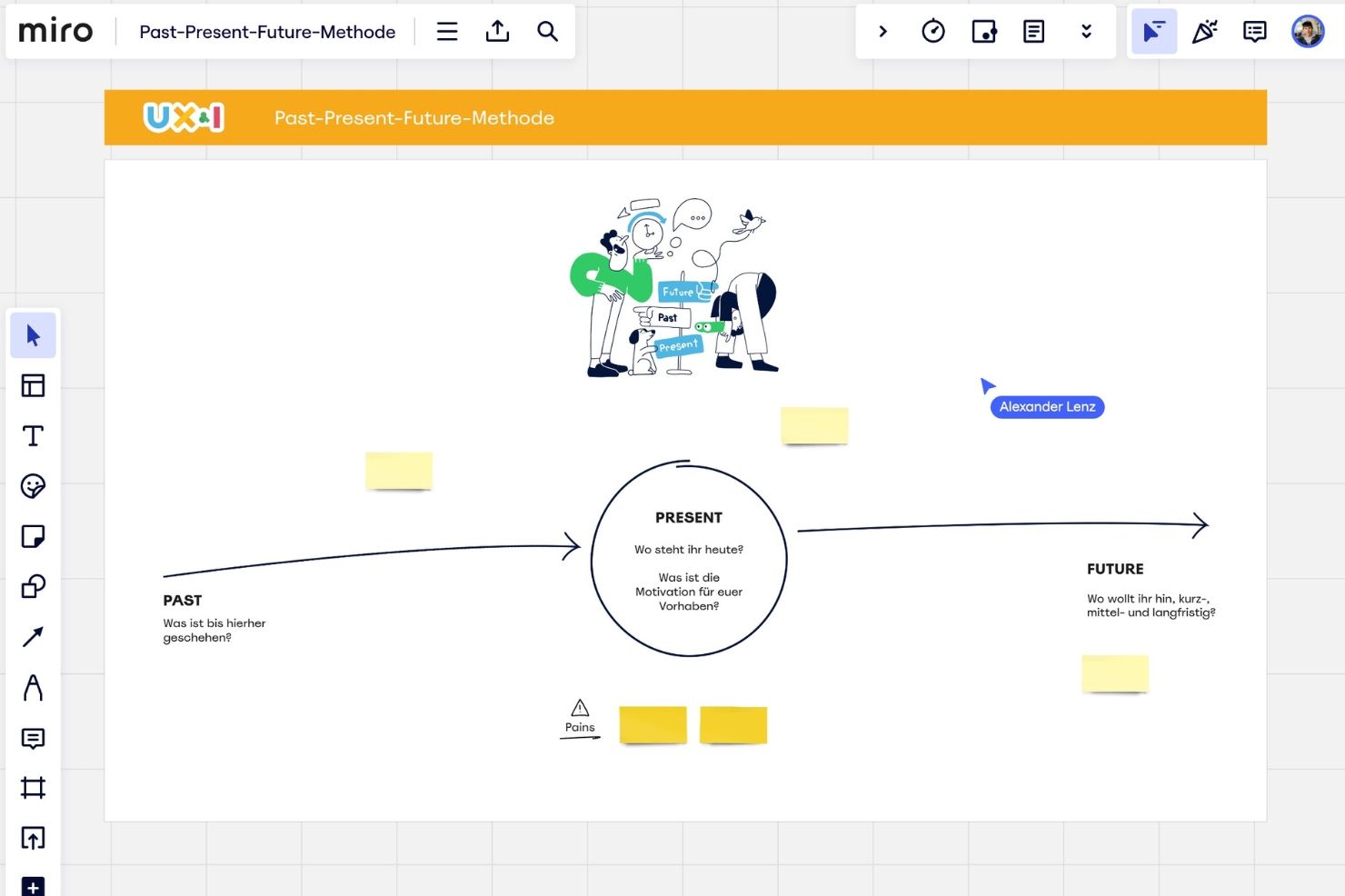
How does the Past-Present-Future method work?
The strength of this method: It’s both accessible and effective, and can be implemented without requiring a significant investment of time or effort.
Process
The key is for the team not to rush headlong into the future right away, but to pause at the right moments and take a look at the bigger picture, ideally with representatives from all relevant roles and stakeholders. Three time dimensions are central to this approach:
- Past: What has happened so far?
Ask yourselves: What led up to this project? What has already happened within the company that is relevant to the current challenge? What is the context within the company? - Present: Where are you today?
Identify what’s driving the project. What’s the current situation? You can also note down the current pain points that require a solution. - Future: Where is this journey headed?
What do you want to achieve together: immediately, in the near future, and in the long term? Talk it over and write it down.
Make sure you define from the outset exactly what is meant by “Past” and “Future” (short-, medium-, and long-term). What time frames are you referring to exactly? What makes sense in your specific context?
Together, you work through the framework from left to right, leaving sticky notes along the way, so that, as a side benefit, you end up with clear, easy-to-follow documentation that can be referenced at any time. Collecting the sticky notes can take the form of either an open discussion, during which the facilitator takes notes, or a brainwriting session, in which all participants take notes in silence and the results are then discussed as a group. Whether you choose discussion or brainwriting depends primarily on the group. With brainwriting, you can ensure that every voice is heard.
It’s important to cluster the sticky notes by topic at the end and to ensure that the resulting documentation is truly clear and organized. Visual connections between thematically related sticky notes can also be helpful.
When and how is this method useful?
The great thing is: You can generally use the Past-Present-Future Method at any time. It’s ideal right at the start of a project, as part of a recap, or even during the sales process when you want to find out exactly what’s needed during the initial project discussions.
Generally, a group size of four to a maximum of ten people is recommended. However, a one-on-one session is possible if it’s easier for organizational reasons. For example, you can run through the process with a single stakeholder and then review and expand on the results with the team, or vice versa. But a slightly larger group is best to stimulate discussion and achieve better results.
The method thrives on its simplicity; participants don’t need any preparation, and in just 30 to 60 minutes, you can already accomplish a lot together. This is another reason why the format is so widely accepted.
And then?
The results you’ve gathered provide the best foundation for a smooth project workflow and serve as an excellent starting point for other methods, such as Working Backwards, process diagrams, or roadmapping, that you can use to continue planning the project in a goal-oriented manner.
Advantages: Why is the Past-Present-Future Method (almost) always a good idea?
With minimal time investment and a simple implementation process, you can achieve several fundamental goals at once and put your project on a solid footing right from the start. Here are the key benefits:
- The foundation for team and project alignment
This is where the magic of the method lies: people start talking to one another. They ask themselves: Why are we sitting together today, and what do we want to achieve? Sometimes, team members don’t know beforehand where others stand, what differing perspectives exist, or where their understanding of shared goals diverges. Through discussion and written documentation, all of this is made explicit. Ideally, everyone will agree on the outcome at the end. - From Roles to People:
In our experience, people in projects are often thrown together haphazardly and hardly take the time to get to know one another. The Past-Present-Future Method helps people come together as a team. This is especially crucial in a remote setting. - Making
results visible Structured documentation makes it possible to revisit the foundation throughout the course of the project. It also makes onboarding new team members quick and easy. - Save
resources Since the method clarifies fundamental questions right at the start, it can be of great value throughout the entire project. It can eliminate misunderstandings from the outset and thus prevent unnecessary work down the line. For example, there have been instances where a discussion revealed that, much like in a jigsaw puzzle, piece 13 of 15 is actually piece 3 of 15. As a result, the project had to be planned entirely differently than originally anticipated.
“We often hear the phrase, “I’m glad we talked about that.””
From real-world experience: a tried-and-true favorite method
Another reason we love using this method is that it’s consistently well-received by our clients, who quickly recognize and appreciate its value. For example, we’ve used it time and again as part of a product discovery program at d.velop. In the video, Product Owner Malte Alsmeier explains why Past-Present-Future was his favorite method:
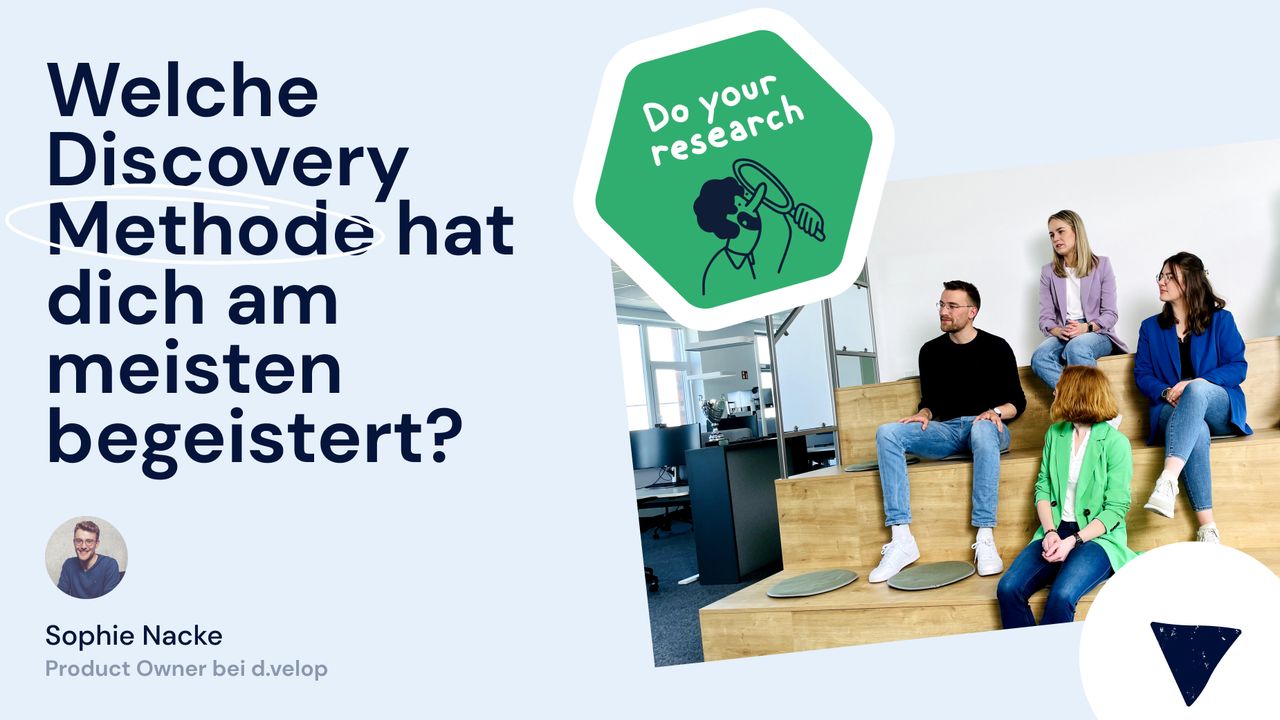
Loading this sends data to YouTube.
Learn more about the “Discovery Accelerator Program” at d.velop and how to sustainably embed Discovery Habits in the Showcase.
Conclusion
It’s really a no-brainer: In 30 to 60 minutes, you can lay the ideal foundation for your project and your team to reach your goals more easily together. As simple as the process sounds, participants are always enthusiastic and find the results helpful. Like any method, this one is just a guideline: feel free to adapt it to your specific situation so it works best for you. Have fun and good luck!
P.S.: We’re curious to hear about your experiences with the Past-Present-Future Method, feel free to share them with us on LinkedIn.
About the experts
Alex is one of the first UXIs, and brings over 10 years of product design experience along with a keen sense for team structures, planning, and processes.
Thomas has been working on user-centered projects for over two decades. His strength lies in aligning business outcomes with user needs and empowering teams.