Article
Discover alternative UX design approaches with needs cards

- Reading time
- 8 minutes
- Updated
According to Sarah Diefenbach, Eva Lenz, and Marc Hassenzahl, basic psychological needs serve as a kind of compass for designing digital products. They help you understand what drives users, on a deeper level, to use your product. The needs cards are a great tool for analyzing these fundamental needs.
In this article, I’d like to give you an overview of how you can work with needs cards and how they can provide you with important insights, especially when it comes to benchmarking.
The 8 (or 7) basic needs
Every person has basic psychological needs, and in principle, these can be met, including through digital applications. These needs are distinct from “user needs,” that is, the requirements and preferences that users have for your product.
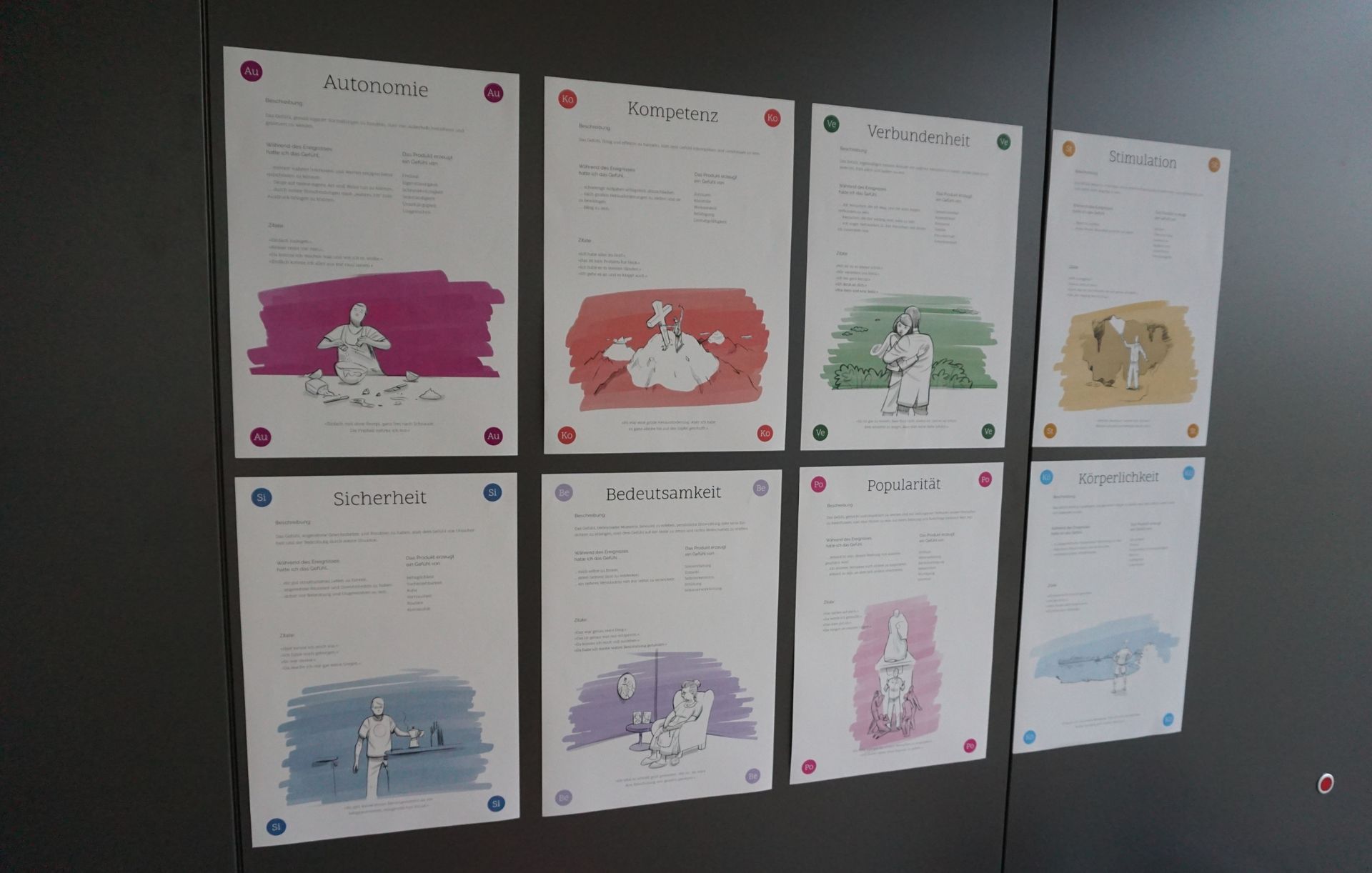
The following basic human needs are described on the needs cards:
1. Stimulation: Your product is used to satisfy a need for stimulation and new experiences. It should therefore continually pique users’ curiosity and keep them entertained.
2. Autonomy: This is about being able to make decisions for oneself. Freedom and independence are very important to users when using the product.
3. Competence: When interacting with the product, users want to feel effective and capable.
4. Connection: People use your product to feel part of a community or to be close to people who are important to them.
5. Popularity: People want to be recognized and appreciated. Features that allow users to share their achievements or contributions and receive recognition for them address this need.
6. Security: People long for security and predictability. A trustworthy product that makes users feel they’re in good hands is essential.
7. Significance: Products that allow users to make a contribution or join a community increase the perceived significance of their own actions.*
8. Physical well-being: Your product makes users feel healthy and fit.
*In a recent lively discussion on LinkedIn, some argued for removing “significance” from the group of basic needs. In UX thinking, significance is now viewed more as a derived need rather than an independent one.
The Arc of Happiness: Autonomy, relatedness, and competence
Three of the basic needs are most deeply rooted within us: Every person longs for autonomy, relatedness, and competence (hence “ARC”: Autonomy, Relatedness, and Competence). These needs are intrinsic, permanent, and cross-cultural. So if your product addresses one of these three, you’ve got it made, so to speak. It becomes easier to win people over to your product.
The extent to which the other four needs are relevant to people depends on social or demographic factors, as well as on the context in which a product is used.
How does this work in practice?
Successful digital products typically place a clear focus on one of the basic psychological needs. Here are three examples to illustrate this:
Facebook fosters a sense of connection: The grand old man of social media primarily satisfies the need to network and connect with others.
Instagram is all about popularity: With its focus on video and photo sharing, Instagram offers plenty of opportunities to present yourself in a positive light, collect likes, and feel your own popularity.
Spotify provides stimulation: The audio streaming service doesn’t just give its users what they explicitly ask for. Spotify takes every opportunity to inspire and entertain listeners, for example, through recommendations, personalized playlists, videos, artist radio, and more.
It’s important to note that, like most applications, these three examples don’t just serve a single basic need. Facebook fosters not only a sense of connection but also popularity, while Spotify also offers opportunities to feel connected. Nevertheless, one need should always be clearly in the foreground. It is the most relevant one, and it is the one that takes priority throughout the entire product design process. In my opinion, very large platforms with different use cases are an exception. For example, on the ADAC platform, one could distinguish between the community forum (need: connection) and the contract sign-up flow (need: security).
Why are basic needs so important for your product?
It’s worth finding out what fundamental needs your users have when they use your product, because:
- Understanding the most relevant basic need helps you prioritize features. Which features do your users really need most urgently?
- At the same time, it also makes it easier for you to make design decisions. How should the feature feel? The core need provides you with clear guidelines that you can use to align and justify your designs.
- Basic needs are a gateway to your users. They help you gain a deeper understanding of their desires, emotions, aversions, and so on. This is particularly helpful when dealing with otherwise quite heterogeneous target audiences.
- You can examine how other products address this basic need and possibly adopt some of their patterns. More on that in a moment.
What basic need does your product address?
So how do you identify the core need of your user group in your specific context?
First, what doesn’t work: You won’t discover it through a personality analysis of your user base. Because it’s always about what matters to people in the context of your product. Why do they open your app, that is, what basic need drives them? Here, I make a distinction between users’ intentions and their basic needs. When I open Outlook, I want to create an appointment or see what’s coming up next. The basic need being met here is most likely competence: you want to feel capable when using it, and definitely not incompetent.
Qualitative research methods are ideal for identifying your users’ most important basic needs.
Use the needs cards with the questionnaire
We like to follow the questionnaire that accompanies the needs cards developed by Diefenbach et al. Using this questionnaire, you can assess the extent to which users experienced certain emotions while using your product.
Ask your users to rate the statements in the questionnaire. This always follows the pattern: “While I was using app XY, I felt XY.” For example: “While I was writing a post on LinkedIn, I felt like someone whose opinion is valued by others.” If many users agree with this statement, you can conclude that popularity is an important basic need when using LinkedIn.
Check whether you need to adapt the questionnaire to your specific research question. Perhaps you can omit a few of the statements because they’re highly unlikely to apply in the context of your product. Maybe you’ll add a few variations to better identify specific needs. And as mentioned, significance, which the questionnaire still assesses, is no longer considered one of the basic needs.
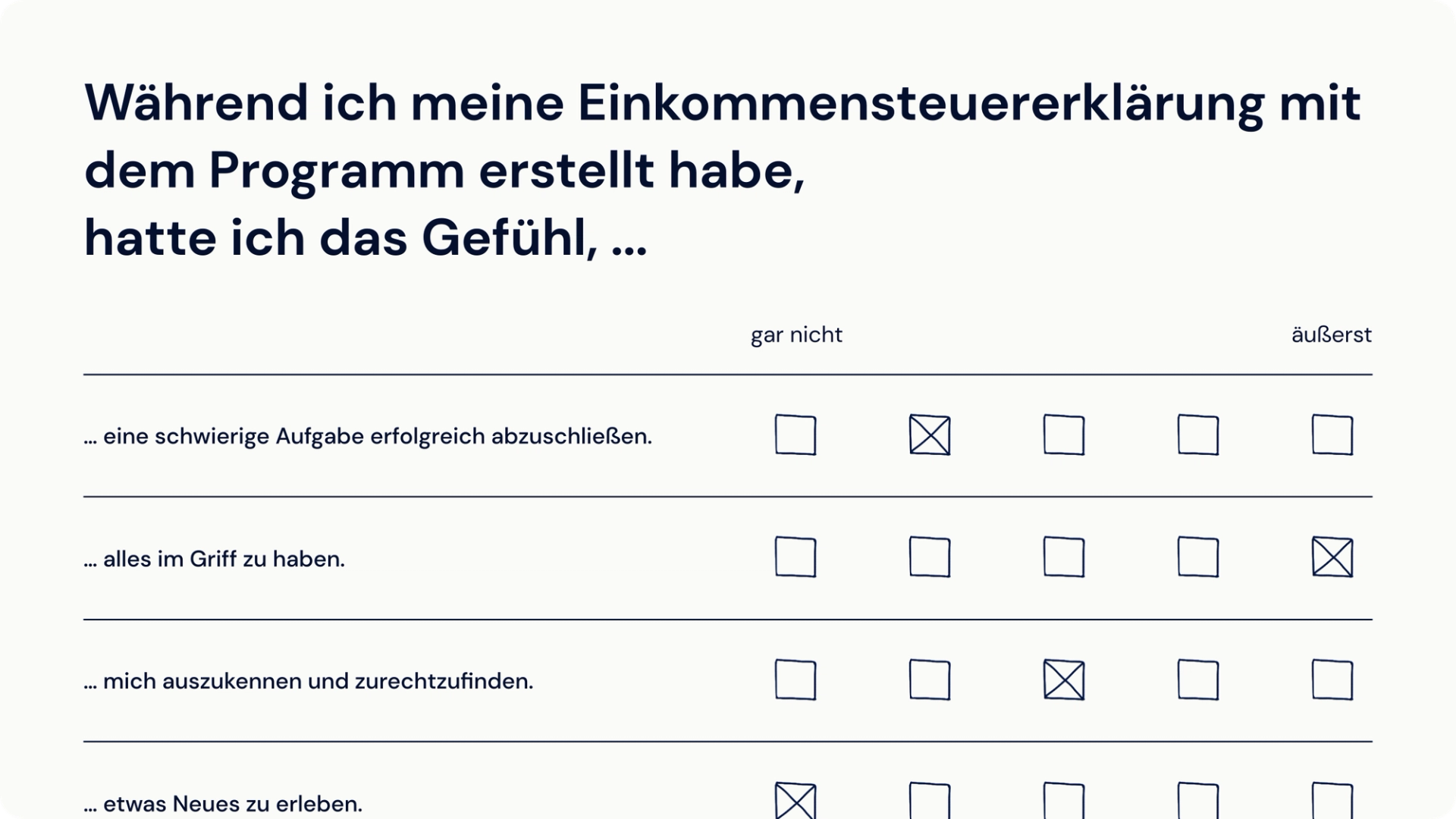
Here is an excerpt from a fictional questionnaire. The first two statements target the need for competence, while the third targets security: by including several statements related to these two needs, we can determine which one plays a greater role. The fourth statement targets the need for stimulation: we can actually rule out this need in the context of our product and, if necessary, use it only to lighten the mood of the questionnaire and the participants a bit.
To use the questionnaire, you’ll need either a finished product or at least a fairly advanced prototype. That’s the only way users can assess how they felt while using it. You’ll also need a tailored research concept, because a product isn’t always used exactly as intended or for the purpose for which it was originally built.
Review existing research
As an alternative or supplement to surveys, you can also derive needs from existing research. To do this, check statements your users have already made about the product for similarities to the phrasing in the questionnaire or to the quotes on the needs cards themselves, such as “I know my way around here” or “Just like always,” which indicate the (fulfilled) need for security. Similarly, you can use negative statements to recognize that your product isn’t meeting a relevant need. If users express frustration that they couldn’t use your product the way they wanted to, or that they felt controlled by an external force, this could be a sign that autonomy is important to them, but your product doesn’t (yet) provide them with that autonomy.
How to use basic needs for benchmarking
Insights into your users’ core needs pay off on many levels; I find them particularly valuable when it comes to benchmarking. Here, they allow you to identify specific patterns that can also help your product create happier users.
Here’s the best way to proceed:
1. Find other products that fulfill the same basic need
Think of contexts (regardless of your industry) in which users might have the need that’s relevant to you, and validate this using the questionnaire. On the needs cards, you’ll find quotes that you can use for reverse engineering. So, for example, if your application is a health insurance app and you’ve identified the need “security,” you can consider the contexts in which security plays a role and examine corresponding products. But be sure to also take into account the various user goals and the areas within the application where users navigate. Even if an app is about stimulation, for instance, stimulation is not the users’ fundamental need when they’re entering credit card information in that app.
2. Identify patterns for this basic need
Now you can analyze the relevant applications. Are there typical patterns, colors, or a specific design language? Do you notice a recurring tone in the UX writing? Which of these elements might also be suitable for your product?

3. Apply the patterns or principles to your product
The user experience benefits from predictability and familiarity. If patterns have emerged for certain basic needs, which you identified during benchmarking, it’s a good idea to incorporate them directly or indirectly into your product.
Take security as an example: In the contexts of your product where users have a strong need for security, it’s especially important to work with familiar patterns from that context. After all, security is also supported by the predictability of interactions: clicking buttons shouldn’t come as a surprise. UX writing plays a crucial role here, especially when dealing with errors, whether system-related or user-induced. The right tone and clear steps to resolve the problem can make the difference between a good and a very bad experience. In design, transitions, animations, and perhaps even color choices should convey calm and continuity to instill a sense of security.
Conclusion
Basic psychological needs are central to the user experience because they directly influence user satisfaction and engagement. Understanding them not only helps you better understand your users and tailor your product accordingly, but also allows you to identify common patterns during benchmarking and provides you with guidance and inspiration. Just give it a try. And remember: Working with the needs cards isn’t a holistic scientific research project. Use the method as a pragmatic, low-barrier tool with a big impact.
About the expert
For more than 12 years, Nadine has been passionate about complexity and has been breaking it down for clients, teams, and users, in a pragmatic way and with snappy headlines.