Article
Working more efficiently: a cleanup for the backlog

- By
- Jan Herzog
- Reading time
- 6 minutes
- Updated
tl;dr
A collection of methods and ideas for efficiently creating value at a rapid pace in challenging project situations.
Bang.
Oh. My. God. Everything’s falling apart, no one’s in the office, clients are screaming “ugh,” how the heck is this whole remote work and furlough thing even supposed to work and… yeah. It’s tough. But between us, how is all this fundamentally different from every other day of the year? Things pile up, but the underlying problems remain exactly what they’ve always been:
- No time
- Scope is too broad
- Not enough people
- Insufficient budget
- It would be nice to have more customers
The difference is: it’s more concentrated, and it’s tougher than usual. Experience shows that the more difficult the situation, the more we tend to act in an unstructured way, viewing many things as equally important and treating them exactly that way. There’s still a difference between “building new things” and “cleaning up old ones,” and that’s exactly what we shouldn’t lose sight of.
So how do we get our thoughts in order? How can we rationally structure our panic mode while still generating profit in the process? Let’s take a look.
Set goals and evaluate them relative to one another
We usually have a lot on our plate:
- Further develop the product (usually with the goal of “growth”)
- Improve existing product features, make them faster and better; clean up (optimize) the code
- Test and validate ideas (experiment)
At first glance, it might seem obvious to just cut things out here: “We really don’t have time to clean up right now.” But let’s pause for a moment. Can we really assess that just yet?
When we start a project, the first thing we do is define the vision. We take a moment to describe “where we want to go,” and not necessarily just “where we want to go during the crisis,” but globally, in general, over the next year: think big.
Why?
Intuitively, we usually assume that ideas have to be worked through one after another. But that’s not necessarily the case: perhaps even a single part of an idea holds value worth pursuing. We can only figure that out, however, if we sketch out the idea as broadly as possible, yet in enough detail, so that everyone involved has the same understanding of it (user story mapping would be one way to approach this). So: Let’s discuss this.
Let’s say we’ve held a user story mapping session; we’ll most likely realize during the process that we’ve come up with quite a few epics. So where do we start?
Expensive vs. worthwhile
It’s crucial to know how expensive my ideas are and how much value they add, which is why it’s a good idea to think about costs and benefits early on. Fortunately, we’ve done our mapping with developers, designers, and… well, everyone involved in the process, so we can break that down a little better.
I like to use the simplest scoring system: a scale from 1 to 5 for the effort involved and another score for the value generated (feel free to check it out here).
Next comes my favorite exercise.
Card sorting
We’ve reached the point where “everything is important.” Different stakeholders, different perspectives, everything is important.
Card sorting isn’t complicated, which is one of the reasons I like it so much: Every identified epic has now been scrutinized, and everyone has an idea of what lies behind the facade. We now take the epics and hang them off to the side in a cluster. We choose one person to start, and that person pins all the cards in the order they think makes the most sense. Important ones at the top, less important ones at the bottom. The next person then rearranges all the cards, if desired. The only difference is that every time a card is reordered, a line is drawn through it. The important thing here is: no discussion. First, everyone is allowed to present their perspective so that all opinions and views are known to everyone.
The most difficult part of this is usually this: Don’t cut corners. Doing things side by side doesn’t work: two things can’t be equally important, because you can only work through them one after the other. Pipelining will happen naturally anyway, since not everyone can work on everything at once, but priorities can only be arranged in sequence. Everyone shares the responsibility for ensuring this is followed, especially managers and decision-makers.
It’s a good idea to start another round. This will likely result in a card that’s already been sorted being re-sorted soon, bringing the reasons behind that decision back into focus. Again: This isn’t a discussion; one person speaks after the other, depending on whose turn it is. We go through two or three rounds like this until we feel that the positions aren’t changing much anymore. There are two possible scenarios for how this might all end:
- No one wants to reorder things anymore: I guess that’s good enough.
- Certain cards are swapped out repeatedly: In that case, a discussion will be initiated right here in the next step.
The interesting thing here is: The more marks there are on the cards, the more discussion we need to have. The reasoning behind this is clear: If we hadn’t done this, the discussion would have been much broader. This allowed us to stay focused.
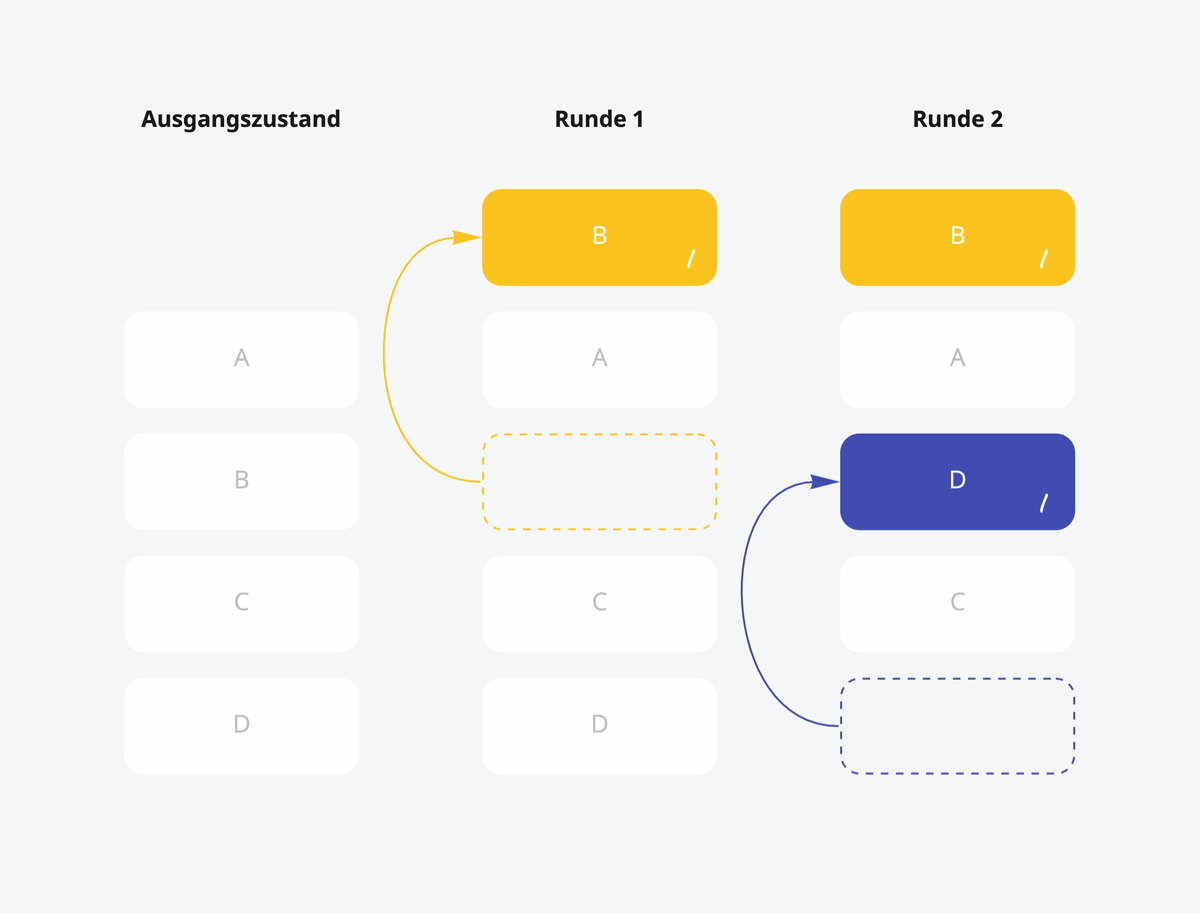
Case 1 is ideal, but rather rare. Case 2 opens up a discussion on specific topics. Keyword: focus. In this case, a moderated, time-boxed format such as Lean Coffee is recommended.
The result of this exercise is a list of items sorted by priority, for which we have identified the effort required and the impact.
Cut, cut, cut: create value quickly
Charmingly enough, the journey here brings you one thing: a pair of scissors. It’s not about fully fleshing out every epic or every idea: it’s about working on the one piece that promises to deliver value.
The smaller the tasks we tackle, the sooner we create value. In times of intense pressure, we need quick results, not complete ones.
So if any of your colleagues start thinking, “I have an idea on how to do this faster…”: Listen, grab a pair of scissors, and toss it in the trash.
Overhead = death
We’ve already clarified the questions of “what” and “when” to do it. The remaining question of “how” to do it is still open and is usually left up to the subject-matter teams. Aspects such as trust and autonomy, which are extremely important, especially when working from home, are cornerstones of rapid progress, but even if all of that has been satisfactorily resolved, there’s one thing you should always keep in mind:
Overhead = death.
It sounds harsh, but it can save projects. The question “Do I really need this?” should be on everyone’s mind, especially when it comes to tools.
So now we have a prioritized list of items that we all support as a team. The next step is to break things down into the smallest possible iterations and eliminate the items that currently require resources we don’t have. When writing tickets, the question “Can this be broken down even further?” should always be at the forefront, because time is of the essence and resources are limited, so the scope is the only thing that can and must vary.
Conclusion
You could summarize the process something like this: Ideally, everyone shares the vision: the big picture: with one another. Everyone is brought on board so that everyone is on the same page. Together, you discuss the importance of various product components so that everyone is moving in the same direction. Spend little time on details up front; work with concepts, thick markers, and paper: make the most of your time, and move quickly and agilely.
This gives us the opportunity to work through the items from top to bottom, according to their assigned priority, and achieve results quickly. Now, just add a dash of trust that the others know what they’re doing, and, while not everything, at least all the relevant tasks will be taken care of.
About the expert
Jan helps companies establish UX frameworks. After several years working at Berlin-based startups, where he gained experience with rapid, iterative product development and international teams, he is now bringing his expertise in UX architecture, e-commerce, and user behavior analysis to the German market.