Interview
From usability reviews to a dedicated UX/UI department: An interview with Kyra, team lead at One Data


- By
- Alina Binzer & Kyra Bollmeyer
- Reading time
- 7 minutes
- Updated
In this interview, Kyra Bollmeyer explains how ONE DATA’s internal UX resource grew from scratch to its own dedicated UX/UI chapter in just three years, and how UX methodology fueled the product vision. Founded in 2013, the tech company ONE DATA helps transform data into business value and bring data products to market quickly. The 2021 Gartner® Report lists the company as one of five “Cool Vendors for AI Core Technologies.”

Kyra Bollmeyer
UX designer and lead at ONE DATA

Kyra is a UX designer and team lead at One Data. Since the UX team was founded, she has been supporting the software development team in continuously improving the user experience. Topics such as leadership and DE&I are particularly close to her heart. However, when Kyra isn’t busy mapping out various customer journeys, she enjoys traveling herself and cruising through Munich on her longboard.
First steps
Kyra, when did UX first become an issue at your company?
UX has actually always been a topic for us, but unfortunately, it’s fair to say that in the beginning, it didn’t receive the attention it deserved. To understand this, you need to know that our product, ONE DATA, a data product builder, originated from contract work. The software became increasingly complex, and before anyone had a chance to give serious thought to the interface, the focus was first and foremost on the technical foundation. The technology framework, tech stack, and basic software functionalities had to be defined. At the time, there were no dedicated UX specialists on the team. So the developers initially used Google’s Material Design as a framework for everything. However, that’s more suited for apps than for complex software. We realized more and more clearly that we needed to focus more on usability. The navigation, for example, was confusing,
and the design lacked consistency in terms of a unified corporate identity. As part of a usability initiative, UX&I was then commissioned to take a closer look at ONE DATA’s UX.
How did the work on usability get started?
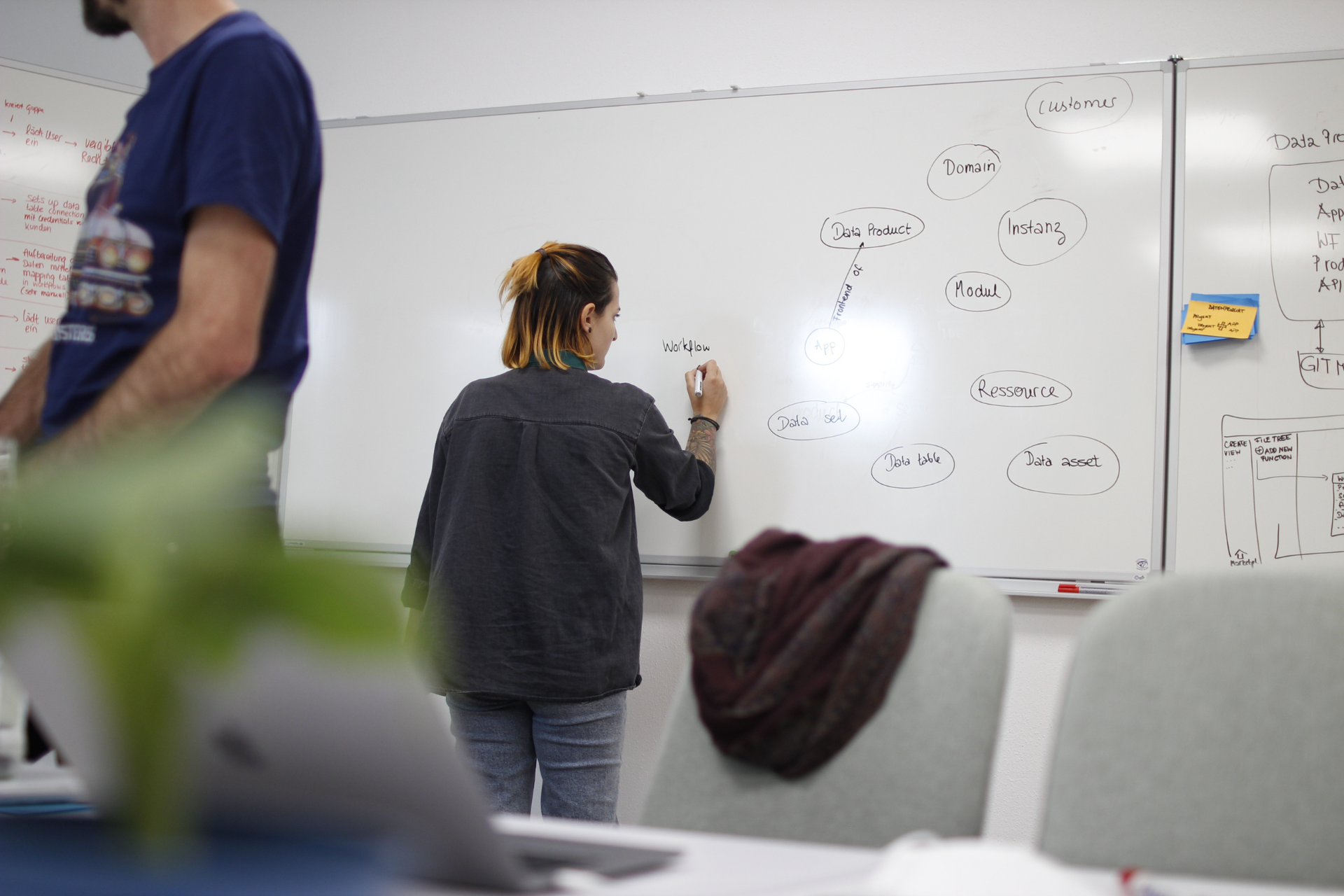
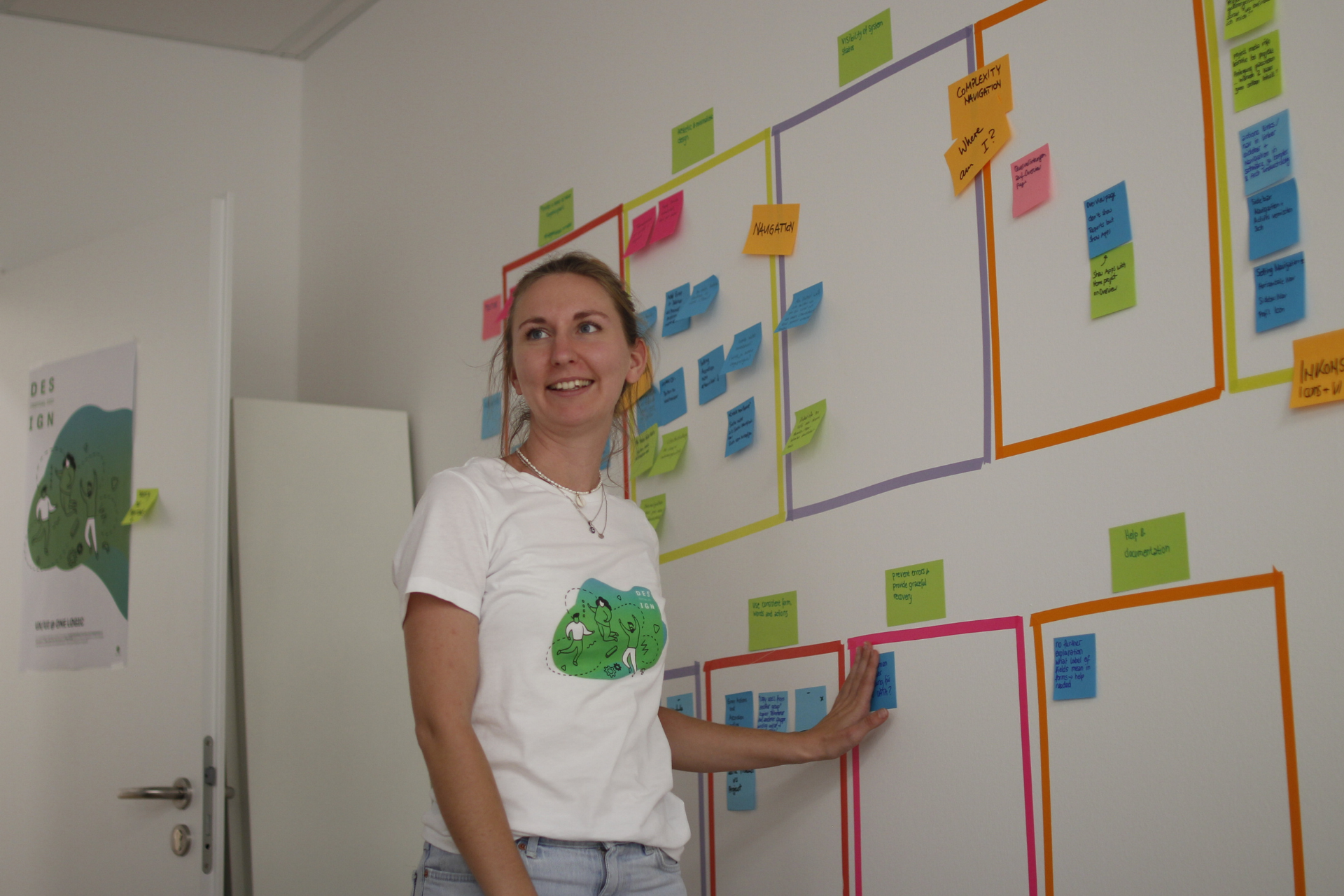
It all started before I joined the company with lots of red Post-its in a workshop. And we began with small steps. After a heuristic evaluation, we worked with UX&I to define the work packages and tackled them step by step. The spirit of UX&I was a great fit with our culture. We collaborated on specific interface topics; a UI designer from UX&I joined us quickly, and later I joined as well. Together, we laid the groundwork for a style guide; the whole concept was broken down into components and implemented in the front end. Kanban Flight Levels helped us with organization and communication. To establish a shared understanding across the entire team and make strategic progress, we used Wardley Maps. Instead of planning out the next five years in detail right away, we refined our product vision and worked through the individual packages one by one.
Were there any overarching UX goals as well?
Yes, we wanted to consistently embed a user-centric approach, ideally in all work processes and throughout the entire company. Gradually, the focus on interface issues evolved into general product coaching. In workshops on individual UX components, we worked to establish a UX mindset. User story mapping was one method we used to identify and specifically address user needs. At the same time, we also began building our own UX/UI team.
We defined roles, looked for processes that incorporated the UX perspective, and sought out suitable colleagues.
Why have a dedicated team?
It gradually became clear that external UX support offered tremendous added value and helped drive our product forward. Naturally, management then wanted to bring even more of that in-house and build up our own strong capabilities in this important area. Calls for better usability grew louder, and there was still a lot to do. Before long, there were more of us UX/UI designers in the company. Back then, we were actually already working directly within individual development teams. In the process, we realized:
It still makes perfect sense to connect with your UX buddies. The idea of a UX team was born, but we quickly realized that we didn’t want to be a silo: we needed to remain part of the development teams. That’s how we ended up becoming a chapter. As a chapter, we now span all development teams and can embed the UX perspective everywhere, while still organizing ourselves internally.
The organization as a UX/UI hub
So you now have your own in-house “UX/UI Hub”? How is it organized?
Overall, One Data is structured into several departments. We, as the UX Chapter, are part of the Software Development Department. This department is further divided into our product, ONE DATA, and our projects. Within the product, there are various development teams. Each of us UX professionals is part of one of these teams and supports the developers. There are also guilds for overarching topics, such as our Diversity & Inclusion Committee. Anyone can participate in the guilds.
Within the development teams, every UX professional has their own areas of focus that they drive forward in collaboration with developers, product managers, and testers. To ensure we stay connected and maintain consistency in both UX and UI, we meet every day for the UX/UI Daily. We discuss what issues have come up, whether someone needs a peer review, or if we should add new components to our library, topics that may not be exciting for the developers but are very important to us. For peer reviews, we have assigned UX buddies, whom we designate at the start of the project. So you always have a partner within the UX/UI team you can turn to when you need help or are running out of creative ideas. This also helps with consistency: four eyes are better than two. For peer reviews, we usually have a quick call or leave comments in Abstract; that’s the fastest way, and it ensures no background information gets lost.
Challenges
What challenges did you face on your journey toward becoming a user-centered product and company?
There were plenty of stumbling blocks, especially in the beginning. At first, the focus was clearly on the product’s functionality and speed. Improving usability and UX was, and still is, explicitly desired by management. But in the early days, that was also the first thing to fall by the wayside when time and budget were tight. And the developers, too, had to learn that UX support could be helpful. We help combine both strengths, tech and UX, while making sure not to lose sight of users’ problems along the way. Because good UX is no longer a matter of budget and time, quite the opposite. These days, many colleagues actively reach out to us when they need support with UX or UI issues. As for our product itself, the challenge here lay in its complexity and extensive feature set. Complex technical relationships had to be made understandable and usable.
Current situation
What has changed since the first usability reviews?
We currently have seven full-time in-house UX/UI experts. User-centered design is an integral part of our company culture. We’ve really hit our stride in recent years; today, UX&I primarily supports us with keynote presentations on UX topics or when we face capacity bottlenecks. The UX/UI team now also includes a management perspective with lead roles, similar to those in product management. UX methods are integrated into many of our processes, such as standardization. Initially, we had many inconsistencies; today, we work strictly according to a style guide maintained by a dedicated team. Our developers also use the style guide, which not only strengthens consistency but also fosters better mutual understanding. If something is unclear, we ask for clarification. The code style guide and UI style guide are synchronized. Text guidelines are planned for the near future. UX has also been incorporated into quality assurance; at the end of the process, a UX specialist always reviews the results and checks them from the user’s perspective. Have we truly solved the initial problem?
Speaking of the user’s perspective, what methods help you with that?
Even though the topic of deep tech can be very confusing and technical, we shouldn’t forget why we’re actually doing this. It always starts with the user’s actual problem, which needs to be solved. This problem can quickly be forgotten in such a highly technical environment. And, of course, the guiding principle “You are not the user”: we’ve really taken that to heart. We conduct user tests as early and as often as possible, and we also engage with users on a small scale even in the preliminary stages. And we work extensively with user flows. This allows us to make user-centered decisions.
How has your product, ONE DATA, evolved?
The focus is now on the product vision. In the beginning, we were very caught up in project-based work. We were primarily busy trying to keep up with our clients’ requests and working through their requirements. We’ve learned to say no sometimes and to drive our own roadmap forward.
Goals
What’s next for the UX/UI chapter?
Our goal is to take a generalist approach and gain comprehensive expertise across a wide range of UX topics. For example, when it comes to research and conducting user interviews, none of us should panic. We want to build a broad foundation in UX topics so that we can cover everything effectively within the chapter. That’s why a desire to keep growing is so important. Our long-term goal is to be completely self-sufficient in the field of user experience. There’s plenty to do, and we’re looking for talented people who aren’t intimidated by tech and code. We also need more women in tech 😅. I always try to inspire others. Back then, I never would have thought I’d end up pursuing computer science. Now I can say it was one of the best decisions I’ve ever made. If you specialize in this field, all doors are open to you.
You can find out more about One Data’s UX success story in the Showcase.
By the way, there are open positions on Kyra’s team 👉 Visit One Data’s careers page.
Our expert

Alina Binzer
Marketer
Alina comes from the agency and startup scene and is passionate about inbound marketing that truly puts people first. She has been working at UX&I since 2020.
About the expert
Alina comes from the agency and startup scene and is passionate about inbound marketing that truly puts people first. She has been working at UX&I since 2020.