Article
Feature Overload in SAFe? Here’s how to make better product decisions

- Reading time
- 7 minutes
- Updated
The SAFe® (Scaled Agile Framework®) agile framework is designed to help companies make complex product development more agile and customer-focused. But in practice, the reality is often quite different: Features are developed for months on end, only to offer little to no added value in the end. Why does this happen, and how can it be prevented?
Why SAFe often doesn’t lead to the right developments
SAFe® is based on agile principles, but one crucial phase is often overlooked: exploring the problem space and defining the problems worth solving. The Double Diamond model from Design Thinking describes two phases:
- Problem space: What is the actual problem that needs to be solved?
- Solution space: What does the best possible solution look like?
While the second diamond: solution development, works well in many SAFe® projects, the first phase often lacks the necessary depth. It’s a common pattern seen in companies: decisions about developing new features are often based on internal assumptions rather than on valid data or real user needs and problems. As a result, teams are tasked with developing solutions based on these assumptions. This leads to features that are rarely used later on because they don’t solve a real user problem and, consequently, don’t make processes more efficient, but in the worst case, actually make them more complex.
Prefer to watch instead of read?
We’ve recorded a webinar on the topic of this article. In it, you’ll learn why SAFe® often fails and how to make better product decisions.
Loading this sends data to YouTube.
Integrate strategic research as an integral part of SAFe
To ensure that SAFe® works not only efficiently but also effectively, a structured approach to problem identification is needed. This requires systematically integrating strategic research into decision-making processes.
Three key steps for better research: real user research instead of expert input
1. User research as the foundation for decisions
Every successful product development begins with a deep understanding of the users. But product managers and other decision-makers often rely on assumptions or insufficient data. A robust research process incorporates both qualitative and quantitative methods, such as interviews, surveys, and data analysis. The goal isn’t just to capture what users do, but, more importantly, why they do it. This allows you to identify real pain points, which can then inform decisions about what to develop.
2. View user research as a continuous process
Research isn’t a one-time event at the start of a project, but rather an ongoing process that ensures product development is based on users’ actual needs, using a variety of methods throughout all phases of product development and at all levels of the SAFe® framework.
In practice, this might look like this: at the lowest level, within the development teams, regular usability tests are conducted using prototypes and initial development results. At the same time, at the levels above, context interviews are conducted with users to understand their work processes and identify the problems and challenges that exist at any given time.
Each level in SAFe® should therefore conduct user research using the appropriate methods based on its level of involvement in the project.
3. Centralize the analysis of user research results
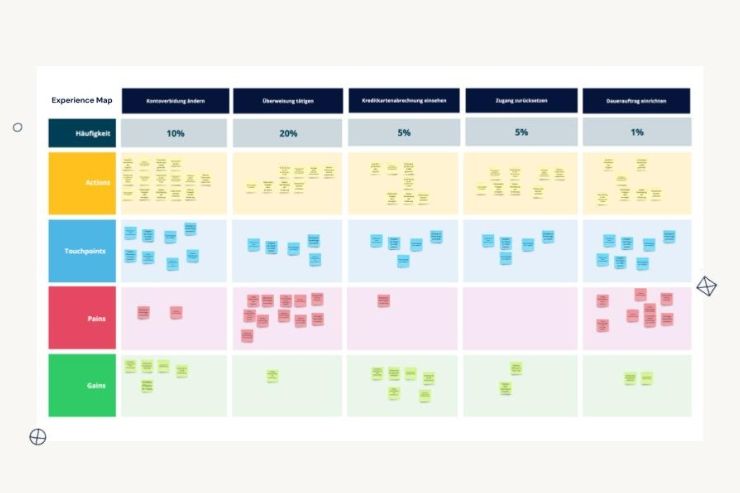
To ensure that the results of user research can be incorporated into product development at all levels, it’s essential that they be compiled and made accessible in a central location and in appropriate formats. It’s important that insights gathered from different sources and by different people find their way into these centrally maintained formats. User tests conducted at the development team level often reveal insights that are relevant to users’ overall experience with the entire product portfolio. Therefore, these insights should also be incorporated into an Experience Map and User Journey that take this overall experience into account. This allows these insights to be factored into decision-making at higher levels, ensuring that this knowledge does not remain confined to the development team where it was originally gathered.
A new mindset for SAFe projects
However, the research activities mentioned above and the analysis of the results require new ways of thinking and working, as well as breaking away from, or expanding, the established processes and roles in SAFe®. Without this, it will likely not work, since the existing roles, especially at the higher levels, often lack the necessary skills and, above all, do not have the capacity to take on these additional tasks.
Product triads at every level
In recent years, a concept has emerged in product development that is now considered a key factor in the success of products.
This is an interdisciplinary team that covers the three areas of expertise: Business, Tech, and User, and works together to make product decisions based on the respective insights and requirements of these three areas.
Such interdisciplinary teams, or “product trios,” as Teresa Torres calls them, are not provided for in SAFe® in its purest form, or are only provided for at the lowest level of the development teams.
To ensure that the research activities described above can be carried out at the respective levels, and, above all, that the insights gained from them can be incorporated into product decisions, product trios should be introduced at all levels in SAFe®. This means that development teams should include UX designers, and that, in addition to product managers and system architects, UX managers should round out the product trio at the ART (Agile Release Train) level. Similarly, at the enterprise solution level, there should be UX managers alongside solution managers and solution architects, and, ideally, a corresponding UX role at the Lean Portfolio Management level as well.
If you’d like to learn how Teresa Torres describes product trios, we recommend this video (YouTube): What’s a product trio?
Adapt SAFe processes to a new research strategy
To ensure that research findings from all levels can be collected and made accessible in a central location, it is essential to maintain two-way communication between the various teams at different levels. This requires forums where individuals can share their insights. And it requires designated individuals to ensure that all insights are incorporated into the appropriate documentation formats and made accessible.
It’s important that information flows in all directions. This means that UX designers working on the development team and conducting usability tests there can share their findings with the highest levels of SAFe® while also receiving information from those higher levels to help them design new features.
Moving away from internal assumptions toward data-driven decisions
The research findings, which have been gathered and centrally documented, provide the perfect foundation for making decisions that bring real added value to the product and ensure its success. These days, decisions about which features to develop are usually made from a purely business perspective. When implementing these features, organizations often rely on so-called subject matter experts who were removed from their operational user roles at the start of the project and now serve as advisors to the developers, providing process expertise.
The problem with this approach is that decisions made purely from a business perspective usually fail to address the actual needs of future users; instead, they merely attempt to translate processes into a digital format. At the same time, even the subject matter experts at the development team level fail to bring about genuine innovation, as they focus on the old systems they are familiar with from their time in operations. As a result, only old solutions are reproduced: these may be built on a new technical foundation, but they are very similar in use to their predecessor systems and, accordingly, do not make their users more efficient.
Instead, the newly introduced UX roles must be involved at the higher levels. This allows the findings from the research to be incorporated into the decision-making process. Genuine collaboration among the three distinct perspectives: business, tech, and users, makes it possible to align these three areas and make feature decisions that, on the one hand, provide real value to users and, on the other hand, also take business needs and technical requirements into account.
If UX designers are given sufficient freedom to design solutions at the development team level, true innovations can emerge that bring about lasting, positive changes to users’ work processes.
Conclusion: SAFe needs a genuine user focus
As a framework, SAFe® offers many valuable structures for scaling agile practices. But that alone isn’t enough to develop truly user-centered and successful products. Without the consistent integration of strategic user research, SAFe® risks turning into nothing more than a feature factory, where assumptions dominate instead of insights.
The key lies in establishing research as a continuous, structured, and centrally anchored component of SAFe®: at all levels, with the appropriate roles and processes. Only then can well-informed decisions be made that align business goals with genuine user needs. This requires new ways of thinking, new forms of collaboration, and a genuine shift in how priorities are set.
When you successfully incorporate user perspectives into product development in a systematic way, you create solutions that not only work but also deliver real value, for users and for the company. This makes SAFe® an effective tool for building truly better products.
Our expert
“UX is only sustainable if everyone gets on board.” Christian Korff turns user experience into a team effort and particularly enjoys getting involved with complex systems.