Article
Hands vs. Brains: Jared Spool on UX Strategy

- Reading time
- 7 minutes
- Updated
What happens when an international UX heavyweight stops by UX&I and discusses beans and noses, hands and brains with us? In this article, we summarize for you what Jared Spool shared about UX strategy at our Flipper Friday event and why, in his view, there are two fundamental distinctions among UX service providers.
Why Jared Spool?
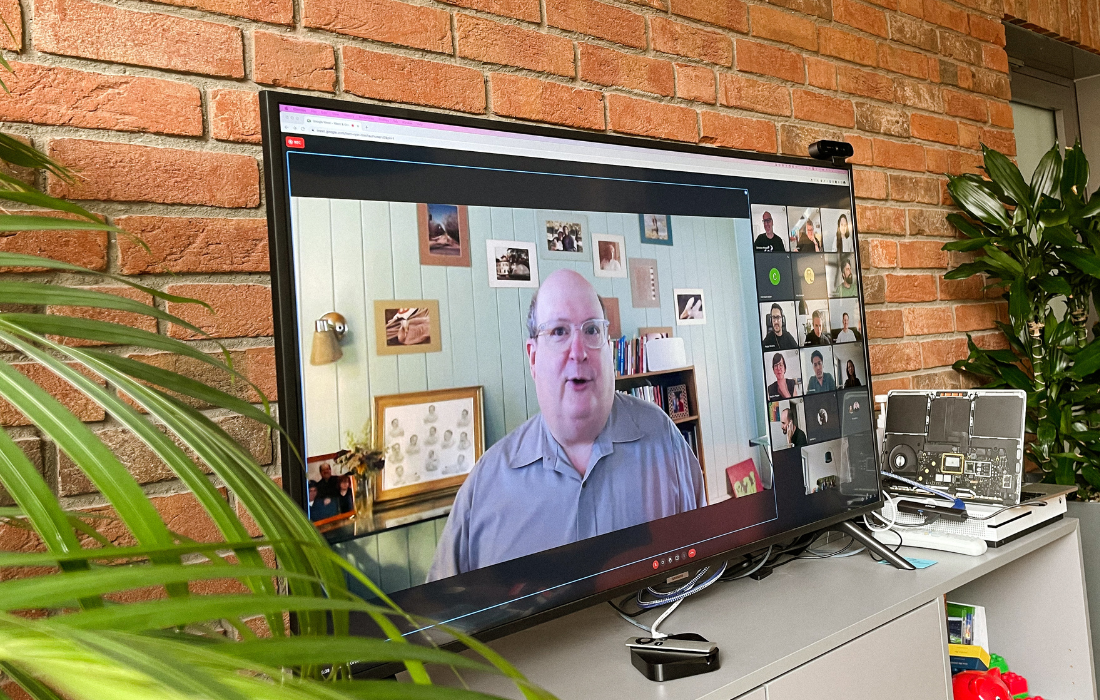
At UX&I, “Flipper Friday” is the format where we share experiences, discuss projects, and gain new insights, often with external experts. This time, we were thrilled to welcome a special guest: Jared Spool is an author, researcher, educator, and acclaimed speaker. He has been a fixture in the tech industry for 43 years. Together with Leslie Jensen-Inman, he founded Center * UIE to train industry-ready UX designers as “Makers of Awesomeness” and help companies develop competitive products and services. Spool is passionate about the world of UX and consistently brings exciting new ideas to the community, such as his insights on UX maturity.
The UX&I team specifically asked Spool not to give a presentation that we could just as easily watch online. We wanted a panel discussion where we could address specific questions from our day-to-day project work and that of our clients. And that’s exactly what we got.
Hands vs. brains: Get the job done or solve the problem?
Spool shared a key insight with us: Every UX agency, or, in our case, UX consulting firm, must decide: Do we provide “Hands” or “Brains”? Do we act as a service provider that gets a job done (“Hands”), or do we want to solve a problem (“Brains”)? Conversely, every company must also ask itself what kind of service provider it needs, because the implications are far-reaching.
First, Spool highlighted the dividing lines between “Hands” and “Brains.”
Tactics vs. strategy
Much of UX work today is tactical and therefore “hands-on.” Specific tasks are carried out using appropriate methods. It doesn’t matter whether goals or problems change during the process.
UX strategy is the opposite; Spool referred to it here as a “high-level plan.” It’s about what we will and won’t do. How can we leverage all that knowledge, those resources, those people, that expertise, and those tools? How can we design products and services in a way that contributes to the company’s goals? The strategy must continually adapt to the situation. Spool sees a problem in the fact that UX strategy exists alongside many other strategies within the company, such as marketing or sales, and still too rarely attempts to influence them or support them with user insights.
Output vs. Outcome
Spool makes a second distinction with regard to the result. “Hands” delivers output: that is, concrete deliverables. “Brains,” on the other hand, delivers outcome. When it comes to outcome, the question arises: If we do our job well, how do we improve the lives of our users? To answer this, we need to understand the current user experience as well as the users’ current problems.

Price vs. Expertise
Hands Work is typically outsourced when the company lacks the necessary internal resources. In theory, however, the work could also be done in-house. The job is focused on a specific task. The choice of service provider depends heavily on price. Brains Work, on the other hand, is designed to solve a problem. The company cannot handle this internally due to a lack of expertise and experience.
Brains Work isn’t easily replicable; unique solutions must be developed for each problem, there are no quick, standard methods. Brains must not only understand their own mission; they must also understand the entire business model.
When looking for “brains,” expertise is the primary consideration in the selection process, rather than price.
Can’t I get everything from a single source?
Spool’s strict separation between “Hands” and “Brains” raised quite a few questions for us: Don’t our clients hire us for both? We come to solve a problem. At the same time, though, we also roll up our sleeves and get to work, for example, when implementing the UI design or during development. And ultimately, we like to make ourselves redundant: that is, we want to pass on our knowledge and empower our clients. Isn’t that a clear ambiguity when it comes to “Hands” and “Brains”? Can’t we start by providing “Hands” and then bring “Brains” into the mix over time? Our guest shook his head.
Please specify
For Spool, what matters is the fundamental direction, which must be clear from the very beginning, for both service providers and the company. Is the goal to execute a project, or to solve a problem, with everything that entails? “Brains Work” isn’t just much more expensive; it also requires a much broader scope of work. If it becomes apparent during the agile process that we’re actually working on the wrong problem, “Brains” must have the flexibility to adjust the roadmap accordingly.
“For brainwork, you need a free hand.”
However, clinging to a solution for the wrong problem would be legitimate in the context of “Hands Work.” Spool sees no hybrid forms. Even if specific tasks are carried out as part of the process, he considers it “Brains Work” if it is part of the overall goal, that is, solving a problem.
Brains are facilitators
Another “Brains” factor emerged during the discussion: enablement. The service provider ensures that the company internalizes the UX mindset and is also able to find the right people for the “Hands” work, that is, to create a good briefing. It’s important to make this clear from the start: We’re not going to build the finished product for you in the first version. We’re going to empower you so that you can deliver it yourself in the second version.
“Basically, when you’re doing hands-on work, you’re delivering a design. But when you’re doing strategic work, you’re facilitating the delivery of a design.”
Brains act as facilitators. This requires not only abstract knowledge but also practical skills. Brains have often worked as Hands for years and bring that knowledge to the table (this is also the case at UX&I: we all know our field inside and out).
“Understanding how the hands work helps you do the brain work.”
Beans and Noses: Change must come from within
Spool repeatedly emphasized how important the right fit and a shared understanding between service provider and client are, especially when it comes to “Hands” and “Brains.” Anyone who opts for “Brains” must be aware of their own problem and accept that it needs to be solved. This insight cannot be imposed from the outside. Spool explained this using the “Beans and Noses” metaphor: If someone has decided they must stick a bean up their nose to solve a specific problem, they must do so and cannot be dissuaded from it by outside influences. Not even with clever arguments and facts. Outsiders can ask afterward how it felt and whether the problem has now been solved. Only then can help be offered. But the will and the realization to pursue a new solution and to accept help in doing so must always come from within.
“It’s a myth that we can get other people to change. That doesn’t happen. The only thing that causes someone to change is when they decide to change on their own.”
Are brains too expensive?
According to Spool, “Brains” cost three to five times as much as “Hands.” Why? How can you make this case to financial decision-makers?
It’s crucial not to view the UX problem in isolation, but to consider all its implications within the broader context of the company. The cost of solving the problem must be determined accordingly. Here’s an example from Spool: If a product has a UX flaw, users will repeatedly need help. They’ll turn to support or customer success, which requires significantly more resources. The best way to make the case for “Brains” is through a cost-benefit analysis: What does it cost not to solve the problem?

Pay nothing!
Spool goes so far as to say that a service provider should only be paid once the problem has truly been solved. But what does that mean for cost estimation? It involves far more risks and unpredictable variables than “Hands Work.” “Brains Work” is strategic and must constantly adapt to the situation. If, for example, the business goal changes during the process, the UX strategy must change as well, even if a great deal of time and effort has already been invested in the original solution. How can an appropriate price be determined under these conditions?
Discovery projects
When in doubt, Spool recommends a discovery project. It accounts for about 10–20% of the total project and serves the purpose of jointly understanding and assessing the problem in advance. Often, it’s only at this stage that the true scope of the project becomes clear. Afterward, costs can be calculated accurately. Another advantage: You’ll learn in advance how professionally the service provider works and can make your decision accordingly.
Conclusion
Spool’s “Brains vs. Hands” presentation sparked a fascinating discussion, not only within our team but also among the clients and partners we had invited. Opinions diverged sharply, especially when it came to the strict “either/or” approach.
We view Spool’s thesis as an impetus to continually reexamine our own self-image and our approach, and to carefully balance them, regardless of a distinction between “Hands” and “Brains,” based on the needs of our clients. Conversely, when selecting external UX experts, it’s also worth asking yourself from the very beginning: What do you expect from your service provider, and how does the provider see itself? What mindset, tools, and skills are needed for the task or problem at hand?
You can read more about what else matters when it comes to external support in this article: Why you should establish UX in-house, and how to do it.
Author
Juliana has been bringing text to the digital world since 2009. As a UX writer, she ensures that language guides users to their goals and makes products measurably more successful.