Article
Idea evaluation using the Bet-Cost matrix

- By
- Eric Brecht
- Reading time
- 4 minutes
- Updated
When a new product idea is on the table, those involved usually bring a certain intuition to the table: a very personal assessment and opinion of the product. How can these often still vague and unspoken attitudes be transformed into a shared and, above all, user-centered evaluation? And how can this help draw reliable conclusions about the idea’s future viability?
The Bet-Cost Matrix is a simple method that helps teams validate ideas or individual features in a targeted manner. Not only does it clarify what should happen next with the idea, but it also fosters a shared understanding and a stronger sense of commitment within teams.
How does the Bet-Cost method work?
“Betting” plays an important role, but let’s start from the beginning: The Bet-Cost Matrix consists of a 5x5 grid. All participants evaluate an individual idea. It doesn’t matter whether it’s a large-scale overall concept or a single feature, a user story or an epic.
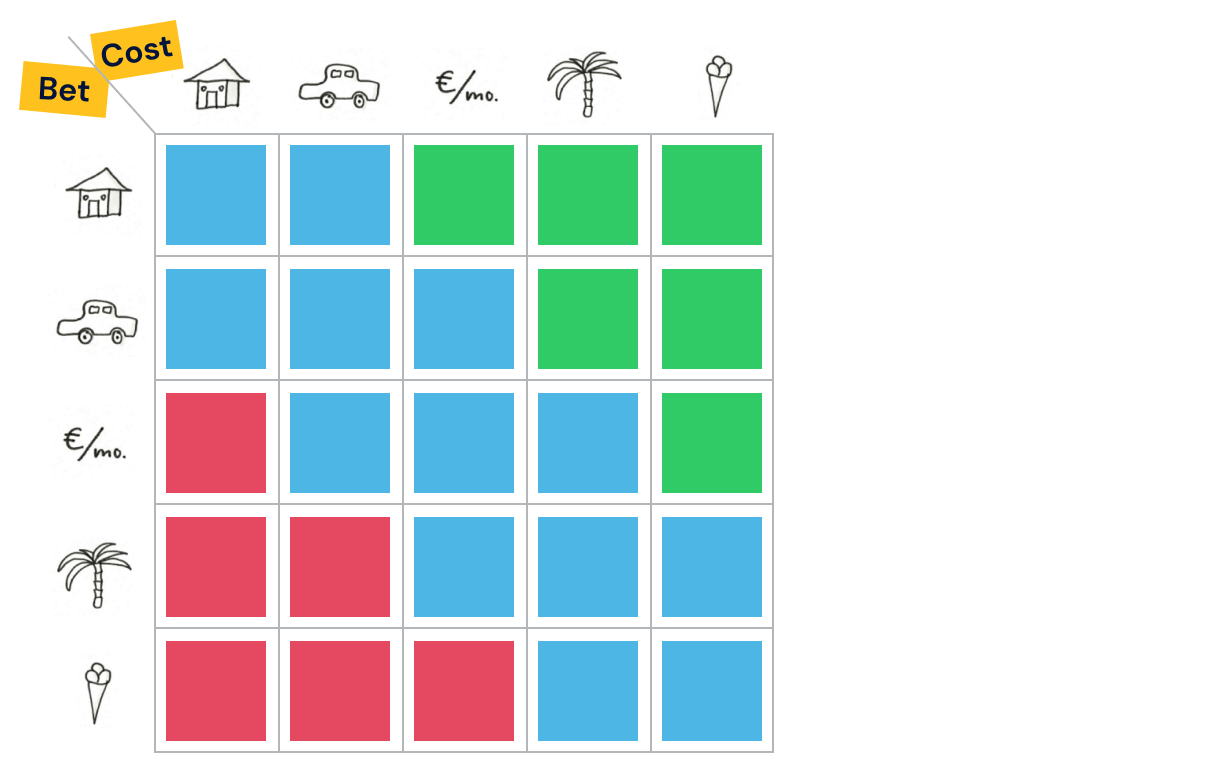
The evaluation is conducted along two dimensions:
- What would you bet that Epic/Story XY offers real value to users? (your own stake)
The vertical axis focuses on how strongly each individual believes in the idea, specifically in terms of its value to the user. By proposing your own stake, you automatically develop a personal connection to the idea; the higher the stake, the stronger this connection, and thus the greater your willingness to fight for the idea. On the other hand, this also creates a personal connection to the investment: it’s simply a very different matter to estimate the value of company money than to stake your own car. This often leads to more conservative estimates, which is the intended outcome. - How much do you estimate it will cost to implement Epic/Story XY? (Company funds)
The horizontal axis represents an estimate of the financial burden the company would incur if the idea were implemented. This is based on the principle of affordable loss: In an extreme scenario, how much would the company be willing to lose?
Both the bet amount and the cost estimate are rated based on real-life references. We often use these symbols:
🏡 > 🚗 > 🏖️ > 🍽️ > 🍦
Home > Car > Vacation > Dining out > Ice cream
This is something everyone can really relate to. However, it’s also well-received to use values that draw on the participants’ individual life experiences or the subject matter of the product idea. For a restaurant app, for example, it might look like this:
🧳 > 👨🍳 > 🦀 > 🍽 > 🥜
Gourmet World Tour > Private Michelin-Starred Chef > Year’s Supply of Lobster > 3-Course Meal > Nuts
Get started right away: This method is quick and easy to implement
The Bet-Cost method is deliberately designed to work without extensive preparation and with minimal effort on the part of the team. Each participant receives a matrix and first evaluates the idea confidentially along both axes. Afterward, all evaluations are revealed. The differing assessments among team members spark lively discussions that help establish a shared understanding within the team. Hidden assumptions regarding costs and benefits also come to light. Once the team has agreed on an evaluation, the idea is placed in the corresponding cell on the matrix.
The results are used to determine how to proceed with the idea
Now comes the crucial part: Concrete recommendations for action are derived from the joint evaluation. To do this, specific clusters are identified on the matrix (or were identified in advance) and highlighted in color. Actions are assigned to these areas. Now it’s immediately clear at a glance what should be done next with each evaluated idea.
Here’s an example: The green area in the image represents an idea with low financial costs but high benefits. There’s no question: this idea should be pursued—build it! In the blue zone, the costs are more or less equal to the benefits; here, it’s worth testing with a prototype and possibly breaking the idea down into smaller units. The red zone, with high costs and low benefits, indicates that the idea still requires fundamental research and should be pivoted.
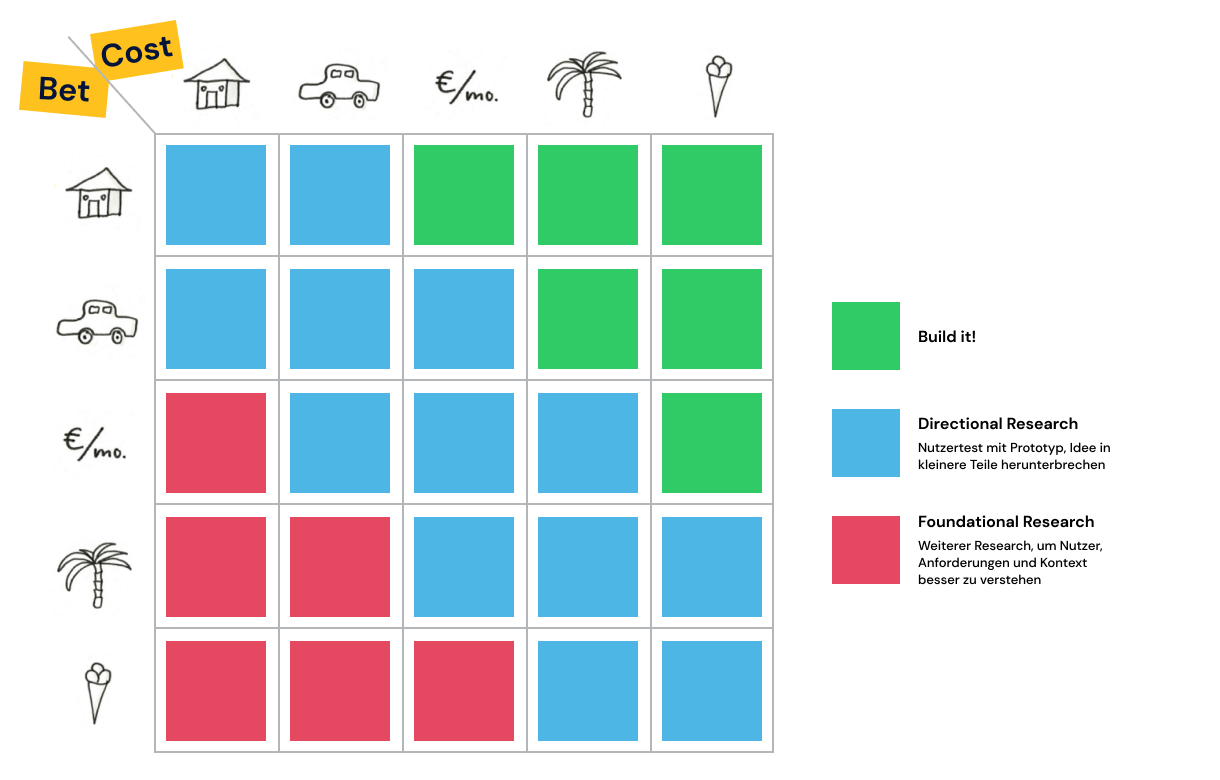
Clusters and actions should be defined individually depending on the project.
Conclusion: Idea evaluation made easy
The Bet-Cost Matrix is a particularly efficient and easy-to-understand way to assess the potential of product ideas. So you can easily give this method a try. All you need is a blank matrix with an appropriate reference system.
Advantages of the Bet-Cost method:
- Helps in the evaluation and refinement of application ideas
- Puts your belief in your own ideas to the test
- Enables an early budget estimate
- Increases commitment within the team and ensures a shared understanding
- Motivates further research and increases user focus
- Keeps runaway feature requests in check
- Outlines specific next steps
- Can also be used in remote teams
Any other questions?
The Bet-Cost method was developed by Hias Wrba, Managing Director at UX&I Munich. If you’d like to learn more about the method, feel free to email him at hias.wrba@uxi.de. Or take a look at his presentation from the talk he gave at Mensch und Computer 2019.
Our expert
Eric is a senior UX consultant and has been part of UX&I since 2016. For more than 11 years, he has been advising clients on user-centered product development.