

Skip to content

DATEV

The evolution of UX writing: Pioneering work for holistic UX

DATEV, one of Europe’s largest software companies, has long been a pioneer when it comes to strategically establishing UX within the organization. The company also recognized early on the importance of language for a positive user experience. We are pleased to support DATEV in advancing the internal professionalization of UX writing.

DATEV logo

For 60 years, DATEV has been supporting law firms and their clients on their journey toward a digital future, with solutions that connect people and build trust.

Background

  1. DATEV: An expert in UX development

    At DATEV, the importance of a good user experience in its often complex and domain-specific products has long been a core focus. We have strategically built up internal UX expertise over the years, and user-centered methods and mindsets have been gradually established throughout the company. In particular, the creation of a UX Community of Practice (COP) is viewed within the industry as a major source of inspiration and a blueprint. Today, DATEV has a large, high-performing UX team and a high level of UX maturity.

  2. Language as a key factor in user-centered design

    As user-centered product development gained traction, the topic of language also came increasingly into focus. Especially in the context of comprehensive accounting and tax software, the interaction between users and the product must be designed to be as intuitive, understandable, and effective as possible. Clear, targeted UX writing plays a crucial role in making complex functions understandable, guiding users through processes, and increasing user satisfaction and productivity.

  3. A milestone: UX writing becomes an official discipline

    To ensure that all DATEV products offer consistent, user-centered communication, the role of “UX writer” was introduced within the company. The fact that UX writing is an official discipline at DATEV, with its own Community of Practice serving as a regular forum for exchange, makes it clear: language is not a peripheral issue here, but an integral part of product development. In the German market, this is still pioneering work, especially when compared to the international landscape.

  4. Our shared goal: Building internal UX writing expertise

    The next step is to expand the skills of those in these roles and empower them to independently implement UX writing in practice and integrate it into the company. UX&I was founded to build on solid expertise in this area and to gain insight into current best practices. Together, we embarked on this mission:

    • Laying a solid foundation to build the discipline of UX writing internally
    • to train role holders and equip them with the necessary foundational knowledge
    • Sharing expertise and practical experience from other industries
    • to support linguistic guidelines and promote their use
    • Providing support in specific real-world scenarios

Challenges

  1. The complexity of the subject matter

    The world of taxes and finance is inherently complex and rife with technical jargon. It is a particular challenge to translate these topics into language that is tailored to the target audience and easy to understand without sacrificing accuracy. This requires a deep understanding of the subject matter, even from us as external consultants.

Two DATEV interfaces: the “Income tax” document storage with folder tree and tasks, and in front the “Welcome to MyDATEV” home screen with messages, orders, invoices and open deadlines
Complex interfaces require clarity in design and language
  1. Varying levels of knowledge

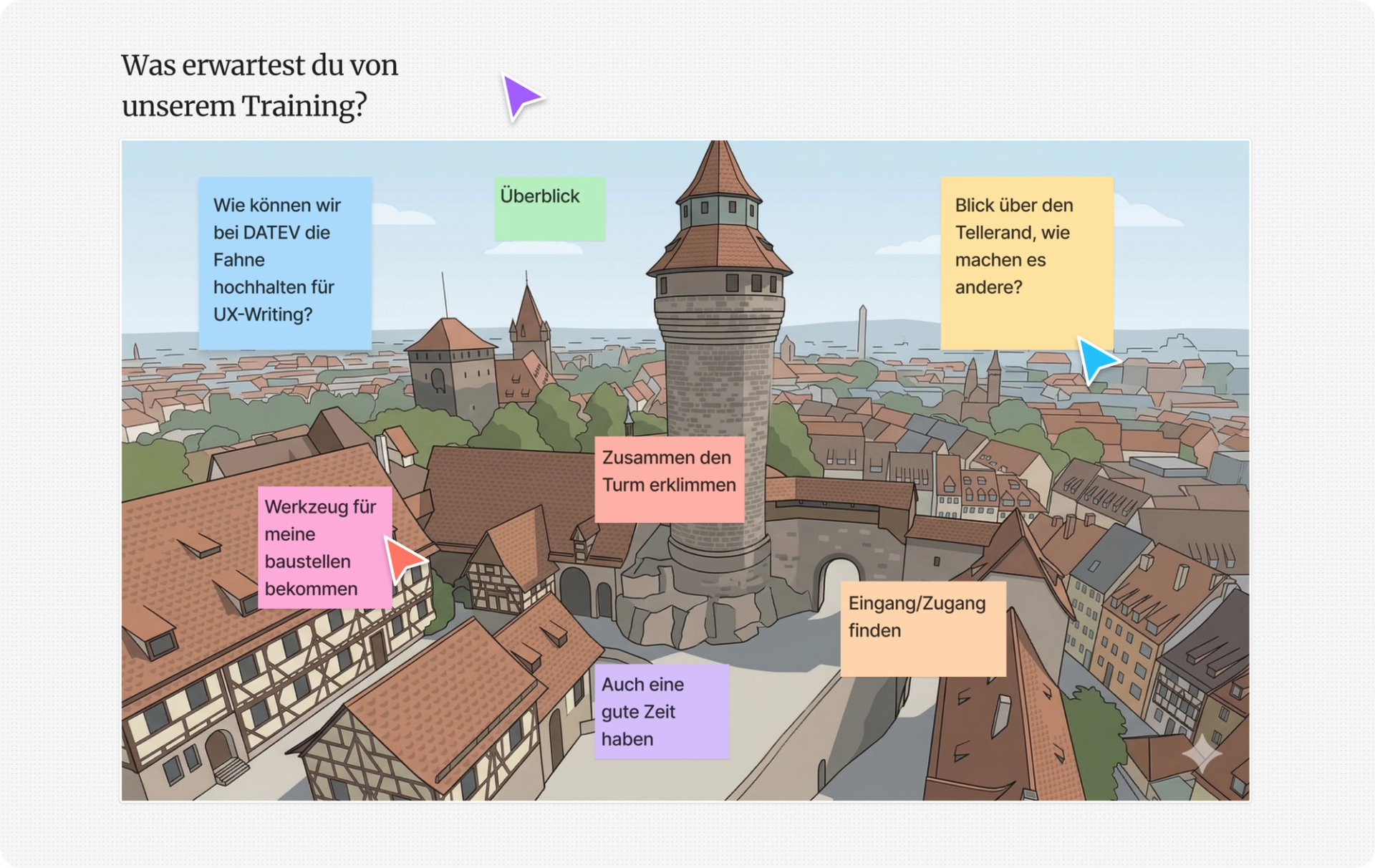
    When the role of UX writer was introduced, those in the role came from a wide variety of backgrounds and job profiles, ranging from researchers to help authors and requirements engineers to UX designers. The training had to be balanced so that it would neither overwhelm nor underchallenge anyone and would remain relevant in a wide variety of practical contexts.

Digital whiteboard “What do you expect from our training?” with an illustration of Nuremberg’s old town and sticky notes such as “How can we fly the flag for UX writing at DATEV?” and “Climb the tower together”
Diverse interests among training participants
  1. Hands-on: practical foundations instead of pretending to know it all

    The goal of our support is to quickly and pragmatically empower people to apply UX writing in their day-to-day work. Good UX writing isn’t a skill you can learn in a single day, yet it is possible to teach the fundamentals in a way that brings about initial improvements and lays the foundation for further growth through independent practice.

Steps

  1. Assessment workshop: Where should we go from here?

    No off-the-shelf concept works when it comes to establishing and embedding UX writing as a discipline. From the very beginning, we had to understand the context, for example, how product development works at DATEV, what role user-centered design plays in general, and how mature UX writing already is within the company.

    In an initial workshop, we worked together in a small group to analyze the current situation and objectives. Based on the four pillars: mindset, working methods, structures, and learning, we prioritized the roadmap and determined that the initial focus should be on concrete practical knowledge, methods, and guidelines.

Diagram “4 pillars” of the UX writing assessment: mindset, structures, ways of working and learning, each with keywords such as maturity, team structure, processes and research
4 pillars for building UX writing
  1. Development of linguistic guidelines for UX copy

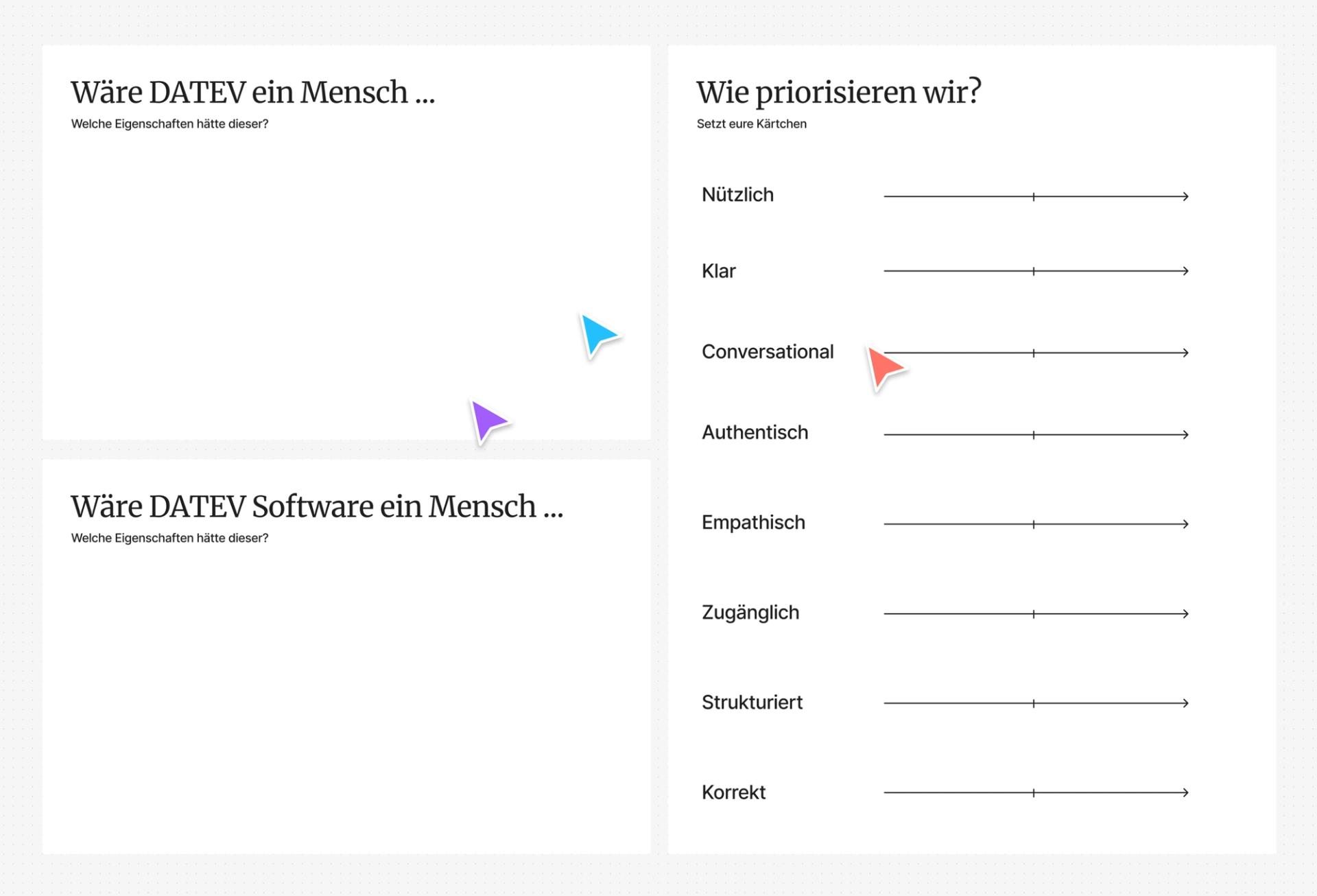
    In another workshop, we created the framework for UX writing guidelines at DATEV. We defined the structure, examined the brand and its brand language, prioritized eight criteria for effective UX copy for DATEV, and ultimately identified the most important characteristics for the language used in DATEV software.

    The result: guidelines that are firmly embedded throughout the company as an integral part of the design systems and can be used at any time by a wide variety of employees. Their importance is growing: Well-documented language guidelines are now also the foundation for meaningfully integrating AI into product development.

Digital workshop board for defining the UX voice: questions “If DATEV were a person …” and “If DATEV software were a person …”, next to scales for prioritizing useful, clear, conversational, authentic, empathetic, accessible, structured and correct
Development of the UX language for DATEV
“Clear language on user interfaces is crucial for usability and customer satisfaction. That’s why we’ve established UX writing as a distinct discipline at DATEV. With qualified employees, regular opportunities for exchange and professional development, as well as clear guidelines and tools, we ensure that our UI texts meet the needs of our users. UX&I has actively supported us in this endeavor from the very beginning and has played a key role in making our vision a reality.”
Benjamin Messingschlager Team lead, design operations & customer experience content at DATEV
  1. Introductory training in UX writing: A toolkit for practical application

    Based on the insights gained from the workshop, we designed an introductory training course. Participants gain an understanding of exactly what UX writing entails at DATEV, what falls within its scope, what makes texts so effective, and, most importantly, which methods and tips they can apply directly in their day-to-day work.

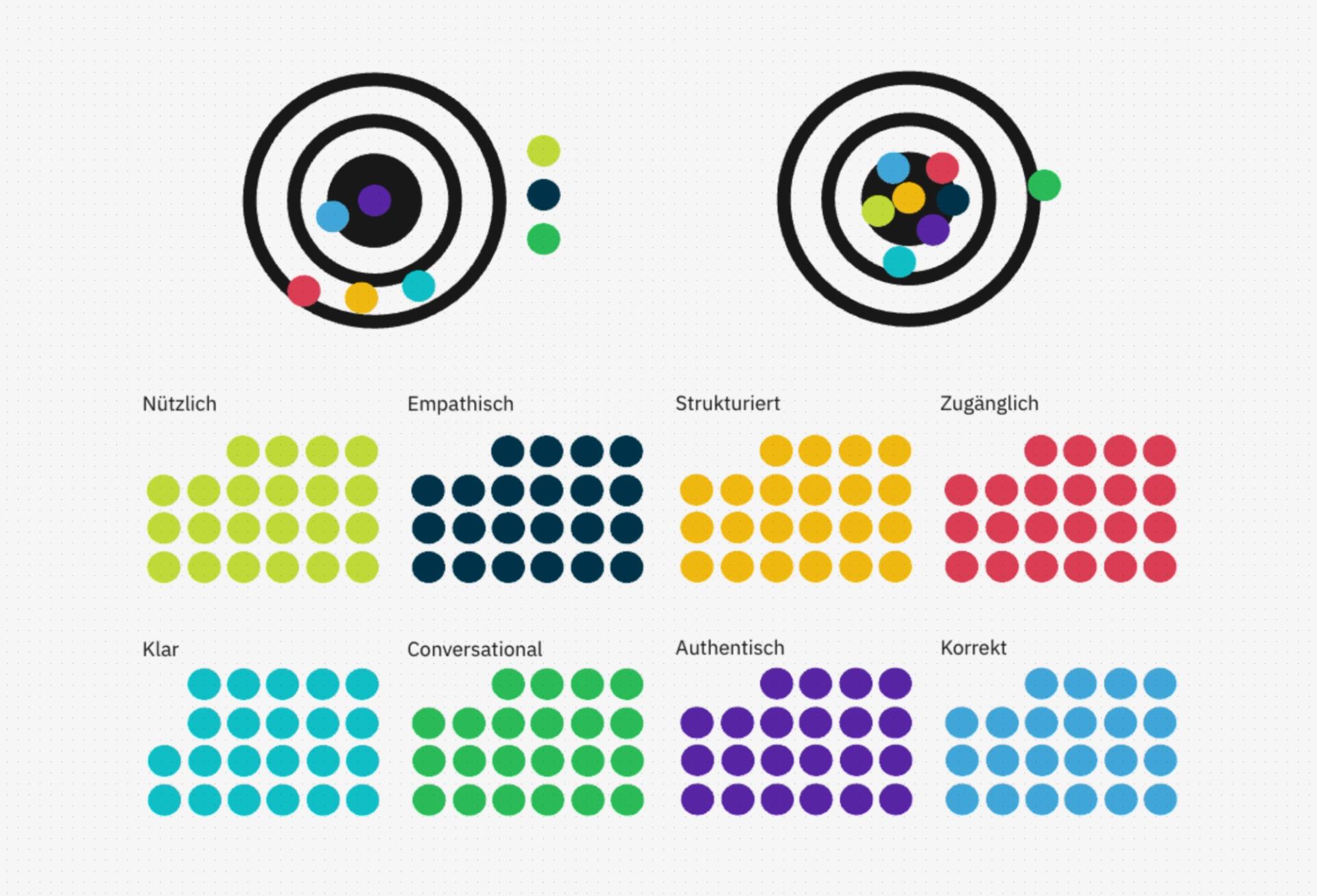
    A practical toolkit is always at the center of the approach. For example, especially in the beginning, the target audience assessment is helpful. It highlights weaknesses in texts, categorizes them, and enables highly targeted optimization.

Diagram with two targets and colored dots, below them dot grids for the voice principles useful, empathetic, structured, accessible, clear, conversational, authentic and correct
Visual evaluation of text based on the 8 criteria for good UX copy
  1. As much theory as necessary, as much practice as possible

    We divided the training content into two half-days: The first day focuses on the fundamentals, while the second day focuses on applying what has been learned. The goal is always to offer plenty of opportunities for practice, stimulate discussion, and give participants the chance to get to know one another and network. The latter is an important added benefit of the training sessions, because, especially when establishing a new discipline, it is crucial that those in these roles support one another, promote the topic together, and foster ongoing exchange. The Community of Practice also ensures this: It meets regularly, not only remotely, but also in person.

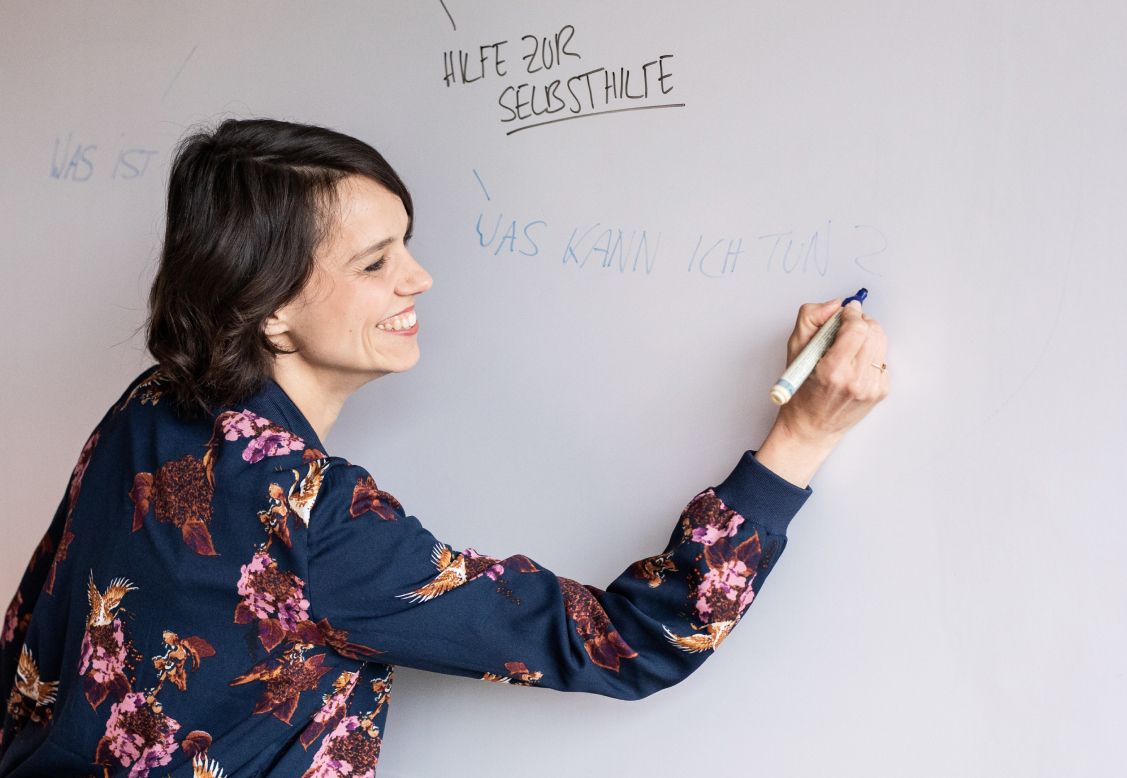
UX writing as self-help: Juliana Hirsing smiling as she writes “What can I do?” under “Self-help” on a whiteboard
Error messages should guide users, be clear and easy to understand, and provide a solution.
  1. Focus workshop: “Error messages”

    In addition to the introductory training, we’re working with DATEV to develop additional formats that cover key areas of UX writing in detail. In a focused training session on “error messages,” we examined the various types found in DATEV products, explored how they work, their structure, and, last but not least, their tone. After all, especially in problematic situations, the right tone can make the difference between a good and a bad user experience. Working in small groups, we practiced what we’d learned in a hands-on manner, ensuring that the next error message not only meets DATEV’s standards but also represents another major step toward user-centered design.

    The jointly developed rules for error messages have since proven to be a successful blueprint: Following the same pattern, additional guidelines for various types of dialogs are continuously being developed.

Error messages

Error messages

While the first step is always to avoid error messages (including through the use of text), they still occur in every digital application and must fulfill crucial roles there in the interest of a good UX. Not only are they responsible for quickly helping users resolve issues, but they can also ensure that users have a positive experience while using the application and always feel confidently guided.

Successes

  1. The role of UX writing is growing and thriving

    The UX writing role, which was introduced in 2022, is now well-established and has generated significant interest. UX writing is increasingly integrated into product development processes, and internal expertise and processes are constantly being improved. The UX writing guidelines are a living document that is continuously refined and firmly integrated into the design system, always grounded in real-world practice and always up to date. The role holders are well-connected with one another, and a growing range of training opportunities supports and motivates them.

  2. Let’s continue

    DATEV and UX&I continue to jointly drive the development of UX writing forward. Our UX writing training courses are firmly integrated into DATEV’s continuing education program. We maintain close communication with the Community of Practice, work hand in hand to develop new concepts, and provide targeted consulting based on our practical experience, for example when it comes to selecting the right tools or expanding processes. This consulting relationship has grown into a true partnership: We now also provide operational support to DATEV, including UI and UX design as well as conceptual and strategic guidance.

    Since 2022

Juliana Hirsing
“It’s wonderful to witness the development of this topic close to my heart in such an exciting environment and to see how UX writing has found its place at DATEV. It sends an important signal that a company like DATEV consistently prioritizes language and continues to serve as a role model and source of inspiration when it comes to sustainably integrating a discipline into an organization.”
Juliana Hirsing Senior UX writer, UX&I

Related

Do you have an idea or a tricky UX problem?

We support you from strategy and agile product development all the way to training your team.

Nadine Pieper, senior UX consultant at UX&I, smiling with glasses and arms crossed in the office

Nadine Pieper Senior UX consultant · Berlin

Prefer to talk right away?

30 minutes by video call, free and with no obligation. All times are Berlin time.

 Loading available times …

Or send us a message

Two or three sentences are enough.

We reply within two business days.

We process your data to handle your request. Details in our privacy policy.

Nadine Pieper
Hias Wrba
Patrick Oselka
Claudia Schönwälder
Mato Sauer

Your call with

Nadine Pieper

Senior UX consultant

Berlin

Your call with

Hias Wrba

Product coach

München

Your call with

Patrick Oselka

Managing director at UX&I

Düsseldorf

Your call with

Claudia Schönwälder

Senior UX consultant

Hamburg

Your call with

Mato Sauer

Customer empowerment lead

Frankfurt