Benjamin Sporer joins the UX&I team as a senior UI designer
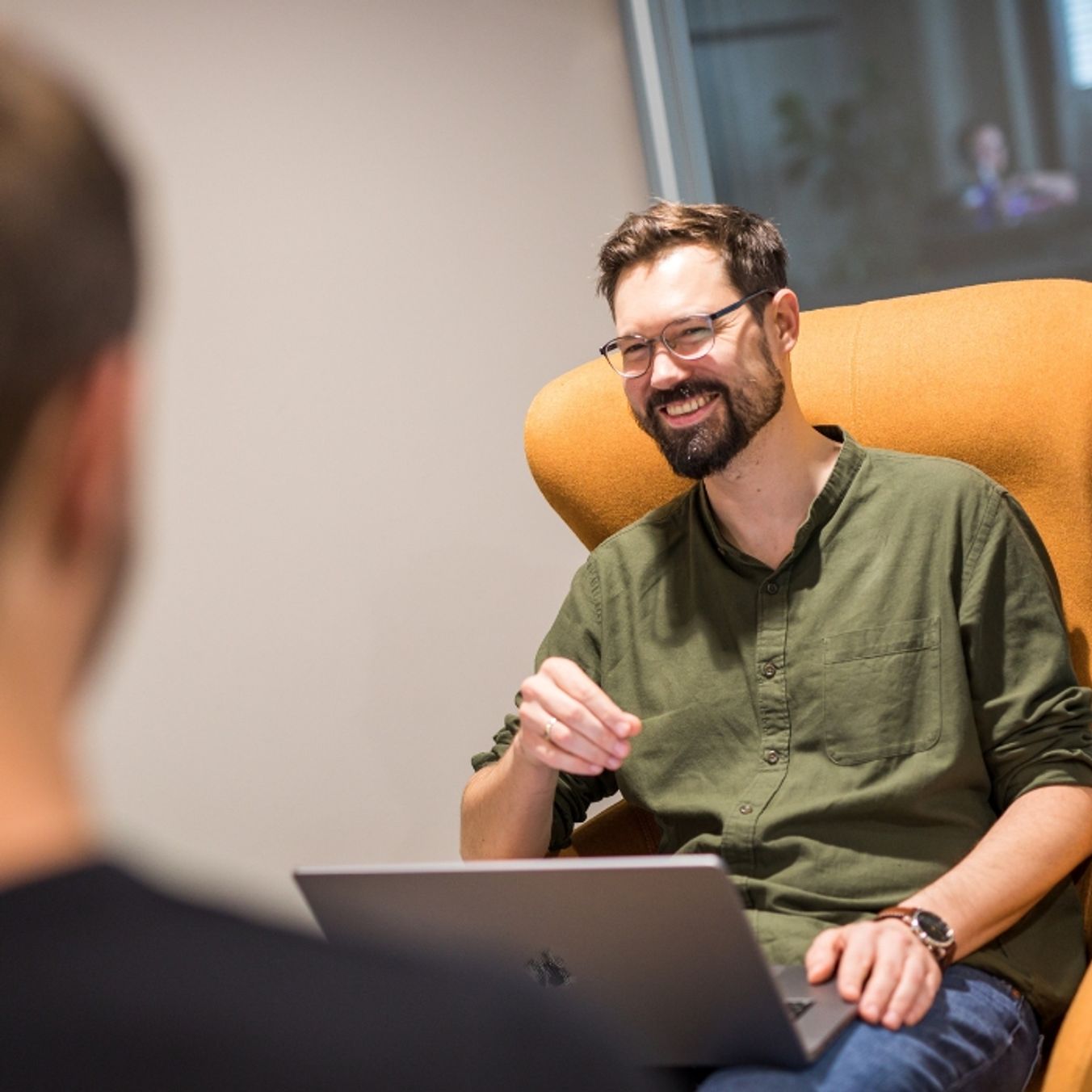
“Good UI design has to work over the long term. I create design systems to make life easier for others, whether they’re designers, developers, or, of course, users.” Benjamin Sporer carefully considers every component of the design system, because that’s the only way to create a harmonious overall picture. Just like with Lego.
Benjamin, you studied at the Bauhaus University in Dessau, among other places. Tell us a little bit about that time.
That’s right: I have a degree in Integrated Design and Product Design, and I also spent some time in Dessau. That was a very formative period of my studies, during which I was able to gain a lot of practical knowledge, for example while developing an e-scooter using a 3D printer. I was involved in every step of the process, from the initial design to the prototype and the accompanying app. That’s exactly what Integrated Design is all about. The Interaction Lab is located in a historic Bauhaus building, and there’s a quote by Charles Eames on the wall that I really love: “Problems don’t respect boundaries.” Guided by this motto, I learned to think interdisciplinarily, experimented, and developed my first prototype apps for the iPhone and the first iPad.
Today, as a Senior UI Designer, you specialize in design systems. What excites you most about this?
Ultimately, a design system must function sustainably. You can compare it to the foundation of a house, upon which everything else is built. The focus must be on what designers and developers, who will eventually work with “my” design system, need. And, of course, optimal user guidance is the top priority.
That all sounds very functional. Can good user guidance even be aesthetically pleasing?
Of course! This is where my time in Dessau and the Bauhaus principle of “form follows function” come into play again. Applying this principle allows for the creation of an aesthetic design that is tailored to the functionality of the user interface. A good example of this is the use of color in the user interface. A well-designed color palette can lead to more intuitive navigation through a website or app.
You mainly work from home in Mannheim. What do you particularly appreciate about hybrid work, and how well does it work at UX&I?
At UX&I, working from home goes smoothly because we use effective communication and collaboration tools like Slack, Miro, and Figma, and have implemented remote work policies and procedures. I can spend more time with my family because I don’t have to commute. That means I take our three-year-old son to daycare every morning, get a kiss at lunchtime when he comes home with my wife, and can put him to bed in the evening. Plus, the UX&I office in Frankfurt is only an hour away. We meet there for team offsites, among other things, which bring us together and strengthen our sense of community.
UX and UI are very dynamic fields that are constantly evolving. Do you see any new trends or changes?
ChatGPT is all over the media right now, but AI-generated designs are also on the rise. AI integration, or Artificial Intelligence Design, is currently changing a lot of things. It’s now possible to create designs using simple voice or text inputs. Designers simply select from the options and refine the result. However, a design created by AI can only serve as a starting point for a designer, that is, for a real person. AI isn’t capable of reading between the lines, at least not yet. The creative spark and the process of finding solutions and creating something new simply cannot be replicated digitally, and that’s a good thing. Artificial intelligence won’t be replacing us anytime soon.
In addition to your passion for design systems and well-thought-out user guidance, you have another big hobby: Lego!
Thanks to my young son, I’ve rediscovered Lego. Just like with a Lego set, every element, every piece, and every component of a design must be carefully crafted to interact seamlessly and harmoniously with the overall picture. The smallest details come together as a whole, just like in a perfect design system. Even if the process is complicated, the result should appear effortless. That’s the magic of Lego. And of design.
About UX&I
UX&I offers consulting, enablement, and implementation services in the field of user experience (UX). We focus on deep tech, enterprise software, and digital transformation. Our goal is to help people harness complex technology to serve users. In doing so, we bring together all relevant perspectives: human, business, and technology.
- Locations: Düsseldorf (Headquarters), Berlin, Hamburg, Frankfurt am Main, Munich
- Employees: 37
- Founded: 2014
- Clients: Ten of the fifteen largest German companies, among others, rely on our UX expertise