Article
Product management 2025: Firsthand insights into trends and challenges

- Reading time
- 12 minutes
- Updated
Product development continues to undergo profound change. New technologies, especially AI, growing volumes of data, and ever-faster market cycles are demanding adaptability and new approaches from product managers and their teams.
How do experts see the future? We asked ten highly experienced product professionals for their insights: What trends will shape the year 2025? What challenges are on the horizon? And what skills should be developed today to be prepared for what’s to come? Their answers provide an honest insight into what lies ahead, and point to ways in which product development can continue to evolve.
The respondents
The experts surveyed represent a broad spectrum, from large corporations to small and medium-sized businesses, startups, and freelancers. This provides a multifaceted perspective on the trends and challenges in product management in 2025.
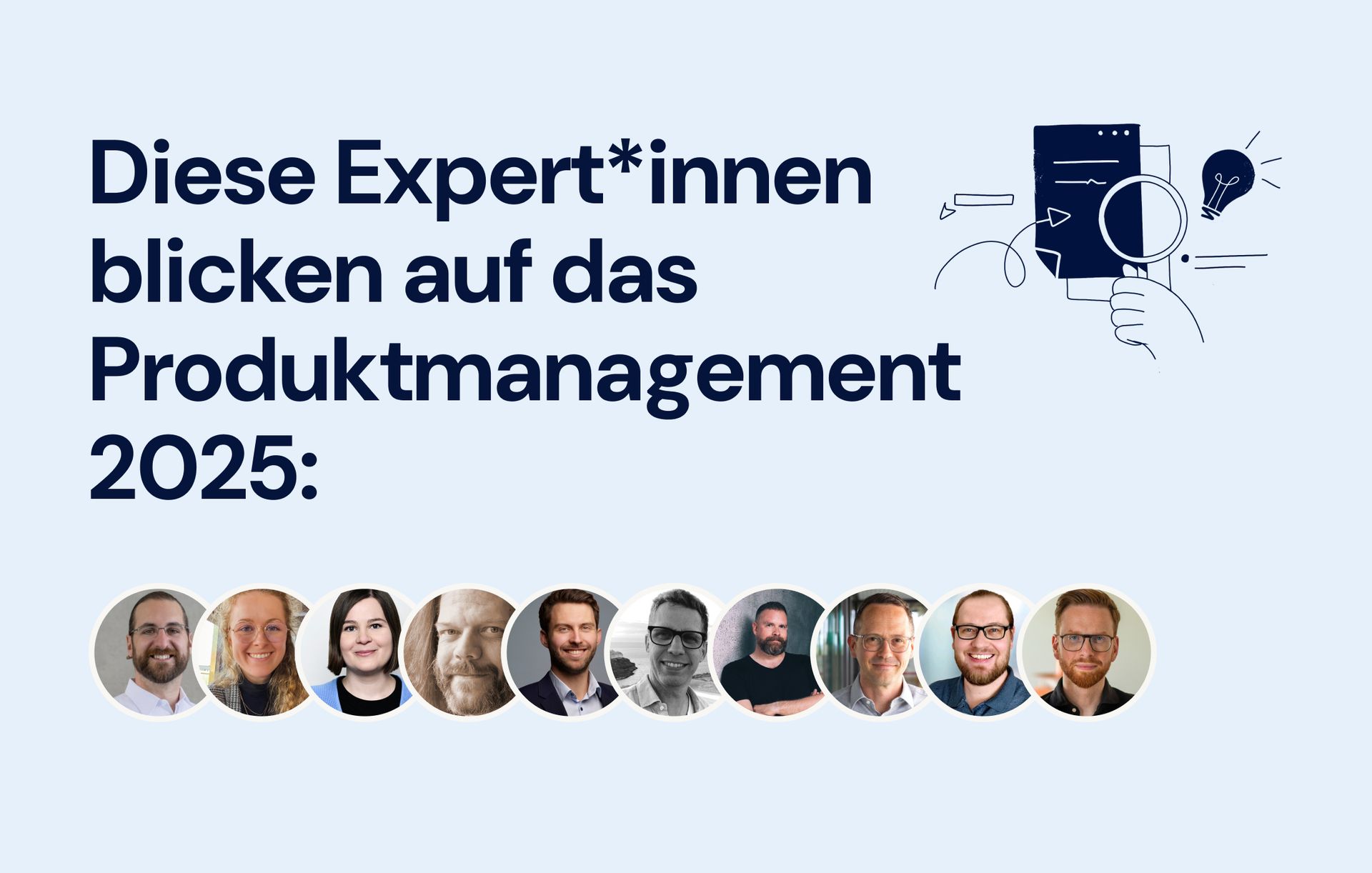
- Dominique Winter, Product Experience Coach at Die Produktwerker
- Elena Morawin, chapter lead at MOIA
- Eva Nasbach, senior product owner at chargecloud
- Jörn Cölsch, product manager at BMS CS
- Lucas Giering, head of product at Spanflug
- Maik Schröder, director of product at IBM Instana
- Marco Stark, Product Manager at Schönhofer Sales & Engineering
- Marko Kehm, product manager at AEB
- Paul Wall, product manager at Starke+Reichert
- Tim Herbig, product management coach and consultant
Trends for 2025: What will shape product development
We asked: “In your opinion, which trend will have the greatest impact on product development in 2025?”
In a nutshell
The respondents’ answers reveal a clear trend: Generative AI and automation will be the most defining trend in product development by 2025. AI will enable efficiency gains, automate routine tasks, and shift the focus more toward creative and value-adding activities. There is even potential for a new stage in AI development: so-called “agentic AI,” which makes autonomous decisions and handles complex workflows. At the same time, AI is changing user behavior and forcing companies to evolve technologically in order to remain competitive.
Another key factor is economic pressure and the need to work efficiently. Companies are under cost pressure and must allocate their resources strategically. AI is seen here not only as a driver of innovation, but above all as a means of increasing efficiency and reducing costs.
In addition to AI, sustainability was also cited as a relevant trend. It has been gaining importance for years, from both an economic and an environmental perspective.
The results in detail
Generative AI and automation (8 mentions)
“The (perceived) potential for efficiency gains through AI support, allowing for a greater focus on what only humans can do, will continue to be a factor.”
(Tim Herbig)
“The year 2025 could become a pivotal year for ‘Agentic AI,’ a form of artificial intelligence that makes autonomous decisions, interacts with its environment, adapts, and solves complex problems in multiple steps. This next stage of development opens up entirely new possibilities for automation, as even complex workflows can be handled and optimized by interacting AI agents, such as the automated processing of customer support inquiries based on customer and system data. At the same time, it enables dynamic and adaptive personalization of the user experience without the need for complicated, predefined rule sets.”
(Marko Kehm)
“Generative AI will enable us to automate even more tedious tasks and devote our energy to creative and valuable work.”
(Lucas Giering)
“Out of curiosity, I entered this question into ChatGPT: Unsurprisingly, the analysis result was ‘Generative AI and automation.’ Personally, I think AI has long since become part of our everyday work lives, if only because I’ve challenged my own assessment with a digital sparring partner and, for example, was contacted just yesterday by an interesting ‘AI Target Audience Panel’ tool.”
(Elena Morawin)
“I think AI will change user behavior and the range of possible solutions to problems more than any other trend. Companies need to invest in this area so they don’t get left behind in their business models. AI will help companies gain a competitive edge.”
(Eva Nesbach)
“AI influences product management in two ways: 1) As a technology, it offers opportunities for almost all software products, so product managers need to understand at least the basics of it. 2) It will make day-to-day work more efficient and possibly more effective by supporting analysis, decision-making, and automation.”
(Maik Schröder)
“I consider automation to be particularly important. There’s a shortage of skilled workers everywhere. This is where automation can step in and mitigate the impact. In addition, thanks to the smart use of AI, users can focus on other tasks and make decisions faster.”
(Marco Stark)
“In my opinion, the targeted use of AI in product development can significantly reduce risks related to value, usability, feasibility, and business viability.”
(Paul Wall)
Economic pressure and the need to work efficiently (1 mention)
“Many companies are currently under economic pressure. We’re seeing this in the UX field as well, in terms of order volumes, community sponsorship, and job openings. This will lead to a need for consolidation in many areas of product development. AI is certainly important, but primarily because of the pressure to achieve economic efficiency. This is where potential solutions will emerge that help improve efficiency and reduce costs.”
(Dominique Winter)
Sustainability (1 mention)
“Sustainability has become an increasingly important goal over the past 2–3 years, driven by factors such as costs, effort, and (to a certain extent) climate concerns. AI is in the process of moving beyond its “hype” phase and, particularly by 2024, will have become a rapidly growing part of the world of work and business processes. It offers many advantages, ranging from research to taking over time-consuming tasks. However, it also has downsides and risks, including a lack of regulation and fake news. In my opinion, placing the focus on users and their needs, and aligning (product and development) decisions accordingly, has become a more central issue in 2024. This mindset has “finally” taken hold, especially in large, traditional companies.”
(Jörn Cölsch)
We must prepare for these challenges
We asked: “What will be the biggest challenge for product managers in 2025?”
In a nutshell
The responses highlight three key challenges for 2025:
The integration of generative AI presents many companies with the challenge of identifying meaningful use cases and realistically assessing its actual benefits. While AI can support product development through data-driven decisions and automation, questions regarding regulation, ethics, and data protection remain. In addition, teams must build the necessary skills to use AI effectively and responsibly.
At the same time, technological developments are becoming increasingly complex, putting more pressure on product managers to keep pace with rapid change. Market insight and technical expertise are becoming increasingly important for making informed decisions. Many are relying on continuous training, close collaboration with developers, and more room for experimentation.
Another challenge is striking a balance between short-term and long-term goals. Economic pressure forces companies to deliver quick results, which often complicates strategic decision-making. To ensure they don’t lose sight of long-term goals, some companies are increasingly relying on new coordination processes and clearly defined goal hierarchies.
The results in detail
Integration of Generative Artificial Intelligence (4 mentions)
“We are working to make our decisions more data-driven, as AI enables in-depth analysis from various data sources and thus creates a better foundation for decision-making. At the same time, we are placing greater emphasis on agility and self-organization in product development so that we can respond flexibly and quickly to technological changes. Cross-functional collaboration continues to grow in importance, as it helps break down silos and enables the seamless integration of new AI technologies into the value creation process. In addition, we place great emphasis on the increased use of AI tools to automate repetitive, manual tasks and better solve complex problems.”
(Marko Kehm)
“In 2025, our task will be to identify meaningful areas of application for generative AI while realistically assessing its potential. To this end, we should make it a habit to always question the potential and suitability of AI approaches for every topic.”
(Lucas Giering)
“The biggest challenge is, and will remain, how we handle the new possibilities offered by AI and integrate them meaningfully into product development, without losing touch with our real users or forgetting to critically question AI results.”
(Elena Morawin)
“I believe that the topic of AI, its potential applications and, in some cases, the necessity of its use, will pose a major challenge. This starts with building up know-how and expertise. The lack of regulations, as well as ethical and data protection issues, will influence its use and could potentially hinder it.
I will tackle these issues the way I approach every challenge: by facing them head-on, taking them on, and then analyzing, evaluating, and determining what can help, in what form, or what must be discarded. Challenges are opportunities to learn, to break new ground, and to grow, both as a person and as a company.”
(Jörn Cölsch)
Dealing with increasingly complex technologies (3 mentions)
“I’ll set aside time for training and stay in close contact with developers.”
(Eva Nesbach)
“A solid technical background, combined with a deep understanding of the market, certainly helps here. Personally, I’ll try to stay up to date and set aside more time for experimentation.”
(Marco Stark)
Balancing short-term and long-term goals (2 mentions)
“Economic pressure is narrowing our focus. This is counterbalanced by the strategic value of certain requirements. We’ll be taking a more goal-oriented approach and asking much more frequently whether what we’re doing here actually contributes to our strategic goals. To that end, we’re currently introducing new coordination processes and rituals that encompass all decision-making levels within the product (from the Executive Board down to the Product Owner).”
(Dominique Winter)
“For my clients, the question of explicit strategic time horizons and their precise translation into measurable goals is also becoming important.”
(Tim Herbig)
Others:
“Navigating a World of ‘False Precision’” Marty Cagan [product management visionary and author] emphasizes: “Data is valuable, but insights matter more.” With AI and automation, we have access to more data than ever before, and anyone can quickly have ChatGPT supposedly analyze large amounts of data. But in 2025, the real challenge will be not to be fooled by the illusion of absolute precision. Correlation does not imply causation. Product managers must learn when they can trust data, and when intuition or direct user interaction is more important. Those who follow only numbers without understanding the context will steer in the wrong direction.”
(Maik Schröder)
What skills will product managers need in 2025?
We asked: “What skills should product managers develop or further develop now to be prepared for the demands of 2025? Choose three.”
In a nutshell
Respondents identify three key skills as essential for 2025:
A solid technical understanding (e.g., of AI) is becoming increasingly important for using technologies effectively and making informed decisions. Similarly, data analysis and interpretation are cited as critical skills, as data-driven decisions are increasingly shaping the product development process.
In addition to these technical skills, strategic thinking and prioritization remain core requirements. Product managers must strike a balance between long-term planning and short-term demands. At the same time, creative, user-centered problem-solving, as well as resilience and stress management, are key factors in coping with the increasing demands and fast-paced nature of product development.
In addition, some emphasize that empathy, strong communication skills, and conflict management are becoming increasingly important, whether in stakeholder management or in challenging decision-making processes.
The results in detail
Data analysis and interpretation (7 mentions)
“By 2025, product managers will be inundated with AI-generated analytics, but more data doesn’t automatically mean better decisions. A keen bullshit detector and a deep understanding of users are essential to avoid misinterpretations.”
(Maik Schröder)
Technical expertise (e.g., AI, programming skills) (6 mentions)
Strategic thinking and prioritization (4 mentions)
Creative and user-centered problem solving (4 mentions)
Resilience and stress management (3 mentions)
Stakeholder management and negotiation skills (1 mention)
Other:
“Another skill that is beneficial in dealing with almost any challenge is conflict management. Recognizing, identifying, and addressing problems and conflicts is key to success, especially in harmonious teams.”
(Elena Morawin)
“Empathy or emotional intelligence, for example, to turn those affected into active participants or to manage stakeholders, is a key factor, especially in today’s (global) political climate. Strong communication skills, too: I see these as going hand in hand with empathy. Also, the ability to ‘meet people where they are’ Product managers always find themselves ‘caught in the middle’ and in a ‘justification situation’ during critical moments or decision-making processes. In such moments, it’s extremely important to ‘bring others on board’ by explaining what the goal is, how the issue aligns with or diverges from that goal, and communicating this openly, for example, to ensure there’s always common ground.”
(Jörn Cölsch)
Conclusion
Expert assessments paint a clear picture: AI will have a significant impact on product development in 2025, whether through automation, data-driven decisions, or the next stage of “Agentic AI.” At the same time, economic pressure is mounting, making efficiency and rapid decision-making even more critical.
But with new opportunities come new challenges. Dealing effectively with AI, increasing technological complexity, and the balancing act between short-term success and long-term strategy are key issues that product teams must address.
To successfully navigate this transformation, you need not only a technical understanding but also a deep understanding of users, analytical skills, a “bullshit detector” when dealing with AI, and strategic thinking. But soft skills such as empathy, strong communication skills, and conflict management also play a crucial role, especially when it comes to getting teams and stakeholders on board during times of change.
Product managers are facing a challenging but exciting year. Those who acquire the right skills now and make strategic use of new technologies will be able to actively shape the future of product development.
And what does that mean for us at UX&I?
We believe that good product development is more than just new technologies or quick decisions: it requires a strong team that dares to innovate, thinks critically, and always keeps the true added value in mind. The challenges of 2025 are significant, but that is precisely where the opportunity lies: Those who not only foresee the future but also consciously help shape it will achieve lasting success.
The author
Juliana has been bringing text to the digital world since 2009. As a UX writer, she ensures that language guides users to their goals and makes products measurably more successful.