Interview
Nicolas from Kaufland e-commerce explains why communication plays a key role in product development


- By
- Thomas Petzold & Dr. Nicolas Neubauer
- Reading time
- 7 minutes
- Updated
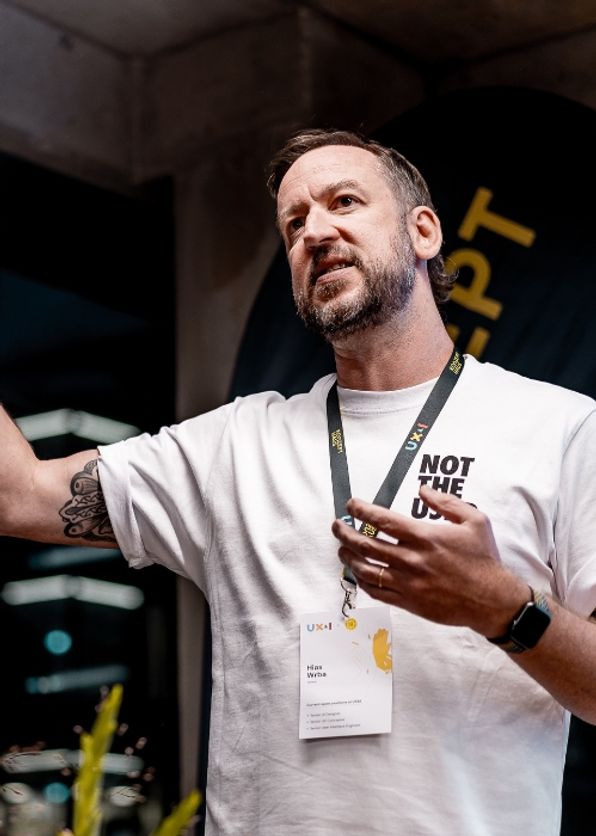
Nicolas shares his personal bag of tricks for digital product management with us. He explains how to win over stakeholders, build teams, and the benefits of remote workshops. And why does his job actually require him to talk so much?

Dr. Nicolas Neubauer
Head of product shopping experience at Kaufland e-commerce
Nikolas discovered the “product mindset” back in the “Wild West” of the early iPhone years. After launching his first apps while in college and subsequently joining an IT consulting firm, he dove deep into product development at a startup. Before taking on his new role as Head of Data Science at real.digital, he spent several years supporting PwC in the development of digital tools.
Success factors in product development
Nicolas, you’ve already launched a whole host of digital products. What’s most important in the early stages of product development?
These days, technical products are extremely complex and extensive. Especially in large companies, there are often a wide variety of stakeholders who want, and should, have a say in a product idea. Whether it’s subject matter or technical experts, operations, security, legal, or compliance, getting all these people to talk to one another is a balancing act. The potential outcome, however, is very valuable. In my experience, it’s best to get as many people on board as possible right from the start and explain what you’re planning to do. Communication is everything, especially at the beginning. Once the actual project work begins, of course, not everyone needs to be involved right away.
How can UX methods help?
Workshops and Design Sprints, for example, are extremely useful at the start, but UX runs through the entire product development process and is often even more enduring than the technology itself. The question “Are we doing the right thing for our users?” is constantly on the table, while the technology is, to a certain extent, interchangeable. In very large projects with strategic relevance, it’s important to talk early on with the people who will ultimately use the product. That’s how you find out whether you’re actually on the right track. After all, the worst thing that can happen is a “Big Bang” when the finished product is unleashed on the user: You’ve invested a lot of money and time, and yet you’ve essentially taken a gamble, even though you could have relied on data.
Startup vs. corporate giant
Does the startup or UX mindset also face resistance, especially in larger companies?
Sure, there are sometimes clashes with traditional corporate structures. In large companies, there are a wide variety of interests, including political power dynamics, and the person in charge of the budget is usually not the project manager. One approach that has worked well for me is to focus on risk minimization and cost savings. What are the costs of developing a feature when we don’t know if it will be accepted by the market, versus the costs of conducting a test? The same applies to scheduling: How much time needs to be invested in early testing, and how much time might it take to fix an untested feature later on? But it’s always a tough sell. I find myself in this situation sometimes, too: You’re caught up in the excitement of your own product idea and want to get everything done quickly, before you run the risk that someone might not like it after all. But generally speaking, the high ROI of UX research is a strong argument for motivating stakeholders.
How do you handle it when the team is heading in the wrong direction and a change of course is needed?
Here, communication once again plays the most important role, especially when you have bad news, in the worst-case scenario, the cancellation of a project. The people working on a product have invested a lot of time and passion into it and are usually highly motivated. You have to speak to them respectfully and clearly explain the reasons behind a decision. Ideally, you can draw on data and, for example, use test results to show that a feature is used too infrequently. Quantitative data is perfect, but qualitative data also helps make the situation understandable to the team.
team
What experience have you gained when it comes to staffing your teams?
Team coordination is a crucial process. Who starts which task and when? The trade-off is always this: Do you start with product design and UX first and tackle implementation later, or do you wait to begin the project until the team is fully staffed? The answer also depends on the people who will ultimately be working together. In smaller companies, an incomplete team is often less of a problem because everyone already knows and trusts one another. It can also be helpful if the UX and design processes have a bit of a head start. In a traditional iteration or sprint, many disciplines have nothing to do on Day 1 because there is no interface or design yet. In such cases, it’s worth working according to Kanban and viewing the UX process as a kind of workstation that must first complete its part of the work to a certain extent. This doesn’t have to mean working in a silo; there can still be collaboration with other teams. Of course, sometimes the word “lead time” immediately sets off alarm bells: it sounds like the waterfall model. Ultimately, a balance needs to be struck. Even in an agile process, lead time can be built in to minimize waiting time.
How big would your ideal team be, and what skills do you need?
It’s hard to generalize, and it also varies throughout the course of a project. At the beginning, you need different skills than you do later on, once the product has matured. But generally speaking, it’s better to start with a smaller team and then expand it as needed. That way, communication channels and decision-making are faster from the start. When you bring together larger groups with many points of interaction, it can also be helpful to have a process management expert, such as a Scrum Master, Agile Coach, or process guardian.
If you want to expand your team’s internal resources, what do you look for in external service providers?
That depends mainly on the context:
- Support with a specific issue: The simplest scenario is this: I need an expert for a clearly defined task. In that case, expertise is the most important factor.
- Collaboration with startups: Honesty and clear communication are what matter most here. What’s possible and what isn’t. Smaller startups, in particular, tend to oversell their capabilities. But it doesn’t have to be a deal-breaker if they can’t deliver everything. The only problem is when gaps become apparent only later in the process.
- Long-term collaboration: The team fit, mindset, and, of course, the skill set all have to be right. This process is more like a hiring process for a permanent employee. You need a clear picture of the person; otherwise, it can end up being a waste of time for both sides.
Remote work
What are your thoughts on remote work? Or, to put it more specifically, do you have any experience with how remote workshops can be conducted?
Events where you want input from a lot of people are particularly challenging when held remotely. The planning effort can also be greater. What I find especially important is having the right tools. Not every video conferencing tool is suitable for remote workshops. It often helps to draw an analogy to the real-world situation: someone walks up to the whiteboard and sticks a note on it. At UX&I, you work a lot with Miro. In some ways, this even has some charming advantages over in-person workshops, because you can do things that aren’t possible in a traditional workshop setting in front of a whiteboard. For example, 20 people can’t all move, rearrange, or cluster sticky notes at the same time. Sometimes, in a traditional workshop, some participants are more passive or get distracted more easily. In a remote setting, it may be harder to start chatting with the person next to you, but email, Slack, or other tools are just a click away. There’s also the effect that, once the group reaches a certain size, no one really wants to speak up anymore. After all, you’re always addressing everyone directly, not just the person sitting next to you, as if you were standing virtually in front of the group. I haven’t seen a good solution for that yet.
Speaking of tools, is there one that’s been frustrating you lately? And one that you really liked?
The Hue app for “smart” lighting has driven me absolutely crazy before. I wanted to set up an account for my parents, but the service was apparently unavailable at the time. However, no useful error message was displayed; just the input screen again. I have no idea how my parents were supposed to set it up on their own. I was really impressed by a Spotify feature I discovered completely by chance. It suggests relevant tracks that you can add to your playlists. It worked just as intuitively as I expected.
You recently made the switch from PwC to real.digital, a completely different environment. What insights have you gained from your UX experience?
At real.digital, I’ll be responsible for a cross-functional role as Head of Data Science. I believe I learned a great deal about team leadership and product management during my time at PwC, for which I’m very grateful. At real.digital, I’ll definitely strive to work as closely as possible with the product managers. Furthermore, data science is a discipline that’s very time-consuming and therefore expensive. In my opinion, this is precisely where it pays to test hypotheses early on, before investing many person-days into developing complex models. I’m also bringing my positive experiences with UX&I with me, of course (and no one forced me to say that ;)), and I’d be delighted if we could work together again on a project.
Thank you very much for your tips and insights, Nicolas.
About the expert
Thomas has been working on user-centered projects for over two decades. His strength lies in aligning business outcomes with user needs and empowering teams.